
Is Canada Actually in a Recession? Here’s What the Numbers Don’t Tell You
I’ve been watching the Canadian economic conversation for the past several months and I want to say something that might sound strange coming at the top of an article about a potential recession.
The word recession is doing a lot of damage right now.
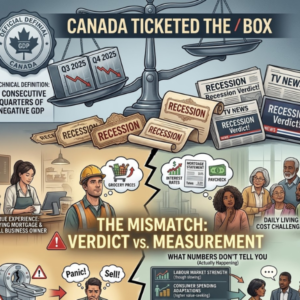
Not because it’s wrong exactly. By the technical definition — two consecutive quarters of economic contraction — Canada has ticked the box. The numbers at the end of 2025 and into early 2026 were negative enough that economists and news anchors started using the word and once they started it became impossible to stop. Recession. Recession. Recession. Said enough times it starts to feel like a verdict rather than a measurement.
But here’s what’s been bothering me. Every time I talk to someone actually living inside the Canadian economy — running a small business, working a job, trying to pay a mortgage — the experience they describe doesn’t match the word being used to describe it. It’s not that things are great. Canada Entering They’re not. It’s that the word recession carries connotations that don’t fit what’s actually happening. And using a word that doesn’t fit the situation leads people to make decisions based on a misdiagnosis.
So let me try to describe what’s actually happening as honestly as I can Canada Entering
What This Actually Feels Like From the Inside
The best description I’ve heard came from a friend who owns a small manufacturing business outside of Hamilton. He’s been running it for eleven years. He lived through 2008 and 2009 when orders dried up almost overnight and he had to make genuinely terrible decisions about which employees he could afford to keep. Canada Entering He remembers what a real economic shock feels like.
I asked him how things felt right now compared to then.
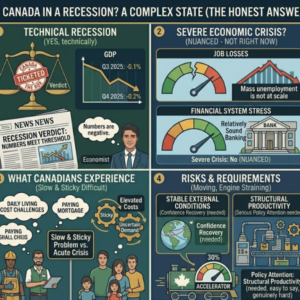
He thought about it for a second and said it feels like driving a car where the accelerator is stuck at thirty percent. Canada Entering You’re moving. You’re not stalled. But you’re going slower than you should be and you can feel the engine straining and you’re not sure if something is about to break or if it’s just going to keep grinding along like this indefinitely.
That image has stayed with me because I think it’s more accurate than anything I’ve read in an economics report. Canada Entering Canada’s economy isn’t crashed. It isn’t in freefall. It isn’t experiencing the kind of acute crisis that produces mass layoffs and bank failures and the genuine fear that the whole system might not hold. Canada Entering What it’s experiencing is something slower and in some ways more insidious — a persistent loss of momentum that makes everything harder without producing the kind of dramatic event that forces a clear response.
The Technical Reality and Why It Only Tells Part of the Story
Let me be honest about what the data actually shows because I think you deserve the real picture rather than a softened version.
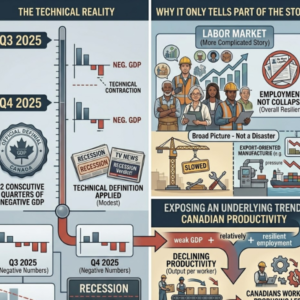
GDP contracted in the final quarter of 2025 and continued to contract into early 2026. Canada Entering That’s the definition. Two quarters of negative growth. Recession, technically.
But the contractions were small. We’re not talking about the catastrophic declines of 2008 or the sharp pandemic shock of early 2020. We’re talking about modest negative numbers — the kind where a slightly different methodology or a slightly different data vintage could move them from just negative to just flat to just barely positive. The difference between recession and stagnation at these levels is genuinely thin.
More importantly the labor market has been telling a more complicated story than the GDP numbers alone suggest. Employment hasn’t collapsed. The mass layoff wave that typically accompanies a serious recession hasn’t materialized in the same way. Some sectors are hurting — construction has slowed meaningfully, some export-oriented manufacturers are under real pressure — but the broad employment picture isn’t the disaster that the recession label implies .Canada Entering
What this combination of weak GDP and relatively resilient employment suggests is that productivity — output per worker — has been declining. Canadians are working but producing less economic value per hour than they were. That’s a concerning underlying trend that’s been building for years and the current slowdown is partly exposing it rather than creating it.
Trade Uncertainty Is Doing More Damage Than People Realize
Here’s the part of the story that I think deserves more attention than it’s getting in the general conversation.
Canada’s economy is structurally dependent on trade in a way that makes it unusually vulnerable to the kind of global uncertainty we’ve been living through. Canada Entering The United States is Canada’s dominant trading partner by an enormous margin — more than three quarters of Canadian exports go south of the border. When that relationship is stable and predictable Canadian businesses can plan, invest, hire and grow with reasonable confidence .Canada Entering When that relationship is uncertain, even if the uncertainty never fully materializes into actual disruption, the effect on business behavior is immediate and significant.Canada Entering
And right now that relationship has been anything but predictable.
The tariff threats and countermeasures and negotiations and renegotiations of the past couple of years have created an environment where Canadian exporters genuinely don’t know what their cost structure is going to look like six months from now. A manufacturer deciding whether to expand their facility, hire new workers, and take on new orders has to factor in the possibility that the trade environment they’re planning around could change dramatically before their expansion is complete.
Most of them are responding the same way rational people respond to genuine uncertainty — they’re waiting. Not quitting. Canada Entering Not closing. Just waiting to see what becomes clear before committing to anything major. And when thousands of businesses make that same decision simultaneously the aggregate effect is a significant reduction in investment and hiring that shows up as economic weakness even though nothing catastrophic has happened .Canada Entering
Business confidence surveys have been capturing this clearly. The numbers that track whether Canadian businesses plan to invest and hire have been weak not because businesses are failing but because businesses are cautious. Caution at scale looks like recession in the data.
The Immigration Story That Changes the Calculation
There’s a dimension of Canada’s current economic situation that I don’t think gets explained clearly enough in most coverage and it’s important for understanding why the GDP numbers feel worse than the employment numbers suggest they should.
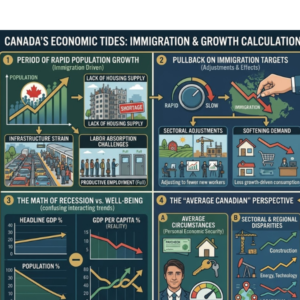
Canada went through a period of very rapid population growth driven by immigration policy. Canada Entering The intention was to address labor shortages and support economic growth. The reality was more complicated. Population grew faster than housing supply, faster than infrastructure capacity, and in some cases faster than the economy’s ability to absorb new workers into productive employment.
Now the government has been pulling back on immigration targets. Which is itself creating a different set of short-term economic effects. Some sectors that had been relying on a continuous flow of new workers are adjusting. Some demand that had been driven by population growth — for housing, for consumer goods, for services — is softening.
Here’s the mathematical reality that makes this confusing. If your economy is growing at one percent but your population is growing at two percent then GDP per person is actually shrinking even though the headline number is positive. Canada has been experiencing something like the reverse of that recently — population growth slowing while the economy is also slowing — and the interaction between those two trends makes the picture genuinely hard to read .Canada Entering
When economists and journalists say Canada is in recession they’re usually talking about the headline GDP number. But for the average Canadian the number that matters is what’s happening to their own economic circumstances — their income, their purchasing power, their job security. Canada Entering Those numbers tell a somewhat different story depending heavily on which sector you work in and where you live.
The Bank of Canada’s Genuinely Difficult Position
I want to spend a moment on the Bank of Canada because I think what they’re navigating right now is harder than the commentary usually acknowledges.
Their job is to keep inflation low and stable while supporting economic growth. In normal times those goals are compatible. When growth is strong and inflation is rising they raise rates to cool things down. When growth is weak and inflation is low they cut rates to stimulate activity. The lever goes up or down and the economy responds more or less as expected.
Right now the Bank of Canada is dealing with a situation where both of those goals are pulling in somewhat different directions simultaneously and the external environment is adding complexity that their tools don’t address directly.
They’ve been cutting rates in response to economic weakness which is the right thing to do. Canada Entering But the transmission of rate cuts into actual economic activity has been slower than in previous cycles. Part of that is because household debt levels in Canada are very high — when people are already carrying significant mortgage debt at variable rates the financial system’s sensitivity to rate changes works differently than it does when debt levels are more moderate.
And then there’s the inflation question which hasn’t fully resolved. Certain categories of prices remain elevated in ways that make aggressive rate cutting risky. If the Bank cuts too fast and inflation reaccelerates they’ll have to reverse course quickly which would be genuinely damaging. So they’re moving carefully in an environment that keeps throwing surprises at them.
It’s not a comfortable position. And the criticism they receive from both directions — too slow from people who want more stimulus, too risky from people worried about inflation — is probably a sign that they’re threading a genuinely difficult needle.
What Small Businesses Are Actually Experiencing
I want to come back to the ground level because I think macro analysis can float too far above the actual experience of the people living inside the economy.
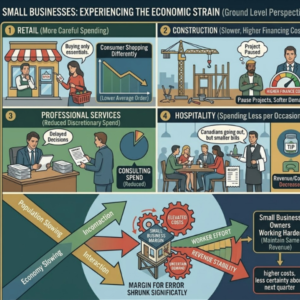
Small and medium sized businesses are the ones feeling this most acutely. Canada Entering Not because they’re failing in large numbers — they’re not, at least not yet — but because the margin for error has shrunk significantly. A larger company with access to capital markets and diversified revenue can absorb a period of slower growth without existential stress. A small business running on thin margins in an environment of elevated costs and uncertain demand is in a genuinely precarious position even if it’s technically still operating.
The specific pressures vary by sector. Retail is dealing with consumers who are spending more carefully and shopping differently than they were two years ago. Canada Entering Construction has slowed as higher financing costs and softer demand have pushed developers to pause projects. Professional services are seeing clients delay decisions and reduce discretionary spending on consulting and advisory work. Hospitality is managing through a period where Canadians are still going out but spending less per occasion .Canada Entering
None of these things are catastrophic individually. Together they create an environment where a lot of business owners are working harder to maintain the same revenue they had before, with higher costs, and with less certainty about what next quarter looks like.
That experience is real even if it doesn’t produce dramatic headlines.
The Productivity Problem That Predates This Recession
Here’s the uncomfortable truth that the current slowdown is forcing into the light even though it’s been hiding in plain sight for years.
Canada has a productivity problem. Output per worker, investment in technology and innovation, the rate at which the economy generates value from the effort being put in — these measures have been trending in the wrong direction for a while. The economy was papering over that problem with population growth — more workers producing more output even if each worker wasn’t becoming more productive. Canada Entering
That approach has limits. And those limits are becoming visible now.
A genuine economic recovery for Canada — not just a return to the slow growth of recent years but actual improvement in living standards — probably requires addressing that underlying productivity deficit. Which means investment in technology, in infrastructure, in education and skills development, in the regulatory environment that either encourages or discourages business investment. These are long-term solutions to a long-term problem.
The current policy conversation is mostly focused on the short-term — what can be done to stimulate activity in the next twelve months. That’s understandable given the immediate pressures. Canada Entering But the risk is that short-term stimulus addresses the symptoms of the current slowdown while the underlying structural issue continues to develop.
So Is This a Recession or Not
I keep coming back to this question because I think the honest answer is that the word matters less than what you’re trying to understand.
If you’re asking whether Canada’s economy is contracting by the technical definition then yes it is meeting that threshold. That’s real and it matters.
If you’re asking whether Canada is experiencing the kind of severe economic crisis that produces mass unemployment, financial system stress, and genuine threat to living standards at scale — that’s a different question and the answer is more nuanced. Canada Entering Not right now. Not yet. The situation is genuinely difficult but it’s difficult in the way that slow and sticky problems are difficult rather than in the way that acute crises are difficult.
The risk is that slow and sticky becomes something worse if the external environment deteriorates further — if trade tensions escalate into actual trade wars, if global demand softens more than expected, if the housing market corrects more sharply than the current gradual softening suggests.
Canada has meaningful buffers. A relatively sound banking system. Natural resources that retain value across economic cycles. A broadly skilled workforce. Geographic proximity to the world’s largest economy even when that relationship is complicated.
What it needs — and this is easy to say and genuinely hard to do — is a period of stable external conditions that allows business confidence to recover, combined with serious policy attention to the structural productivity problem that sits underneath the current cyclical weakness.
Whether it gets that combination is genuinely uncertain. The external conditions aren’t within Canada’s control. The policy choices are, but they require political will and long time horizons that democratic systems don’t always reward.
For now Canada is exactly where my friend described it. Moving .Canada Entering Not stalled. Engine straining. Accelerator stuck at thirty percent.

Your Partner in Financial Growth
Helping you save and invest smarter since 2026. Our mission is to simplify finance for everyone.