
Blue Origin’s New Glenn Blew Up on the Pad. I’ve Been Thinking About It Ever Since.
Let me tell you the thing that actually surprised me about May 28th.
It wasn’t the explosion. Explosions happen in rocket development. Anyone who has spent time paying attention to this industry knows that the path to a working rocket is paved with things that didn’t work. Engines that quit. Valves that fail. Welds that crack under pressures that seem impossible until the moment they become very possible. The history of spaceflight is essentially a long list of things that went wrong before the things that went right.
What surprised me was how quiet the initial reaction was inside the industry. Not quiet in the sense of nobody noticing. Everyone noticed. But quiet in the way that happens when something confirms a fear that people had been carrying around for a while without saying out loud. Not shock. Recognition.
That quiet told me more about where Blue Origin stands right now than the explosion itself did.
Twenty Six Years Is a Long Time
I want to put New Glenn in context because I think most coverage of this event treats it as an isolated incident and it isn’t.
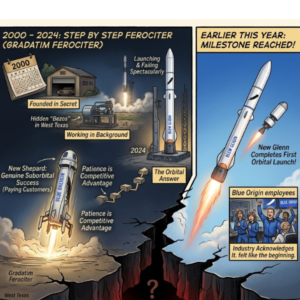
Blue Origin was founded in the year 2000. Jeff Bezos started it quietly, without the public fanfare that tends to accompany the launch of something ambitious, and for years it operated almost entirely in secret. While the rest of the world was getting its first glimpse of what private space companies could do — while SpaceX was launching and failing spectacularly and launching again and gradually becoming the most important rocket company in the world — Blue Origin was working in the background. Developing technology. Blue Origin Testing engines. Building infrastructure in West Texas where Bezos owned land and nobody would bother them.
The philosophy that Bezos articulated for the company was something he called gradatim ferociter. Step by step ferociously. The idea was that careful methodical progress compounded over time would outperform the fast-fail approach that SpaceX was making famous. That patience was a competitive advantage in an industry where moving too fast could get people killed.
For years this philosophy produced New Shepard — a suborbital vehicle that could carry passengers and payloads on brief trips above the Karman line and return to land vertically on its engine in a way that was genuinely impressive to watch. Blue Origin New Shepard worked reliably enough that Blue Origin eventually started flying paying customers on it .Blue Origin
But New Shepard was never going to make Blue Origin a serious commercial launch provider. It doesn’t reach orbit. It can’t deploy satellites. It can’t compete for the government contracts or the commercial constellation launches that represent the real money and the real strategic importance in the space business .
New Glenn was supposed to be the answer to that. The orbital vehicle. The thing that proved Blue Origin could compete with SpaceX and ULA and the other serious players. The moment the company stepped out of its long development shadow and became a real force in commercial and government launch services.
New Glenn completed its first orbital launch earlier this year. That was a genuine milestone. The industry acknowledged it. Blue Origin employees celebrated it. It felt like the beginning of something.
Then May 28th happened.
Static Fire Tests Are Supposed to Be the Safe Part
Here’s what I want people who aren’t deep in the space world to understand about what a static fire test is and why this particular failure stings the way it does.
When you’re developing a rocket you don’t just build the thing and then light it up and hope for the best. You test components exhaustively on their own before you test them together. You test the engines separately. You test the propellant systems. You test the avionics. You test every subsystem until you’ve accumulated enough data to have reasonable confidence that they’ll all work together correctly.
A static fire test is the step where you integrate all of that and test the whole propulsion system with the vehicle secured to the ground. You ignite the engines. You run them for a controlled period — sometimes just a few seconds, sometimes longer depending on what you’re trying to verify. You collect data from hundreds of sensors. You shut everything down. You analyze what you learned. If everything looks good you move toward the actual launch.
It’s one of the lower-risk moments in the development process in the sense that the vehicle is bolted down, there’s no trajectory to manage, there’s no orbital insertion to worry about. You’re just verifying that the engines start and run as expected.
For something to go badly enough wrong during a static fire that the vehicle is destroyed — that’s not a minor anomaly. That’s not a sensor reading outside of limits that triggers an abort. That’s a fundamental failure of something important happening under conditions that were supposed to be controlled.
The investigation into exactly what failed will take months. Blue Origin hasn’t said much publicly and that’s appropriate — you don’t speculate about root cause before you actually know the root cause. But the fact that the failure was severe enough to destroy the vehicle tells you something about the nature of what went wrong and the questions it raises about what was missed in prior testing.
The People Who Don’t Make the News
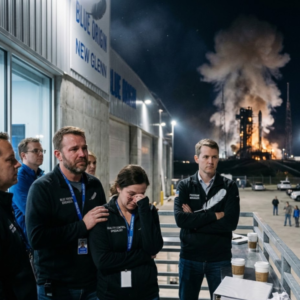
Before I get into the business and strategic implications I want to spend a moment on something that I think gets completely lost in coverage like this.
There are engineers and technicians and quality control specialists and program managers who have been working on New Glenn for years. Some of them have been on this program for the better part of a decade. They chose to work at Blue Origin when they could have gone to SpaceX or NASA or Lockheed or any number of other places. They believed in what the company was building. They put in the late nights and the weekends and the grinding work of solving problems that don’t have obvious solutions because they thought New Glenn was going to matter.
I talked to someone who used to work in the launch industry — not at Blue Origin, at a different company — and asked what it feels like when something like this happens. They were quiet for a second and then said it’s like watching your house burn down. You know intellectually that you’ll figure out where to live next. But in the moment you’re just standing there watching something you built disappear.
The space industry asks a particular kind of emotional labor from the people who work in it. You sign up knowing that failure is part of the process. You tell yourself you’ve made peace with it. And then something explodes that you spent years working on and you find out you hadn’t quite made as much peace with it as you thought.
That experience deserves acknowledgment. Not just the business metrics and the competitive implications. The actual human cost of a moment like this.
What It Means for the Broader Space Industry
Okay now let me get into why this matters beyond Blue Origin specifically because I think it does matter in ways that extend pretty far.
The United States government has been deliberate about wanting multiple viable launch providers. The reason is straightforward. If your entire access to space — for satellites, for national security payloads, for scientific missions, for eventual human exploration — runs through a single company then you’ve created a catastrophic dependency. One bad year, one catastrophic failure, one leadership crisis at that company and your entire space program is grounded.
SpaceX has become so dominant in launch services that this concern about single-point-of-failure dependency has become genuinely urgent. The company has been extraordinary by essentially every relevant metric — launch cadence, reliability, cost, innovation. But its dominance creates systemic risk for the space enterprise overall regardless of how good SpaceX is.
New Glenn was supposed to be a real alternative. Not a hobbyist operation. Not a startup burning through runway. A serious heavy-lift vehicle backed by serious resources that government and commercial customers could count on alongside SpaceX.
That alternative just took a significant hit. The missions that were being planned around New Glenn’s availability now need contingency options. The government customers who were counting on competitive pricing pressure from a viable second source need to recalibrate their assumptions. The commercial satellite operators who had been evaluating New Glenn as a launch option are going to wait and see before committing.
None of this is fatal to New Glenn’s future. But it sets the program back in a competitive environment where being set back has real costs.
The NASA Moon Program Connection That Nobody Is Talking About Enough
Here’s a specific consequence that I think deserves its own section because it’s more significant than the general coverage has suggested.
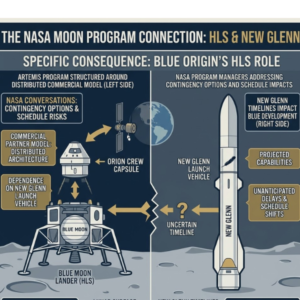
NASA’s return to the Moon under the Artemis program has been structured around a distributed commercial model. Rather than NASA building everything itself the agency contracts with commercial partners for various mission elements — launch services, spacecraft, landers, surface infrastructure. The Blue Moon lander that Blue Origin has been developing is a key piece of that architecture.
Blue Moon was designed with assumptions about New Glenn’s capabilities and availability. The lunar surface access mission that Blue Origin has been awarded depends on vehicles and timelines that just got significantly more complicated.
NASA program managers are now having conversations about contingency options and schedule impacts that they were hoping to avoid. The Artemis program has already experienced its share of delays and budget pressures. Adding New Glenn’s uncertain timeline to that mix isn’t helpful.
I want to be careful not to overstate this. NASA programs routinely adapt to setbacks from commercial partners. The architecture has redundancies built in precisely because program managers know that individual components will face problems. But every adaptation costs time and money and political capital that could have been used for actual progress. And the Moon program is already operating in a political environment where its budget and timeline are under scrutiny.
The Blue Origin Culture Question
This is the part of the analysis that I’ve been most reluctant to write because it involves making judgments about an organization from the outside and I know how unfair that can be.
But I also think it would be dishonest to ignore it.
Blue Origin has gone through significant leadership changes over the years. Engineers who joined the company excited about its mission have left and talked publicly about frustrations with the pace of progress and the internal culture. The gap between what the company said it would accomplish and when it said it would accomplish it and what actually happened has been persistent enough over long enough a timeframe that it’s hard to attribute entirely to the difficulty of rocket development.
The ferociously patient philosophy that Bezos articulated is genuinely coherent as a theory. Move carefully, build deep foundations, don’t rush into failures that set you back further than slower progress would have. There’s real wisdom in that approach in an industry where catastrophic failures can end programs and cost lives.
But there’s a version of ferociously patient that becomes something else over time. Where patience becomes an excuse for avoiding hard decisions. Where careful becomes risk-averse in ways that prevent the rapid iteration that you need to actually learn what works. Where the commitment to doing things right becomes a cover for organizational dysfunction that nobody wants to confront directly.
I don’t know which version has been operating at Blue Origin. I’m not sure anyone outside the company does. But the May 28th explosion is going to force a reckoning with that question internally in a way that the company’s previous challenges haven’t quite demanded.
If Blue Origin can be honest with itself about what the investigation reveals — not just about the technical failure but about the organizational factors that may have contributed to it — there’s a real path forward. The resources are there. The talent exists. The market opportunity is genuine.
If the company responds to this the way organizations sometimes respond to painful failures — by protecting existing decisions, attributing blame narrowly, and resuming the previous approach without genuine examination — then the May 28th explosion will be the beginning of a longer decline rather than a recoverable setback.
What I Think Happens Next
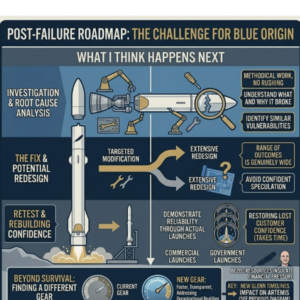
The investigation will take longer than Blue Origin’s most optimistic stakeholders hope. Root cause analysis on a failure this significant is methodical work that can’t be rushed without risking missing something important. The team needs to understand not just what broke but why it broke and what that implies about other parts of the system that might have similar vulnerabilities.
After the investigation comes the fix. Depending on what the root cause reveals this could range from a targeted modification that gets New Glenn back to a test pad relatively quickly to a more extensive redesign that adds substantial time to the program. The range of outcomes is genuinely wide and anyone who tells you confidently which end of that range applies before the investigation is complete is speculating.
Then comes the retest and rebuild of confidence. Even after a successful static fire following the fix Blue Origin will need to demonstrate reliability through actual launches before government and commercial customers restore the confidence they’ve lost. That process takes time regardless of how well the next test goes.
Blue Origin won’t die from this. Bezos has committed resources to this company that insulate it from the kind of financial pressure that kills smaller aerospace ventures after a major setback. The question isn’t survival. The question is whether the company can find a different gear — faster, more transparent, more willing to confront uncomfortable organizational realities — than the one it’s been operating in.
The space industry needs Blue Origin to figure that out. Not for Blue Origin’s sake. Because genuine competition in launch services is good for everyone who depends on access to space. Because the concentration of launch capability in a single company creates risks that extend beyond any individual mission or any individual customer.

Your Partner in Financial Growth
Helping you save and invest smarter since 2026. Our mission is to simplify finance for everyone.