
What You’re Actually Paying For When You Fill Up Your Tank in 2026
I pulled into a gas station last week and stood there staring at the price on the pump for probably fifteen seconds longer than I needed to. Not because I couldn’t afford it. Just because something about it felt wrong in a way I couldn’t immediately explain. The number didn’t match anything I could point to in the news. Oil prices had been relatively calm. There hadn’t been a major supply disruption that I’d read about. And yet there I was paying more than I expected to.
That feeling — the vague sense that the price you’re paying doesn’t connect to anything you can actually understand — is something I hear from people constantly. And I’ve come to think it’s not just frustration or financial anxiety. It’s actually a pretty accurate read of how broken the communication is between what’s happening in global energy markets and what shows up on that sign at the corner gas station.
So let me try to actually explain it. Not in the way that economics textbooks do, with supply and demand curves and commodity price charts. But in the way that might actually make you feel less crazy the next time you’re standing at the pump wondering what you’re really paying for.We Really Paying
The Contradiction Nobody Explains Properly
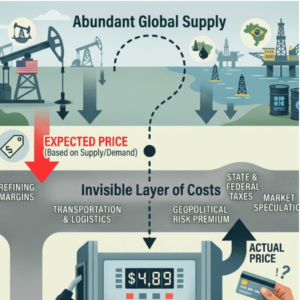
Here’s the thing that confuses most people first. The world is currently producing a lot of oil. More than a lot actually. The United States became the world’s largest oil producer and never really looked back. Brazil has been ramping up offshore production. Guyana — a country most people couldn’t find on a map five years ago — has become a significant producer almost overnight. We Really PayingOPEC countries cut production to try to hold prices up but those cuts kept getting undermined by members who needed the revenue too badly to stick to their quotas .We Really Paying
By basic supply and demand logic, abundant supply should mean low prices. And sometimes it does. But then you look at what you’re actually paying at the pump and the math doesn’t work the way it should.
That gap — between what should logically be happening and what you’re actually experiencing — is the real story. And it exists because gas prices were never really just about supply and demand. There’s a whole invisible layer of cost sitting on top of the commodity price that most people never think about because nobody ever explains it to them .We Really Paying
The Price You See Is Not the Price of Oil
This is the single most important thing to understand and I want to spend some time on it because it changes everything else.
When you pay at the pump you are not paying for crude oil. You are paying for the end result of a remarkably long and complicated chain of processes, each of which has its own costs, its own vulnerabilities, and its own way of adding to the final number on that sign.
Start with the oil itself. It gets extracted from the ground somewhere — Texas, Saudi Arabia, offshore Brazil, take your pick. We Really Paying Then it gets transported, probably on a tanker ship, to a refinery. We Really Paying That journey takes time and costs money and runs through specific shipping routes that can be disrupted by weather, We Really Paying conflict or political decisions about who’s allowed to sail where.
Then there’s the refinery. We Really Paying This is where most people’s mental model of the process falls apart because refineries are not the interchangeable factories that the word implies. They’re highly specialized facilities that are configured to process specific types of crude oil and produce specific ratios of gasoline, diesel, jet fuel and other products. You can’t just swap one type of crude for another without significant adjustments. We Really Paying You can’t quickly increase output because the equipment is almost always running near full capacity. And there aren’t that many of them. We Really Paying The United States has been running on roughly the same refining capacity for decades because building new refineries is expensive, politically contentious and takes years.
What this means in practice is that the refinery is a bottleneck. We Really Paying When something goes wrong at a major refinery — a fire, a maintenance shutdown, a weather event — the ripple effects on local fuel prices can be dramatic even if global oil prices haven’t moved at all. I’ve watched prices spike twenty cents a gallon in specific regions because of refinery issues while the rest of the country saw nothing. We Really Paying That’s not the global oil market. That’s the regional infrastructure constraint making itself felt.
After the refinery the fuel has to be moved again — through pipelines, on trucks, into storage facilities, and eventually to the individual gas stations where we buy it. We Really Paying We Really Paying Each step adds cost. Each step has its own potential failure points We Really Paying. And all of this happens before we even get to taxes, which in most states represent a significant portion of what you’re actually paying per gallon.
So when oil prices drop twenty percent and your gas price drops five percent, you’re not being ripped off by mysterious forces. You’re seeing the reality that the commodity itself is only one component of what you’re paying for — and often not even the biggest one.
The Risk Tax You Pay Without Knowing It
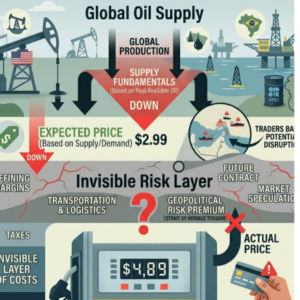
There’s another layer that’s even harder to see and I think it’s the one that makes people feel most confused when prices jump without obvious cause.
Energy markets run on futures contracts — agreements to buy or sell oil at a specific price at some point in the future. We Really Paying The people trading those contracts aren’t just reacting to what’s happening right now. They’re constantly making bets about what might happen next. And one of the biggest inputs into those bets is geopolitical risk.
The Strait of Hormuz is a stretch of water between Iran and Oman that’s about twenty-one miles wide at its narrowest point. Roughly twenty percent of the world’s oil supply passes through it. We Really Paying When tensions rise in that region — and they rise fairly regularly — traders start pricing in the possibility that those shipments might be disrupted even when they aren’t being disrupted yet. That possibility gets baked into prices immediately. You pay it at the pump even though no actual oil has been blocked and no actual shortage has occurred.
This is what I mean when I say there’s a risk layer sitting on top of the commodity price. It’s not visible on any receipt. It doesn’t appear as a line item. But it’s there, and it fluctuates constantly based on news events, diplomatic tensions, military movements and a dozen other factors that have nothing to do with how much oil is physically available right now.
I talked to someone who trades energy futures a while back and asked him how much of the price at the pump was pure risk premium at any given moment. We Really Paying He thought about it for a second and said honestly it’s hard to separate but on a tense day in the Middle East you might be paying five to ten dollars per barrel just for uncertainty. That works out to something like twelve to twenty-five cents per gallon that you’re paying not for oil that exists but for oil that might theoretically become unavailable.
You pay that tax every time you fill up. Nobody tells you about it.
Why Electric Vehicles Are Actually Starting to Matter Here
This is the part of the story that I think changes the long-term dynamics in a way that doesn’t get enough attention.
For most of the history of the oil industry demand was essentially guaranteed to grow. We Really Paying More people, more cars, more miles driven, more oil needed. Producers could count on that growth. It gave them pricing power because eventually supply had to catch up with an always-expanding demand base.
That assumption is starting to break down and it’s happening faster than a lot of people in the oil industry want to admit.
Electric vehicles are not replacing gasoline cars overnight. We Really Paying That’s true. The transition is slow and uneven and there are real infrastructure limitations that are going to take years to resolve. But the psychological and economic shift that happens when a meaningful percentage of drivers no longer need gasoline at all is already starting to affect how oil markets think about pricing.
Here’s the dynamic that matters: if oil producers push prices too high for too long, they accelerate the transition to electric vehicles. People who were on the fence about going electric get pushed over the edge by expensive gasoline. That permanently removes demand from the market — not temporarily, but permanently, because once someone switches to an electric vehicle they almost never go back.
Oil producers understand this. It creates a ceiling effect on prices that didn’t really exist in previous decades. They can’t just maximize short-term revenue by pushing prices as high as the market will bear because doing so undermines their own long-term demand base. We Really Paying It’s a genuinely new constraint on energy pricing that is going to become more significant every year as electric vehicle adoption continues to grow.
The Psychology Part That Nobody Talks About
Here’s something that I find genuinely fascinating about how gas prices work on people emotionally.
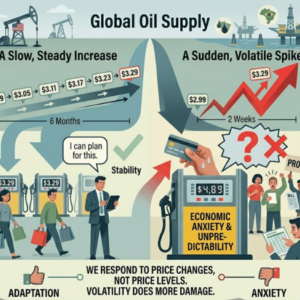
We don’t actually respond to price levels. We respond to price changes. A slow steady increase of thirty cents per gallon over six months barely registers for most people. A sudden jump of thirty cents in two weeks creates genuine outrage and economic anxiety even though the end result is the same.
This matters because it means the volatility of gas prices does more economic damage than the level of gas prices. A world where gas stays at four dollars indefinitely is easier for people to plan around than a world where it bounces between three dollars and five dollars unpredictably. The unpredictability itself is the problem. It makes businesses reluctant to plan, makes consumers feel economically insecure, and creates political pressure that often leads to bad policy decisions made in response to short-term spikes.
The system we have right now is structurally prone to volatility. Not because anyone designed it that way. But because it’s a global commodity market connected to geopolitical risks connected to regional infrastructure constraints connected to local tax policies — and any of those layers can create rapid price movements that ripple through to what you pay on Thursday morning before work.
What the Rest of 2026 Actually Looks Like
I want to be honest about the limits of prediction here because anyone telling you they know where gas prices are going with confidence is selling you something.
What I can say is this. The underlying supply picture looks relatively comfortable. Production is strong. Inventories are reasonable. There’s no obvious physical shortage on the horizon.
But comfortable supply has never been enough to guarantee stable prices. We Really Paying All it takes is one significant disruption — a major hurricane hitting Gulf Coast refineries, a serious escalation in a key oil-producing region, an unexpected drop in production from a major supplier — and prices can move significantly within days.
The system is balanced but it’s not stable. Those are two very different things. A balanced system can absorb small shocks. An unstable one can tip quickly when the right pressure hits the right point.
The range of outcomes for the rest of the year is genuinely wide. We Really Paying Calm months are possible. Significant spikes are possible. The honest answer is that nobody knows which you’re going to get.
What You’re Actually Paying For
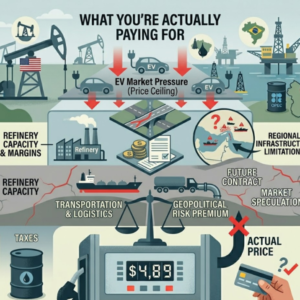
So the next time you’re standing at the pump staring at a number that doesn’t make sense, here’s what’s actually in that price.
The oil itself — a smaller portion than you probably think. The refinery that processed it and the constraints on its capacity. The tankers and pipelines and trucks that moved it. The geopolitical risk premium that traders baked in based on tensions you may never have heard about. The regional infrastructure limitations that have nothing to do with global supply. The local and state taxes that don’t move when commodity prices do. And somewhere in there, increasingly, the pressure from an electric vehicle market that’s slowly but surely starting to put a ceiling on how high any of this can go.
It’s not a simple system. It was never a simple system. It just used to feel simpler when most of us weren’t paying close enough attention to notice how complicated it actually was.

Your Partner in Financial Growth
Helping you save and invest smarter since 2026. Our mission is to simplify finance for everyone.