
What Trump’s Tech Investments Tell Us — And What Nobody Wants to Admit Out Loud
Let me start with an uncomfortable confession. When I first started digging into this topic I almost didn’t write about it. Not because the story isn’t interesting — it’s genuinely fascinating once you get past the political noise. But because the moment you put Donald Trump’s name in a financial article you lose half your audience before the second paragraph. Half the people reading immediately think you’re attacking him. The other half think you’re defending him. Almost nobody just reads the actual argument .Inside the Portfolio
I’m going to ask you to try something difficult
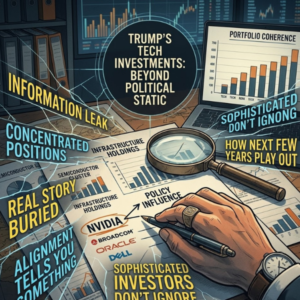
Set the politics aside for the next ten minutes. Inside the Portfolio Not permanently. Just long enough to look at what the investment choices themselves are saying — because there’s a real story buried underneath all the political static and it has nothing to do with whether you like the man or voted for him or can’t stand the sight of him .Inside the Portfolio
Here’s the thing about powerful people’s investment portfolios. They leak information. Not always intentionally. Not always reliably. But when someone with genuine influence over government policy also holds concentrated positions in specific industries, that alignment tells you something about how they think the next few years are going to play out. Inside the Portfolio Ignore it if you want. Sophisticated investors don’t.
So what does Trump’s technology portfolio actually say?
When you sit down and look at the specific names — Nvidia, Broadcom, Oracle, Dell, the semiconductor and infrastructure cluster — the picture that comes into focus is more coherent and more interesting than the headlines suggested .Inside the Portfolio
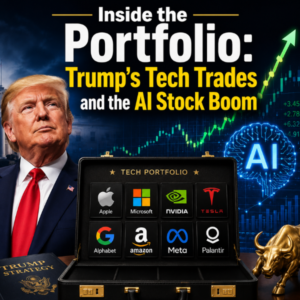
Inside the Portfolio: Trump’s Tech Trades and the AI Stock Boom
I need to address the obvious objection first because it’s a fair one.
Yes, everyone was buying AI-adjacent technology stocks in 2025 and 2026. Inside the Portfolio The sector had been running hot for two years. Nvidia alone had become one of the most valuable companies in human history. You could make a reasonable argument that holding these names was about as bold as putting money in an index fund — they were the index at that point. Inside the Portfolio
But here’s what that argument misses.
This isn’t a broadly diversified technology portfolio. There are no social media companies in there. No streaming services. No consumer apps. No fintech platforms. The concentration is specifically and deliberately in the physical infrastructure layer of artificial intelligence. Chips. Servers. Enterprise computing systems. Data center hardware. Inside the Portfolio The stuff that has to exist before any AI product can work at all.
That’s not someone randomly buying tech because tech was going up. That’s a specific thesis about where durable economic power is going to sit over the next decade. Inside the Portfolio You can agree or disagree with the thesis. But it’s a thesis, not a trend-follow. Inside the Portfolio
The thesis, stated plainly, is this: whoever controls the physical infrastructure of artificial intelligence will have more lasting and defensible power than whoever controls the software running on top of it. Inside the Portfolio Applications come and go. Infrastructure compounds.I nside the Portfolio
The Shift That Most People Haven’t Fully Processed Yet
I’ve been thinking about this for a while and I genuinely believe most people — even people who follow technology closely — haven’t fully absorbed what happened to the economics of this industry over the last five years.
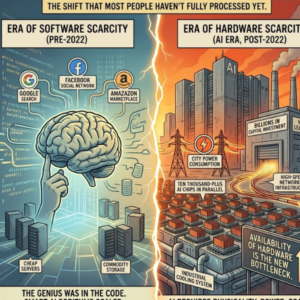
For most of the internet era the scarce resource was software. Specifically the kind of software that could scale to millions of users at almost no marginal cost. The companies that figured out how to do that — Google with search, Facebook with social networking, Amazon with its marketplace — created wealth at a speed and scale the world had never seen. And they did it largely by being smarter than everyone else, not by owning more physical stuff than everyone else.
Hardware was almost an afterthought.
Commodity servers. Cheap storage. Inside the Portfolio Standard networking equipment. The genius was in the code, not the machines running it .Inside the Portfolio
That model quietly broke sometime around 2022 and 2023. Inside the Portfolio And I don’t think most people have updated their mental model of the industry to reflect it.
Here’s the concrete reality. Training a serious AI model today — the kind that actually does something impressive — requires thousands of specialized processors running simultaneously for weeks. I’m not being metaphorical. We’re talking about clusters of ten thousand or twenty thousand chips running in parallel, consuming electricity that would power a small city, generating so much heat that you need industrial cooling systems just to keep the hardware from destroying itself, connected by networking infrastructure that has to move data at speeds that would have seemed like science fiction twenty years ago. Inside the Portfolio
You cannot do this in a garage.
Inside the Portfolio You cannot rent enough computing capacity from someone else to build a sustainable competitive advantage. The bottleneck in AI development right now isn’t the quality of the algorithms. It’s the availability of the hardware to run them on.
That is a genuinely historic shift. Inside the Portfolio The scarce resource moved from software — which you can copy infinitely for free — to hardware — which requires billions of dollars of capital investment and years of manufacturing lead time to produce. That shift changes everything about who wins and who loses in this industry.
Let Me Tell You What These Companies Actually Do
I want to spend a minute on the specific companies because I think a lot of financial writing about this space treats them as interchangeable “AI stocks” when they’re actually doing very different and very specific things. Inside the Portfolio
Nvidia. You’ve heard the name. You probably know they make chips. What’s worth understanding is why their chips specifically became the foundation of the AI industry. It’s actually kind of a weird accident of history. Nvidia spent decades building processors optimized for rendering video game graphics — a task that requires doing thousands of mathematical calculations simultaneously rather than doing them one after another very fast. That specific architecture turned out to be almost perfectly suited for the matrix multiplication that sits at the core of how neural networks learn. A chip designed for Call of Duty became the engine of artificial intelligence. Jensen Huang, Nvidia’s CEO, has been riding that wave with a level of strategic clarity that I find genuinely impressive regardless of what you think about his company’s valuation .Inside the Portfolio
Broadcom company
Broadcom is the company that almost nobody outside the industry knows but almost everyone inside it depends on. They make the networking chips that connect all those Nvidia processors together inside a data center. They design custom chips for major hyperscalers who want silicon built specifically for their workloads rather than general-purpose processors. If Nvidia is making the engines of the AI economy, Broadcom is making a lot of the roads those engines travel on.vInside the Portfolio
Oracle I’ll admit surprised me when I started looking at this more carefully. Most people think of Oracle as that company your company’s accounting department uses and the software is annoying and expensive. That reputation isn’t entirely wrong. But Oracle has quietly built a cloud infrastructure business specifically targeted at AI workloads that has been growing at a pace that surprised even analysts who were bullish on them. They were late to the cloud party. They compensated by showing up with something specifically designed for what the market needed right now rather than what it needed five years ago. Inside the Portfolio
inside the portfolio
Dell is the most old-fashioned name in this cluster and honestly that’s part of why it’s interesting. When a hyperscaler or a large enterprise decides to deploy AI infrastructure at scale they need physical servers. Lots of them. Configured specifically. Delivered on time. Installed correctly. Dell has the supply chain relationships and the enterprise customer base to do that at a scale that most competitors genuinely cannot match. They’re not glamorous. They don’t have a great story about disruption and innovation. They have execution and relationships. In a buildout phase those things are worth a lot.
The Part That Makes This Politically Complicated
Okay I’ve been dancing around this and I should just address it directly .Inside the Portfolio
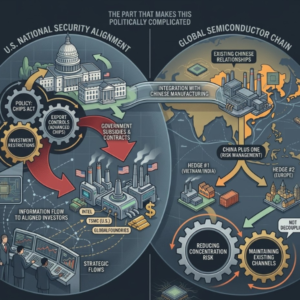
The United States government has decided that semiconductor manufacturing and computing infrastructure are matters of national security. This isn’t subtle. The CHIPS Act put real money behind domestic chip manufacturing. Export controls on advanced semiconductors to China were aggressive and specific. Investment restrictions followed. These were significant government interventions in markets that had previously operated with relatively little political interference.
Government declares
When the government declares an industry strategically critical it typically means subsidies flow toward domestic players, foreign competition gets restricted, government contracts favor certain companies, and the regulatory environment gets shaped to strengthen the industry overall. All of those things benefit investors in those domestic companies.
So when someone with real influence over the direction of these policies holds concentrated positions in exactly the companies most likely to benefit from them — well. I said earlier I wasn’t going to make accusations and I’m not going to start now. What I’ll say is that sophisticated investors pay close attention to this kind of alignment because it carries genuine information about where government support is likely to flow over the next several years. Make of that what you will.
China dismension
The China dimension makes everything more complicated. The global semiconductor supply chain has decades of integration with Chinese manufacturing and that integration cannot be quickly or cleanly unwound regardless of political rhetoric. What companies are actually doing is hedging — building manufacturing capacity in other countries while maintaining existing Chinese relationships, reducing concentration risk without blowing up the system. The industry calls this “China plus one.” It’s not decoupling. It’s risk management. And it creates real advantages for companies large enough and sophisticated enough to manage the complexity.
The Risks I’d Be Dishonest to Skip
I’ve been making this sound pretty compelling and I should push back on myself.
Nvidia’s valuation at various points in 2025 and 2026 was pricing in growth rates that require almost everything to go right for years. When expectations are that elevated a single disappointing earnings report can reprice the entire sector in a single day. I’ve watched that happen before and it’s not pretty if you’re caught on the wrong side of it.
There’s also a real question about whether the infrastructure buildout is running ahead of genuine end-user demand. The major technology companies are spending extraordinary amounts on AI infrastructure partly because they’re terrified of falling behind — it’s as much about competitive fear as genuine demand signals. That kind of fear-driven spending can create oversupply situations that eventually compress the margins of infrastructure suppliers. Not immediately. But eventually.
Taiwan
And Taiwan. The global supply of the most advanced semiconductor manufacturing is concentrated in one island in a geopolitically sensitive part of the world. Everyone who invests in this space knows this risk. Most of them are choosing to take it anyway because the alternative is owning nothing in the most important technology trend of the decade. That’s a rational choice. It’s also a real risk that doesn’t disappear just because people stop talking about it.
What I Actually Think
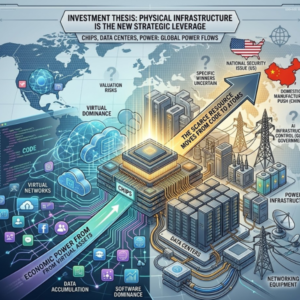
Forget Trump specifically for a moment. The investment thesis embedded in that portfolio — that physical computing infrastructure is becoming the most strategically valuable resource in the global economy — is genuinely worth taking seriously.
We spent the last thirty years in a world where economic power came from information advantages, network effects and software scale. We’re entering a world where it increasingly comes from controlling the physical systems that process information. Chips. Data centers. Power infrastructure. Networking equipment. The countries and companies that control those systems will have leverage that extends well beyond technology markets.
That’s a big claim. But look at what’s happening
. The US government treating semiconductors as a national security issue. China pouring resources into domestic chip manufacturing. Every major economy suddenly caring deeply about where their AI infrastructure comes from and who controls it.
The direction is pretty clear. The timing and the specific winners are genuinely uncertain. The valuation risks are real. But anyone telling you the underlying trend isn’t real isn’t paying attention.
Understanding where power and capital are flowing is useful regardless of your politics. The messenger in this particular story is polarizing. The message itself is worth hearing.

Your Partner in Financial Growth
Helping you save and invest smarter since 2026. Our mission is to simplify finance for everyone.