
The $2 Trillion Rocket: Why Wall Street Can’t Stop Talking About the SpaceX IPO
I want to tell you something about SpaceX that I think gets lost in all the breathless coverage.
This company has been defying expert consensus for so long that the people who kept saying it couldn’t be done have mostly stopped saying it. The critics who called reusable rockets a fantasy have gone quiet. The analysts who said satellite internet was an unworkable business model have moved on to other arguments. The investors who passed on early rounds because the risk profile looked insane have spent years watching the valuation climb without them.
SpaceX didn’t win any of those arguments by debating. It won them by launching things into space, landing boosters back on concrete pads like something out of a science fiction movie, and building a satellite internet network that now serves millions of paying customers in places that ground-based infrastructure will never reach.
For most of that journey regular investors couldn’t participate. Wall Street You had to be an institution, a venture fund, a well-connected insider, or extraordinarily lucky to own any piece of SpaceX. The rest of us could only watch from the outside while the valuation numbers leaked out of private funding rounds and made headlines every couple of years.
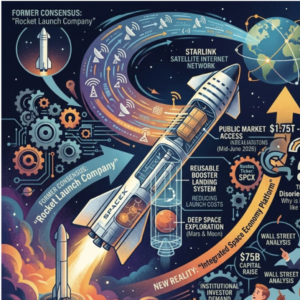
That is about to change. SpaceX is preparing to list publicly on Nasdaq under the ticker SPCX with expectations pointing toward mid-June 2026. The valuation being discussed sits somewhere between $1.75 trillion and $2 trillion with a capital raise potentially approaching $75 billion.
Wall Street has not exactly been calm about this.
The question worth actually thinking about is why. Why is a company that spends enormous amounts of money, operates in an industry most investors have historically avoided, and doesn’t run like a conventional profit machine being valued at numbers that put it in the company of the most valuable corporations in history?
The answer, once you dig into it, is that SpaceX stopped being a rocket company a long time ago. The rockets are still there. They’re just not the main story anymore.
How a Rocket Company Became a Telecom Empire
Here’s the reframe that changes how you think about SpaceX’s valuation.
For most of its existence SpaceX was understood as a launch services company. Wall Street They built rockets. They launched payloads into orbit for NASA, commercial customers, and eventually their own constellation. Wall Street The business model was straightforward even if the technology was extraordinary. You have something that needs to go to space. SpaceX charges you to put it there.
That business is real and genuinely impressive. SpaceX has captured a dominant share of commercial launch services in a way that traditional aerospace companies didn’t see coming and haven’t been able to respond to effectively. Wall Street The Falcon 9 is the most reliable orbital rocket currently flying and the reusability economics have given SpaceX a cost advantage that competitors are still trying to figure out how to close.
But the launch business, as remarkable as it is, doesn’t get you to a $2 trillion valuation. Something else does.
That something else is Starlink.
What Starlink has built is genuinely difficult to fully appreciate until you think about the scale. Wall Street There are now thousands of SpaceX satellites in low Earth orbit forming a network that can deliver broadband internet to essentially anywhere on the planet’s surface. Ships in the middle of the ocean. Research stations in Antarctica. Rural communities in Africa and South America and Southeast Asia that have been waiting for reliable internet connectivity for decades. Aircraft in flight. Military operations in contested areas.
The traditional internet infrastructure model requires physical cables, cell towers, and ground stations — all of which require enormous capital investment, regulatory approval in every jurisdiction, and years of construction time. Wall Street Starlink bypasses all of that. The infrastructure is in orbit. You point a small antenna at the sky and you’re connected.
I talked to someone running a small business in a rural area a while back who described switching to Starlink as the single biggest operational change she’d made in five years. Not because the speed was dramatically better than her old connection but because the reliability was. Wall Street Her old satellite internet was usable on good days and miserable on bad ones. Starlink just works. Consistently. Wall Street That consistency is worth real money to real people and real businesses and that willingness to pay is showing up in Starlink’s revenue numbers.
The company reportedly crossed a billion dollars in monthly revenue from Starlink alone at some point in 2025. That’s not a rounding error. That’s the engine of a serious business.
The Part of the Story That Wall Street Is Still Figuring Out
Here’s where things get interesting and a little speculative — and I want to be honest about the difference between what’s real today and what’s being priced into a $2 trillion expectation.
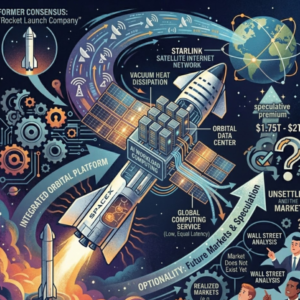
There’s a conversation happening in technology and finance circles about the possibility of orbital data centers Wall Street The idea is roughly this: as artificial intelligence workloads grow, the demand for computing infrastructure is becoming constrained by physical factors on Earth — primarily available land and available power. Space doesn’t have those constraints in the same way. A data center in low Earth orbit could theoretically draw power directly from solar energy with no atmospheric interference, dissipate heat into the vacuum of space, and serve computing needs globally with relatively equal latency because it’s not dependent on terrestrial network geography.
This idea is genuinely early stage. It’s not a product that exists. It’s not a business plan that’s been validated. It’s a possibility being discussed by people who think seriously about where computing infrastructure goes over the next twenty years.
Whether it becomes real and whether SpaceX specifically is the company that executes on it is deeply uncertain. But when you’re trying to understand why investors are comfortable with a $2 trillion valuation for a company whose current revenue and profit profile wouldn’t obviously support those numbers, part of the answer is that some portion of that valuation reflects optionality — the possibility that SpaceX ends up participating in markets that don’t fully exist yet.
That’s legitimate investment reasoning. It’s also how you end up disappointed if those markets don’t materialize on the expected timeline.
The Elon Musk Factor — The Thing Everyone Has an Opinion About
I can’t write honestly about the SpaceX IPO without addressing the elephant in the room.
Elon Musk is one of the most polarizing figures in business and public life. People have strong feelings about him that span from genuine admiration for what he’s built to serious concerns about his behavior and judgment. I’m not going to adjudicate that debate here because that’s not what this is about.
What I will say is that from a purely financial perspective Musk’s involvement in SpaceX creates a specific and unusual dynamic that investors need to think about clearly.
For years investors who wanted exposure to Musk’s vision had Tesla as their primary option. Tesla became in many ways a proxy bet on Musk himself — on his ability to execute, on his judgment about technology trends, on his capacity to attract talent and capital and attention. The Tesla share price has historically been as much about Musk as about the car business.
SpaceX going public changes that dynamic completely. Now investors can take a direct position in what many people consider Musk’s most technically impressive achievement. The company where his specific obsessions — making humanity multi-planetary, building reusable rockets, connecting the world with satellite internet — are most directly reflected in the business.
The demand for that exposure has been building for years among investors who wanted it and couldn’t access it. That pent-up demand is part of what’s driving the frenzy around this IPO.
But here’s the other side of that coin. Musk’s involvement is simultaneously SpaceX’s greatest asset and its most significant concentration risk. His attention and decision-making capacity are finite. He’s running multiple large companies simultaneously. His public behavior periodically generates controversy that affects the companies associated with him in ways that are genuinely difficult to predict. Any serious analysis of SpaceX as an investment has to grapple with what happens to the company’s trajectory if Musk’s attention shifts, if his judgment proves wrong on a major strategic decision, or if his public profile becomes enough of a liability that it materially affects SpaceX’s relationships with government customers.
I’m not predicting any of those things. I’m saying they’re real risks that belong in any honest conversation about this IPO.
The Index Inclusion Wildcard

There’s a technical aspect of this IPO that doesn’t get enough attention in general coverage and it’s worth understanding because it could drive significant price behavior regardless of what you think about SpaceX’s fundamentals.
Major stock indices — the S&P 500, the Nasdaq 100, others — represent enormous pools of capital. Index funds and ETFs that track those indices have to buy whatever’s in the index. Wall Street When a new company gets included the funds that track that index have to purchase shares to maintain their target allocations. For a very large company this forced buying can be substantial.
Normally there’s a waiting period between when a company goes public and when it becomes eligible for index inclusion. The committees that manage these indices typically want to see some track record of trading, some price stability, some demonstrated liquidity before adding a company to the index.
The timeline being discussed for SpaceX is apparently compressed relative to the typical pattern. If SpaceX enters a major index significantly faster than usual the forced buying from index funds could create significant demand for shares that has nothing to do with any investor’s fundamental view of the company. That mechanical demand can push prices well above where fundamental analysis would suggest they belong — at least initially.
This is worth knowing because it means early trading price action for SpaceX may be a poor signal of what sophisticated investors actually think the company is worth. The price discovery process for a company this large and this unusual could take months to play out properly.
The Risks That the Excitement Is Drowning Out
I’ve been relatively positive about SpaceX’s business developments in this piece because I think the positive case is real and worth understanding. But I’d be leaving out something important if I didn’t spend real time on the risks because they’re significant.
The profitability question is the most fundamental. SpaceX spends extraordinary amounts of money. Starship development costs are enormous. Starlink constellation maintenance and expansion requires continuous launches. The vision of becoming the infrastructure layer of the space economy requires capital investment at a scale that makes even large technology companies look conservative.
The company has a path to profitability through Starlink subscription revenue, launch services revenue, and government contracts. That path is plausible. It is not guaranteed. And at a $2 trillion valuation the margin for error is essentially zero. The price assumes almost everything goes right for years. Wall Street That’s a fragile foundation for a company operating in one of the most technically demanding and capital-intensive industries that exists.
Execution risk is real in a specific way for SpaceX that it isn’t for most companies. Rockets blow up. Satellites fail. Launch schedules slip. Any of these events can have consequences that ripple through commercial relationships, government contracts, and investor confidence in ways that are genuinely hard to model in advance. The company has an extraordinary track record but extraordinary track records don’t make you immune to bad days.
The government dependency is underappreciated. SpaceX’s revenue is significantly dependent on NASA contracts, Department of Defense contracts, and other government relationships. Those relationships are valuable but they’re also political. Changes in administration priorities, budget fights in Congress, investigations or controversies that touch on Musk’s other activities — any of these could affect government business in ways that are outside SpaceX’s control.
And then there’s the valuation itself. Two trillion dollars is a number that requires a very specific future to justify. Not a good future. An almost perfect future. The history of IPOs at extreme valuations is not particularly encouraging for investors who buy at the open.
What I Actually Think About This
Here’s my honest view after spending time thinking through all of this.
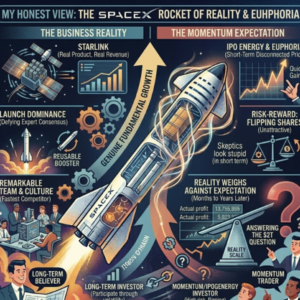
SpaceX is a genuinely remarkable company that has accomplished things most experts thought were impossible and built a real business in the process. Starlink is not hype — it’s a working product with paying customers and real revenue growth. The launch business is genuinely dominant. The team and culture have demonstrated an ability to move faster than any competitor in their space.
The IPO will generate extraordinary demand. Wall Street The early trading will probably produce price action that looks disconnected from any rational fundamental analysis. Wall Street There will be a period of euphoria that makes skeptics look stupid in the short term.
And then at some point — maybe six months later, maybe two years later — reality will start to weigh against expectation. The question of whether the business can grow into a $2 trillion valuation will stop being theoretical and start being answered by actual revenue and profit numbers. Wall Street That’s when owning SpaceX will require genuine conviction in the fundamental story rather than momentum and excitement.
For long-term investors who genuinely believe in what SpaceX is building and are comfortable holding through volatility there’s a real case to be made for participating. Wall Street For people who are excited by the IPO energy and thinking about flipping shares for a quick gain the risk-reward is considerably less attractive.

Your Partner in Financial Growth
Helping you save and invest smarter since 2026. Our mission is to simplify finance for everyone.