
Virgin Galactic Is Back in the Conversation. I’m Not Sure How to Feel About That.
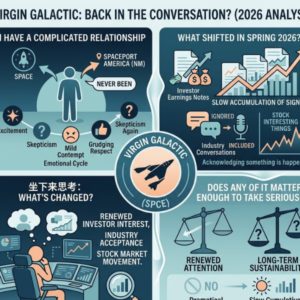
I have a complicated relationship with Virgin Galactic.
Not personally obviously. I’ve never been to space. I’ve never even been to Spaceport America in New Mexico where they operate. But I’ve been following this company long enough that my feelings about it have gone through several complete cycles — excitement, skepticism, mild contempt, grudging respect, skepticism again — and I’m not entirely sure where I’ve landed this time around.
What I know is that something shifted in the spring of 2026. Not dramatically. Not with a single announcement that changed everything. More like that slow accumulation of small signals that eventually reaches a threshold where you have to acknowledge that something is actually happening. Investors started mentioning Virgin Galactic in earnings notes again. Industry conversations that had ignored the company for the better part of two years started including them. The stock started doing things that were at least interesting even if not conclusively positive.
So I sat down and tried to think clearly about what’s actually changed and whether any of it matters enough to take seriously. Here’s what I came up with.
First Let Me Remind You How Quiet It Got
To understand why the current moment feels significant you need to remember just how completely Virgin Galactic disappeared from the conversation for a while.
After they retired the VSS Unity — the SpaceShipTwo vehicle that had been their operational workhorse and the thing that made them famous — there was a period that I can only describe as radio silence. Not the exciting kind of silence where you know something big is being built behind closed doors. The uncomfortable kind where you genuinely start to wonder if anything is happening at all.
For most of 2024 and a large chunk of 2025 if you were trying to follow Virgin Galactic you were essentially reading about delays and financial maneuvers and reorganizations and legal disputes. Nothing that looked like a company building toward something exciting. Just the grinding administrative reality of a company trying to survive long enough to do the thing it actually wants to do.
Investors hate this kind of period. Not because they’re impatient in some shallow way. Because silence in aerospace has historically been a warning sign. Companies that stop communicating visible progress often do so because the invisible progress has stalled. When nothing is happening that you can show people it becomes harder to maintain the confidence of the investors who are funding the work. It becomes a negative spiral if you let it go on too long.
Virgin Galactic let it go on for a while. That’s just honest.
The Thing That Got People’s Attention Again
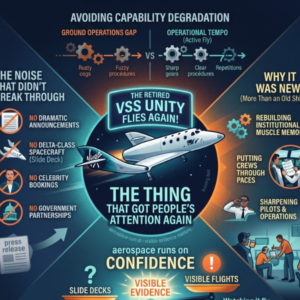
The signal that broke through the noise wasn’t what I expected.
It wasn’t a dramatic announcement about the Delta-class spacecraft being nearly complete. It wasn’t a scheduled flight date or a celebrity booking or a partnership with some government agency. It was something smaller and in retrospect more meaningful.
They flew the VSS Unity again.
Now if you’re not steeped in the Virgin Galactic story this might sound anticlimactic. The VSS Unity is the old ship. The one they retired. The one that’s not the future of the company. Why would flying the old ship be news?
Because it meant people were getting back in cockpits. It meant the pilots and the crew and the operations team were being put through their paces again after an extended period of ground operations. It meant the company was rebuilding the institutional muscle memory that you lose when you stop flying for an extended period.
An aerospace operation that hasn’t been flying for a year or more isn’t just dealing with a gap in the schedule. It’s dealing with a degradation of capability. Skills rust. Procedures get fuzzy. The reflexes that come from repetition fade. Before you can fly a new vehicle at operational tempo you need your people to be sharp again.
Using the Unity as essentially a training and currency-maintenance tool was an operationally intelligent thing to do. And the fact that they did it visibly — that they let people see them flying again — changed the narrative in a way that was probably worth more than any press release.
In aerospace doing something visible matters almost as much as what you do. The industry runs on confidence and confidence requires evidence. Watching an airplane or a spaceship fly is evidence in a way that a slide deck simply isn’t.
What the Delta Program Is Actually Supposed to Solve
Let me explain what the Delta-class spacecraft program is really about because I think it gets described in ways that miss the fundamental point.
The VSS Unity was a proof of concept. A beautiful impressive proof of concept that actually worked and actually took people to space and actually flew more than twenty times before it was retired. That’s a real achievement and I don’t want to diminish it.
But it was never designed to be a commercial operation. Every single flight required an enormous amount of preparation and recovery time. The maintenance burden between flights was significant. The cadence at which Unity could realistically fly was measured in weeks between attempts not days. For a tourism business that needs to generate consistent revenue from consistent flights that’s not a workable model.
The Delta-class is Virgin Galactic’s attempt to build the actual business rather than the proof of concept. The entire design philosophy is oriented around operability — how do you build a spacecraft that can fly multiple times per week without requiring a complete rebuild of confidence between each flight? How do you design maintenance workflows that can be executed quickly enough to support a real schedule? How do you create a vehicle where the turnaround time is measured in days rather than weeks?
These questions sound like engineering questions and they are. But they’re fundamentally business questions. You’re not trying to design the most impressive spacecraft. You’re trying to design the most repeatable spacecraft. Those are different problems with different solutions and the history of aerospace is full of vehicles that were technically impressive but operationally miserable.
Virgin Galactic has said they’re targeting multiple flights per week when the Delta-class is operational. That’s an ambitious goal. Whether they hit it or something close to it will determine whether this is a real business or another iteration of the experiment.
The progress updates in early 2026 were the first visible evidence in a while that this program was actually moving. Not completed. Not proven. Moving. For a company that had gone quiet for so long even that was meaningful.
The Money Situation Which Is Complicated and Uncomfortable
I want to talk about the financial picture honestly because I think coverage of Virgin Galactic often either glosses over it or catastrophizes it and neither serves anyone trying to think clearly.
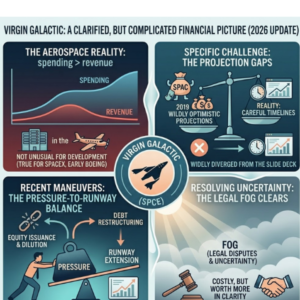
Virgin Galactic has always been a company that spends more money than it makes. That’s not unusual for an aerospace development program. The economics of building vehicles that take people to space are such that you’re going to be deep in the red for a long time before you’re anywhere near profitability. That’s true for SpaceX. It was true for Boeing’s commercial airplane programs in their early days. It’s essentially true for any capital-intensive technology development effort.
What’s specific to Virgin Galactic is the timeline. The company went public via SPAC in 2019 with projections that proved wildly optimistic about when commercial operations would scale. The people who invested based on those projections experienced a painful journey as reality diverged from the slide deck.
The debt restructuring and equity issuance that happened in the recent period is the kind of financial maneuver that tells you a company is under pressure but is not giving up. They’re diluting existing shareholders to extend their runway. That’s painful for people who already own shares. It’s the right move for a company that genuinely believes it’s close enough to something real that getting to the other side of the development phase is worth the dilution.
Whether that belief is justified is the question that can’t be answered yet.
What I can say is that the resolution of various legal disputes that had been hanging over the company cleared some of the fog. When you’re trying to attract investors and partners for a development program and you have unresolved legal uncertainty sitting in the background it affects every conversation. Getting those things settled — even in ways that were costly — was probably worth more to the company’s operational clarity than the raw financial impact suggests.
Why the Space Industry’s Moment Is Pulling Virgin Galactic Along
Here’s something that’s true about Virgin Galactic’s current situation that has very little to do with Virgin Galactic specifically.
The space industry is having a moment right now. The SpaceX IPO conversation has been generating enormous mainstream interest in space companies. New missions, new milestones, new investment flows — the sector is getting attention it hasn’t had since the early days of the commercial space boom. That attention lifts all boats including leaky ones.
Virgin Galactic occupies a specific and fairly unique position in this landscape. They don’t compete with SpaceX. They don’t launch satellites. They don’t do cargo missions. They’re not trying to put people on the Moon. Their market is something much more specific and in some ways more accessible to the imagination — taking private individuals to the edge of space for the experience of it.
When space gets exciting in the cultural conversation that specific offering starts generating a different kind of interest than it does when space is quiet. People who are excited about space think about what it would mean to experience it personally. Companies that provide space experiences start showing up in the conversations of people who would never otherwise think about aerospace investment.
That dynamic is real and it’s affecting Virgin Galactic’s visibility right now. How much of the current attention is genuine reassessment of the company’s prospects and how much is sector enthusiasm that will fade when the excitement around the broader industry settles down — that’s genuinely hard to separate.
The Question That Actually Matters
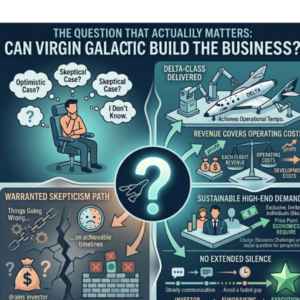
I’ve been dancing around the central question and I should just ask it directly.
Can Virgin Galactic actually build the business it’s been promising to build for longer than most people want to remember?
The honest answer is I don’t know. And I’m skeptical of anyone who claims to know with confidence either way.
What I can tell you is what would need to be true for the optimistic case to play out. The Delta-class program would need to deliver a vehicle that actually achieves something close to the operational tempo the company is targeting. The economics of each flight would need to work well enough that revenue from flights more than covers operating costs even before you start paying down development costs. The demand for what Virgin Galactic offers would need to sustain itself at the price point the economics require — and those price points are not accessible to most people, which is both a business challenge and a social question worth sitting with.
And the company would need to execute on all of this without another extended period of silence that drains investor confidence and makes fundraising harder at exactly the moment when execution momentum is most critical.
That’s a lot of things that need to go right. They’re not impossible. But the history of this company includes enough instances of things going wrong on timelines that seemed achievable that I think warranted skepticism is appropriate even while acknowledging that the current trajectory looks more positive than it did eighteen months ago.
What I’m Actually Watching
Rather than a verdict let me tell you what would change my level of confidence in either direction.
The Delta-class program reaching a first flight is the single most important milestone. Not an announcement of progress. Not a rendering. An actual vehicle flying with people on it. That would be qualitatively different from anything that’s happened recently because it would prove the machine works rather than suggesting it might work.
Flight cadence after that first flight is the second thing. Can they actually turn around and fly again quickly? Is the operational tempo they’re projecting achievable with the vehicle and the team they have? The early flights after a new vehicle enters service tell you more about operational reality than any projection does.
Revenue visibility is the third thing. The company has pre-sold future seats and holds deposits from people who have been waiting for a long time. Whether those customers remain engaged or start asking for refunds will be an early indicator of commercial health.
The Honest Bottom Line
Virgin Galactic is not a success story. Not yet. Maybe not ever. The gap between what they’ve promised over the years and what they’ve delivered is real and it’s fair to factor that history into how you evaluate current promises.
But they’re also not the same company they were at their lowest point. The Delta-class program exists and is progressing. The operations team is flying again. The financial picture is uncomfortable but not immediately terminal. The industry environment is favorable in ways that help them.
What they’re attempting to transition from — an interesting experiment that occasionally took people to space — to what they’re trying to become — a company with a repeatable operational business — is genuinely difficult. Most attempts to make that transition in aerospace fail. Some succeed.
The difference between the ones that succeed and the ones that don’t usually comes down to one thing that you can’t assess from the outside until it’s either proven or disproven. Whether the technology actually works at the cadence and reliability the business requires when it’s actually being asked to perform rather than when it’s being developed.
We’re going to find out over the next eighteen months.
I’m watching with the particular kind of attention you give to something that has disappointed you before but that you haven’t quite given up on.

Your Partner in Financial Growth
Helping you save and invest smarter since 2026. Our mission is to simplify finance for everyone.