
The US Government Is Back in the Economy — And This Time It Means Business
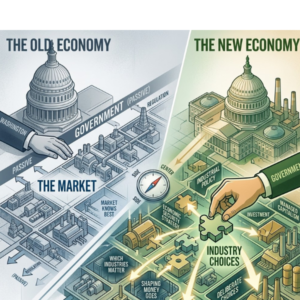
Something has changed in America, and it happened gradually enough that a lot of people didn’t notice until it was already done. The federal government, which spent the better part of thirty years telling everyone that the market knows best, has quietly reversed course. Washington is no longer content to sit on the sidelines, set a few rules, and let businesses figure the rest out. It is now making deliberate choices about which industries matter, where money should go, and how the economy should be shaped. That is a significant change — bigger than most daily news coverage gives it credit for.
Call it what you want. Industrial policy. Economic security strategy. Managed capitalism. The name honestly doesn’t matter. What matters is the reality: the line between government and market in this country is blurrier than it has been since at least the 1970s, and probably longer than that.
Market Economy
The first thing was China. After the Cold War, Washington operated on a comfortable assumption — that open markets, free trade, and American ingenuity would always keep the United States ahead. That assumption aged badly. China didn’t stay in the lane everyone expected. It moved aggressively into advanced technology, dominated manufacturing of batteries and solar panels, poured government money into semiconductor development, and built up capabilities in artificial intelligence that nobody in Washington took seriously until suddenly everyone did. Industries that used to be purely about profit — making chips, building batteries, controlling mineral supply chains — started looking a lot like national security issues. And once something looks like a national security issue, the government gets interested very quickly.Market Economy
The second thing was the pandemic. COVID-19 was genuinely clarifying in a way that economic arguments rarely are. All the theoretical talk about supply chain vulnerability became very real, very fast. Hospitals couldn’t get masks. Car companies couldn’t get chips and had to shut down assembly lines. Store shelves ran empty on items people had never once thought about before. The whole experience made something obvious that economists had been quietly noting for years: global supply chains are extraordinarily efficient right up until the moment they aren’t. And when they break, the consequences hit everyone — not just shareholders, not just executives, but ordinary people trying to buy groceries or get medical care. That lesson stuck.
The third driver is technology, and this one is still unfolding. Artificial intelligence, advanced computing, clean energy systems — these aren’t just fast-growing industries anymore. They are becoming the foundation of economic and military power in a way that hasn’t been true of any technology since maybe electricity or nuclear weapons. When something becomes that strategically important, governments don’t sit back and let venture capitalists sort it out. They get involved. They always have, historically. The internet, GPS, the semiconductor itself — all of these came out of government investment before the private sector took over. We are in another one of those moments.Market Economy
The Chip Story Says Everything
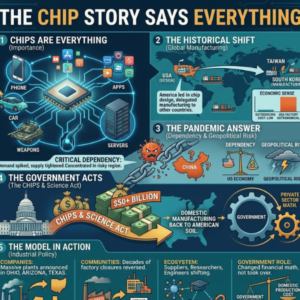
If you want to understand what this shift actually looks like in practice, semiconductors are your best example. Not because they’re exciting — they’re not, really, they’re small pieces of silicon — but because they illustrate exactly how strategic thinking has changed.
Chips are everywhere. Every phone, every car, every weapons system, every server running every app you use — all of it depends on semiconductors. For a long time, America led the world in designing chips but handed off the actual manufacturing to other countries, mainly Taiwan and South Korea. That made perfect economic sense. Building chip factories requires astronomical capital investment. The Asian manufacturers had decades of expertise and infrastructure already built up. Why compete with that?
The pandemic answered that question pretty definitively. When demand spiked and supply tightened, the United States found itself in a genuinely uncomfortable position: critically dependent on foreign manufacturing for one of the most important inputs in the modern economy, with that manufacturing concentrated in a region that carries real geopolitical risk. The Taiwan question alone — the possibility that China could move on Taiwan and disrupt the global chip supply — is enough to give defense planners sleepless nights.
So the government acted. The CHIPS and Science Act put more than $50 billion on the table to bring semiconductor manufacturing back to American soil. Companies that would never have made that bet purely on the economics — because domestic production is more expensive — started announcing massive plants in Ohio, Arizona, Texas. Communities that had watched factories close for decades started seeing construction crews and hiring notices. Market Economy The broader ecosystem of suppliers, researchers, and engineers began shifting too.
The government didn’t take over the chip industry. It didn’t tell Intel what products to make or how to run its factories. It just changed the financial math enough that the private sector started doing something it wouldn’t have done on its own. Market Economy That’s the model. That’s what modern industrial policy actually looks like when it’s functioning.
Power Is the Next Problem
Energy has quietly become the next major pressure point, and the situation is genuinely complicated.
Artificial intelligence runs on electricity — enormous amounts of it. The data centers that train AI models and run AI applications are power-hungry in a way that most people don’t fully appreciate. Stack that on top of the manufacturing capacity coming back to the United States, and you have a significant and growing demand problem hitting a grid that in many parts of the country was already struggling.
Building new power generation takes years. Upgrading transmission infrastructure takes even longer. There are permitting fights, regulatory layers, and coordination challenges that the market simply cannot solve fast enough on its own. So the government is stepping in — guiding where infrastructure investment goes, pushing to modernize the grid, trying to make sure that the energy foundation holds up as everything else builds on top of it.
What’s changed is how people in Washington talk about energy. It used to be treated as just another sector of the economy — important, sure, but ultimately subject to market dynamics like anything else. Now it’s increasingly discussed the way people talk about roads or water systems. It’s infrastructure. It’s the thing everything else depends on. Market Economy And infrastructure, in this country, has always involved significant government involvement.
Trade Isn’t What It Used to Be
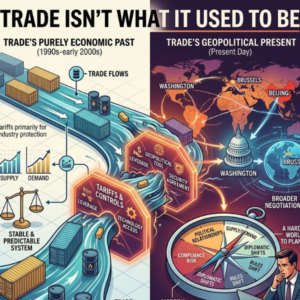
The shift in trade policy has been harder to track because it’s been wrapped up in politics and has changed direction more than once. But the underlying trend is real :Market Economy trade is no longer treated as a purely economic matter.
Tariffs are being used as leverage — not just to protect specific industries, but as tools in broader negotiations that touch on security agreements, technology access, and geopolitical alignment. A tariff on a particular category of goods might have less to do with the economics of that sector and more to do with what Washington wants from Beijing or Brussels on a completely different issue.
For companies that built their operations around a relatively stable and predictable global trading system, this is genuinely difficult. You can’t just look at supply and demand anymore. Market Economy You have to think about political relationships, compliance risk, and the possibility that the rules shift significantly depending on what’s happening diplomatically. Market Economy That’s a harder world to plan in, and a lot of businesses are still figuring out how to adapt.
Let’s Be Honest About the Problems
This approach has real downsides and it would be dishonest to pretend otherwise.
Tariffs and domestic reshoring raise costs. That’s just true. When you deliberately choose more expensive domestic production over cheaper imports, somebody pays the difference — usually consumers and businesses that use those goods as inputs .Market Economy That creates tension with efforts to keep inflation under control, and it’s a tension that doesn’t resolve easily.
The spending is also enormous. Industrial subsidies and infrastructure investment at this scale cost serious money, at a time when the national debt is already a politically charged issue. How long this level of government spending can continue — and whether the returns justify the investment — are open questions that nobody has fully answered.
There’s also the bureaucratic mess problem. Market Economy When government gets deeply involved in specific industries, the regulatory environment gets more complex. More approvals, more compliance requirements, more layers to navigate. That slows things down and can actually discourage the investment the government is trying to encourage in the first place.
And then there’s the oldest criticism of industrial policy: governments are not great at picking winners. For every successful bet, there’s a costly failure. The history of government-directed investment has genuine successes — the interstate highway system, DARPA, the early internet — but it also has expensive mistakes. Skepticism about any particular program is reasonable.
Why This Matters to You
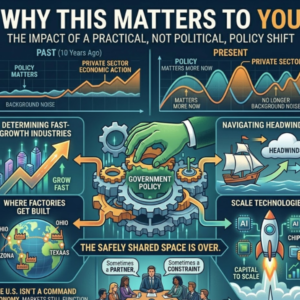
Here’s the bottom line, whether you’re running a business, managing investments, or just trying to understand what’s happening around you: policy matters more now than it did ten years ago.
That’s not a political statement. It’s a practical one. Market Economy The assumption that Washington was mostly background noise for the real economic action happening in the private sector — that assumption is no longer safe. Decisions made in government can now directly determine which industries grow fast, which ones face headwinds, where factories get built, which technologies get the capital they need to scale. That’s a different environment than the one most people built their mental models around.
The United States isn’t becoming a command economy. Market Economy Markets still function. Private companies still make most of the real decisions. But the government is now inside the room in a way it wasn’t before — sometimes as a partner, sometimes as a constraint, sometimes as the force setting the direction entirely. Market Economy

Your Partner in Financial Growth
Helping you save and invest smarter since 2026. Our mission is to simplify finance for everyone.