
Futures Are Up, Oil Is Down — But What Is Actually Going On Right Now? U.S.–Iran
Let me start with something most financial articles skip over. The average person does not wake up thinking about oil. You fill your tank, you buy groceries, you book a flight — oil is somewhere in the background of all of that, but it is not something you consciously track. And yet right now, in June 2026, oil prices dropping by a few dollars is moving stock futures, shifting investor mood, and quietly affecting the value of things sitting in millions of retirement accounts. That gap between “I don’t really follow oil” and “oil just changed what my portfolio is worth” is exactly why this stuff is worth understanding properly.
So let me walk through what is actually happening, why it matters, and what it does and does not tell us about where things are headed.
Oil Is Not Just About Energy Anymore
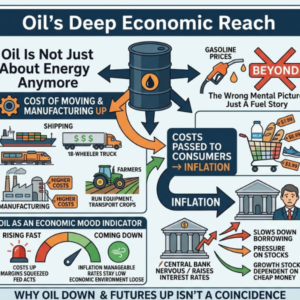
Here is the thing people get wrong about oil. They think of it as a fuel story. Gasoline prices, energy stocks, maybe airline costs if they think hard enough. But oil’s real influence on markets goes much deeper than that.
When oil prices go up sharply, the cost of moving things goes up. U.S.–Iran Shipping goods across the country costs more. Manufacturing gets more expensive. Farmers pay more to run equipment and transport crops. Those costs don’t just disappear — they get passed down the chain, and eventually they show up as higher prices for consumers .U.S.–Iran That’s inflation. And inflation is the thing that makes central banks nervous, raises interest rates, slows down borrowing, and puts pressure on stocks — especially growth stocks that depend on cheap money to fund their expansion.
So oil is really functioning as a kind of economic mood indicator. When it’s rising fast, the market reads that as a warning sign — costs are going up, margins are getting squeezed, the Fed might have to act. When it comes down, even a little, the market reads it as breathing room. Maybe inflation stays manageable. Maybe interest rates don’t have to go higher. Maybe the economic environment stays loose enough for companies to keep growing.
That is the simple version of why futures going up at the same time oil is going down is not just a coincidence. U.S.–Iran The market is not reacting to cheap gas. U.S.–Iran It is reacting to the idea that the economic pressure might ease a bit.
What Is Actually Pushing Oil Lower Right Now
This is where it gets less tidy U.S.–Iran. Oil prices are not dropping because suddenly the world found a new massive supply or because everyone stopped driving .U.S.–Iran The move is largely political, which makes it both significant and fragile at the same time.
Major oil-producing regions are caught up in ongoing geopolitical tension — that’s not news to anyone who follows headlines. What matters for oil markets is not just what is happening, but what traders think might happen .U.S.–Iran Oil moves on expectations, rumors, diplomatic signals, and sometimes just the tone of a statement from a government official.
Right now there appear to be signals of possible de-escalation in some of those tense areas. Nothing confirmed, nothing signed, nothing resolved. Just the early suggestion that things might not get worse, or might even get a little better. That alone is enough for oil traders to start pulling back some of the “risk premium” they had baked into prices — meaning the extra cost that gets added to oil when the world feels unstable.
A lot of the world’s oil still moves through specific shipping lanes and chokepoints. When those feel threatened, traders don’t wait for an actual disruption to happen. They price in the possibility of one immediately. U.S.–Iran You can see oil spike on a single news headline because that headline shifts the probability calculation in traders’ minds, even if not a single barrel has been disrupted yet. U.S.–Iran And when those fears ease, even slightly, prices come back down just as fast.
This is important context because it means the current oil move is sensitive. U.S.–Iran It is not driven by a fundamental change in supply and demand. It is driven by political mood. U.S.–Iran And political mood can reverse overnight.
Why Futures Move While You Are Sleeping
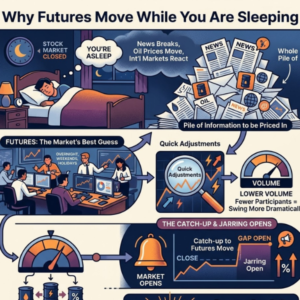
A lot of people find futures confusing and honestly that is understandable because they are a bit abstract until someone explains what they are actually for.
Futures are basically the market’s best guess at where things should open when regular trading starts again. While the stock market is closed — overnight, over weekends, on holidays — the world keeps happening. News breaks, oil prices move, other countries’ markets react to things. By the time the US market is ready to open, there is a whole pile of information that has built up and needs to be priced in. U.S.–Iran Futures are how that process starts before the opening bell.
So if oil dropped overnight because some diplomatic statement came out suggesting tensions might ease, futures traders start buying. They are not doing this in a calm, measured way. U.S.–Iran They are adjusting quickly based on the new information, trying to position themselves before the regular market opens and everyone else piles in .U.S.–Iran Because futures trading happens at lower volume than regular hours — fewer people participating — prices can swing more dramatically on the same amount of buying or selling than they would during a normal session.
When the market opens and regular trading begins, it often has to catch up to wherever futures have moved. U.S.–Iran That catch-up is what creates those sometimes jarring opens where a stock or index is suddenly a percent or two different from where it closed the night before.
Why Stocks Sometimes Open in a Completely Different Place Than They Closed
This confuses people and it is worth explaining clearly because it can feel unsettling if you don’t know why it happens.
Imagine the market closes at 4:00 pm. At 6:00 pm, news breaks — oil drops, a geopolitical tension eases, a big company releases earnings that beat expectations. Investors can’t fully react yet because regular trading is closed. But they are forming opinions, adjusting their thinking, placing orders that will sit in the queue until trading resumes.
By the time 9:30 am rolls around the next morning, there is a backlog of decisions all waiting to execute at once .U.S.–Iran All those buy orders flood in simultaneously, and the price has to quickly find a new level that clears all that demand. That is why you sometimes see stocks open sharply higher or lower than the previous close — it is not that something dramatic happened in that exact moment. U.S.–Iran It is that the market is processing hours worth of information in the first few seconds of trading.
Those opening minutes are genuinely messy. U.S.–Iran Prices often overshoot in whatever direction the news pointed, then pull back once the initial rush of orders clears and things stabilize. Watching a stock’s first ten minutes of trading and drawing conclusions from it is usually a mistake. It is adjustment and reaction, not a reliable signal about where things are heading.
Who Actually Wins and Who Gets Hurt When Oil Moves
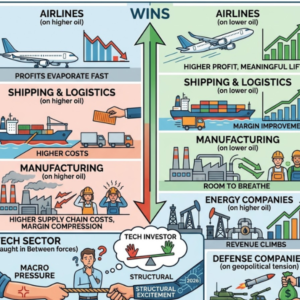
Not every part of the market reacts the same way to an oil price change. Some industries benefit directly and some take a beating.
Airlines are probably the most exposed to oil of any major sector. Fuel is one of the single biggest costs they carry, and they don’t have a lot of flexibility to suddenly pass those costs to passengers without losing customers. When oil goes up, airline profits can evaporate fast. When oil comes down, they get a meaningful lift — sometimes even before they’ve done anything differently operationally.
Shipping and logistics companies face similar math. Their entire business model involves moving physical things from one place to another, and almost all of it runs on fuel. Lower oil is basically a margin improvement for them without having to change anything.
Manufacturing is more complicated. Higher oil raises costs across the supply chain — raw materials cost more to produce, factories cost more to run, finished goods cost more to transport. These costs tend to get absorbed in various ways and show up as margin compression or eventually higher consumer prices. U.S.–Iran A sustained drop in oil gives manufacturers room to breathe.
Energy companies themselves obviously move with oil prices — when oil goes up, their revenue climbs. But the relationship isn’t perfectly clean because their production costs also change, and the geopolitical factors that affect oil prices can also affect where and how they operate.
Defense companies benefit from a different part of the same story. When geopolitical tension rises, defense spending tends to follow. Governments allocate more to military capability, security, and hardware. U.S.–Iran Markets start pricing in that expectation even before contracts are signed.
Tech is the interesting one. Technology companies don’t run on oil the way an airline does. But they get pulled into the story through inflation and interest rates. If oil pushes inflation higher, the Fed tightens policy, borrowing becomes more expensive, and growth stocks — which depend heavily on the assumption of cheap capital over long time horizons — get repriced lower. That relationship has bitten tech investors more than once.
At the same time, the tech sector in 2026 is being carried by a powerful current of optimism around artificial intelligence. Even when macro conditions create headwinds, sentiment around AI’s long-term potential keeps pulling money back into the sector. So tech often ends up caught between two forces pulling in opposite directions — macro pressure on one side, structural excitement on the other. U.S.–Iran Right now the excitement side seems to be winning more days than not.
What the Current Moment Is Actually Telling Us
Futures rising while oil slips is a mood shift, not a transformation. It is the market saying “things feel slightly less threatening right now” — not “the problems are solved.”
What’s behind that mood is partly real and partly just the absence of bad news. U.S.–Iran Oil coming down removes one specific worry from the list. It suggests inflation might not re-accelerate, that the Fed might have more flexibility, that corporate margins might hold up better than feared. That combination is enough to make investors feel a bit more comfortable in the short term.
But the underlying situation hasn’t fundamentally changed. The geopolitical tensions that were driving oil higher in the first place are still there. They haven’t been resolved — they’ve just quieted momentarily. One statement from the wrong official, one incident in a shipping lane, one piece of data that surprises to the upside on inflation, and the mood flips again. Markets, especially when they’re reacting to political factors, can reverse faster than most people expect.
How to Actually Think About All This
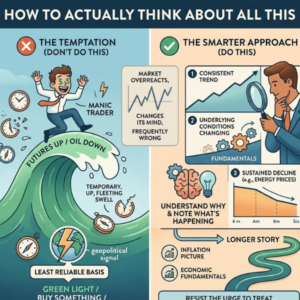
The temptation when you see futures up and oil down is to read it as a green light. Things are good, buy something, ride the wave. And maybe that works for a day or two. But short-term mood shifts in markets driven by geopolitical signals are about the least reliable basis for making investment decisions.
What actually matters is whether the underlying conditions are changing in a sustained way. A single day of oil dropping doesn’t change the inflation picture. A sustained six-month decline in energy prices does. A single futures spike doesn’t define the direction of the market. A consistent trend backed by improving economic fundamentals does.
The smarter approach — and I know this sounds boring — is to note what is happening, understand why it is happening, and resist the urge to treat short-term moves as confirmation of anything in particular. The market is constantly trying to price in what it thinks will happen next. It is frequently wrong. It changes its mind constantly. And it often overreacts to new information before correcting.
Right now, the market is reacting to slightly lower oil prices driven largely by geopolitical signals that could shift at any point. That reaction is real and it is showing up in futures and probably in your portfolio today. But it is one data point in a much longer story, and treating it as more than that is usually where investors get into trouble.

Your Partner in Financial Growth
Helping you save and invest smarter since 2026. Our mission is to simplify finance for everyone.