
I Make $60,000 a Year and I Still Can’t Save Money — Here’s the Honest Truth
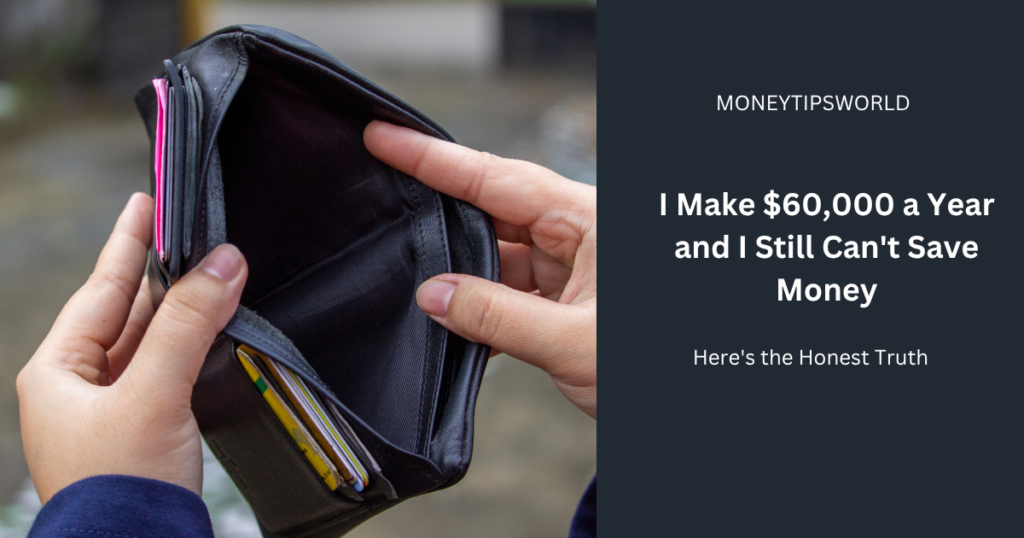
My sister found out how much I had in savings by accident.
We were splitting a dinner bill and I handed her my phone to Venmo her half and she accidentally tapped the wrong app and saw my savings account balance before I could grab the phone back.
She looked at me. Then at the phone. Then at me again.
“Is that — is that your actual savings?”
I wanted to disappear into the restaurant booth. I’m thirty-one years old. I have a degree. I make sixty thousand dollars a year at a job I worked genuinely hard to get. And my sister — who is twenty-seven and works in a coffee shop and openly admits she’s “not a money person” — was looking at my savings account like she’d just discovered I’d been living a secret second life.
The number was $412.
Four hundred and twelve dollars. In October. After eleven months of a year where I’d told myself repeatedly that I was “going to get serious about saving.”
I didn’t say anything. I just took my phone back and we sat in silence for a second and then she said, very carefully, “do you want to talk about it?”
I said no. Then I said yes. And what followed was a two-hour conversation over cold pasta that changed how I think about money more than any book or podcast or financial advice article I’ve ever consumed.
This is what I figured out.
First — The Part That’s Actually Embarrassing to Admit
Before I get into the why, I have to tell you the part I skipped over for months even in my own head.
I thought I was good with money.
Not great. I wasn’t delusional. I knew I wasn’t maxing out my 401k or building a stock portfolio or doing any of the things the financial Twitter people talk about. But I thought I was — reasonably responsible. I didn’t buy expensive things. I didn’t have credit card debt. I drove a 2017 Civic with 89,000 miles on it that I owned outright. I thought “I’m not flashy, I’m not reckless, I’m pretty okay.”
My savings account was calling me a liar and I had been successfully ignoring it.
This is the part of financial articles that nobody writes about honestly because it requires admitting something uncomfortable. The gap between who you think you are with money and who you actually are with money. That gap can sit there for years while you don’t look directly at it because looking directly at it requires updating your self-image in a direction that doesn’t feel great.
I had a $412 self-image update sitting in my savings account. I’d just been avoiding opening the app long enough to see it.
The Math Nobody Wants to Sit With
Okay. Let me do the uncomfortable math because I think it’s important to actually see the numbers rather than gesture vaguely at them.
$60,000 a year sounds like a solid income. And maybe it is — I’m not complaining about earning it. But $60,000 gross is not $60,000 in your pocket.
After federal income tax, state tax, Social Security, Medicare — I take home about $46,200 a year. That’s $3,850 a month hitting my checking account.
My rent is $1,475. Not luxury. One bedroom, decent neighborhood, no doorman, dishwasher that makes a sound that concerns me slightly. Just what rent costs where I live.
Car insurance: $163. Because apparently having one minor fender bender three years ago is a thing insurance companies remember forever.
Phone: $89. Internet: $74. I know I could probably find cheaper internet. I’ve looked into it twice and both times it was complicated enough that I went back to what I had.
Electric and gas average maybe $130, more in winter. Renter’s insurance $18. I almost canceled it twice. My dad talked me out of it both times. Thanks, Dad.
That’s $1,949 in fixed monthly expenses before I’ve bought a single thing. Out of $3,850.
I have $1,901 left. For everything. Food, clothing, household things, entertainment, haircuts, gifts, medical copays, the random stuff life throws at you that you can’t predict.
$1,901 sounds manageable until you actually try to live on it.
Where the Money Was Actually Going
After my sister’s restaurant discovery, I did something I’d been avoiding for about two years. I printed out three months of bank statements and sat down at my kitchen table with a highlighter.
Yellow for food. Pink for subscriptions. Orange for “things I bought that I didn’t need but wanted in the moment.” Green for actual bills. Blue for anything that confused me.
There was a lot of orange.
Here’s what I found that genuinely surprised me.
Subscriptions I was paying for but not using: I found six. Six. Netflix, which I use. Spotify, which I use. A fitness app I signed up for in January during that very specific January energy when signing up for a fitness app feels like the beginning of a new chapter rather than sixteen dollars a month you’ll waste. A meal kit service I tried for three weeks in February and forgot to cancel. An audiobook app I downloaded during a road trip. And something called “Premium Cloud Storage Pro” that I genuinely cannot figure out what it was, even after googling it. Total: $87 a month I was paying for services I’d essentially stopped using. Over a year that’s over a thousand dollars. Gone. Into the void.
Food delivery: I told myself I ordered in “occasionally.” My bank statements told me I ordered in approximately twice a week and that on average each order was $34 including fees and tip. I did the math standing at my kitchen counter and then I stood there for a moment just processing it. That’s $68 a week. $272 a month. $3,264 a year. On food I could have cooked for a fraction of the cost, or picked up myself without the fees.
Twice a week didn’t feel like a lot when I was doing it. It felt like “occasionally.” The number $3,264 does not feel like occasionally. It feels like a flight to Europe.
The thing I’m calling “emotional spending” for lack of a better term: This one’s harder to quantify because it shows up differently every time. It’s the $60 I spent on a candle on a Tuesday because I was stressed and the candle smelled good and buying it felt like doing something for myself. It’s the new jacket in March when my existing jacket was fine but I’d been having a rough month and I walked past a store and it was on sale and I “needed” it. It’s the dinner out that was more expensive than usual because I’d been eating sad desk lunches all week and I deserved a real meal. It’s the thing I added to an online cart two weeks ago and told myself I was “thinking about” and then bought at midnight because I was still awake for no good reason and clicking “purchase” created a small burst of something that felt like satisfaction.
None of these individual purchases broke the bank. All of them together, month after month, added up to the difference between $412 in savings and where I should have been.
The Advice I Always Got That Never Helped
“Cut your subscriptions.”
“Make coffee at home.”
“Stop eating out so much.”
“Track your spending.”
I had been given this advice in various forms for years. By my parents. By financial articles. By podcasts I listened to while doing exactly the behaviors they were telling me to stop. And the advice isn’t wrong — I did need to cut my subscriptions, and I did need to stop ordering delivery twice a week — but it was missing something crucial.
It was missing the reason why I wasn’t doing those things.
I wasn’t ordering delivery twice a week because I didn’t know cooking was cheaper. I was ordering delivery twice a week because on a Wednesday at 7pm after a full day of work and a commute and answering forty-three emails and sitting through a meeting that could have been an email, the idea of standing at my stove for forty-five minutes felt like one thing too many. I was depleted. Delivery was easy. Easy felt necessary.
I wasn’t keeping unused subscriptions because I was careless with money. I was keeping them because canceling things requires navigating websites designed to make canceling difficult, and doing that during a low-energy evening moment felt harder than just letting the charge happen again.
Financial advice that ignores the human and emotional context of why people make the choices they make is advice that feels true and does nothing. Knowing I should spend less has never once, in my life, automatically resulted in spending less. Knowing why I was spending the way I was — that was the actual starting point.
What My Sister Said at Dinner
She’s twenty-seven. Works in a coffee shop. And she said something that I’ve been thinking about ever since.
“I think you’re spending money to feel okay. And nothing I say about budgets is going to matter until you figure out what’s making you not okay.”
I kind of laughed. She didn’t.
She said: “You have a stressful job. You’re tired a lot. You eat delivery food when you’re tired, you buy stuff when you’re stressed, you subscribe to things when you feel like you should be doing more with your life. You’re not bad with money. You’re managing your emotions with money. That’s different.”
She was right. Obviously she was right. And I hated that she was right because it made the problem feel bigger and harder than “just track your spending and cancel your subscriptions.”
Managing emotions with money. That’s what I was doing. That’s what I think a lot of people making decent incomes are doing when they can’t figure out where the money went. They’re not stupid. They’re not reckless. They’re stressed and tired and the path of least resistance in a given moment costs money, and doing that enough times makes you the kind of person who makes sixty thousand dollars a year and has four hundred and twelve dollars in savings.
What I Actually Changed — And What I Didn’t
here’s I want to be real with you about this because the “here’s my turnaround story” section of financial articles usually involves someone becoming a completely different person, and that didn’t happen to meat I did.
I spent one Sunday afternoon canceling everything I couldn’t remember signing up for or hadn’t used in thirty days. Six subscriptions gone. $87 a month back. Done in about ninety minutes including the ones that made me sit on hold for fifteen minutes trying to cancel, which should be illegal but apparently isn’t.
I deleted the food delivery apps. Not blocked them. Deleted them entirely. The added friction of having to reinstall before ordering meant that about half the time I just cooked something instead. My delivery spending roughly halved. I still order in sometimes. I just order in less.
I set up an automatic transfer of $250 on payday — not “whatever’s left over” because there was never anything left over — into a completely separate savings account that I moved to a different bank so it was slightly inconvenient to move money back. Eight months later I have $2,000 in it. The most I’ve ever had in savings as an adult.
Here’s what I didn’t change.
I still sometimes buy things when I’m stressed. I still occasionally order delivery on Wednesday nights when I’m depleted. I still have the candle problem — I own more candles than one person needs and I will probably buy more candles this year and I’ve made a kind of uneasy peace with this.
I’m not a person who has perfected her relationship with money. I’m a person who has a slightly more honest relationship with her actual behavior than she had a year ago.
That’s it. That’s the whole transformation.
$412 is now $2,000. I’m not where I want to be. I’m better than I was. Both of those things are true and I’ve decided to let them both be true without needing one of them to cancel out the other.
The Thing My Sister Was Right About
I still think about what she said. Managing emotions with money.
I think a lot of us are doing this. I think a lot of people who make decent incomes and somehow have nothing saved are not failing at finance — they’re using finance to manage something else. Stress. Loneliness. Boredom. The specific exhaustion of a life that asks a lot of you. The small dopamine hit of clicking “buy” or “order” in a moment when not much else feels good.
The budget fixes — cancel the subscriptions, stop ordering food twice a week, automate your savings — they help. They genuinely helped me. But they’re treating a symptom. The root thing is harder and slower and involves asking yourself why you’re tired all the time and what you’re actually looking for when you put something in a cart.
I don’t have a clean answer to that question yet. I’m still working on it.
What I have is $2,000 in a savings account and a sister who accidentally saw my bank balance at a restaurant and didn’t let me off the hook about it.

Your Partner in Financial Growth
Helping you save and invest smarter since 2026. Our mission is to simplify finance for everyone.