
Gold’s All-Time High What It Means For You
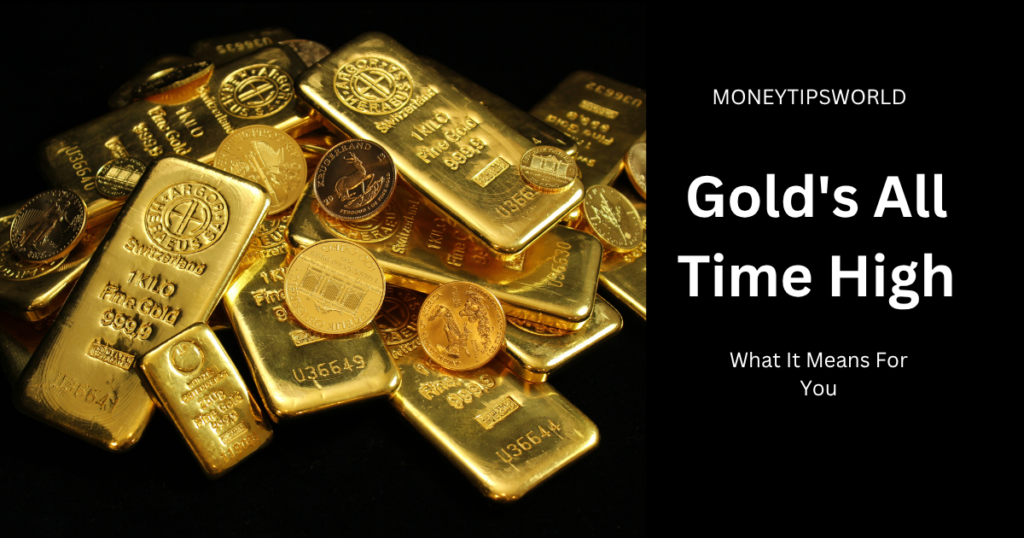
My dad has been telling me to buy gold since I was twenty-two.
Not occasionally. Constantly. Every family dinner for the better part of fifteen years has had some version of this conversation. He’ll mention something about the news, or the economy, or his own portfolio, and somewhere within four minutes he’s circling back to the same point he’s made a hundred times before: “You should have some gold. Everyone should have some gold.”
I used to nod along and change the subject. Gold felt like something my dad’s generation worried about a relic from an era of different anxieties, different economic memories. I had a vague sense it was the kind of investment people made when they didn’t trust banks or governments or anything modern, and I didn’t think of myself as that kind of person.
Then gold hit an all-time high a few weeks ago. And I called my dad, and for the first time in fifteen years, I actually asked him to explain himself properly instead of just letting the conversation slide past me.
What followed was a longer conversation than either of us expected, and it genuinely changed how I think about a corner of investing I’d dismissed without ever really examining.
What Actually Happened With Gold
Let me start with the simple version before I get into the more complicated parts.
Gold has been climbing for a while now, and recently it pushed through to levels it has never reached before. Not adjusted for inflation, not in some technical sense that requires an asterisk an actual, nominal, all-time high. The kind of number that gets headlines even from outlets that don’t normally cover commodities closely.
When something like this happens, there’s always a temptation to treat it as a single, simple story. Gold went up, here’s why, buy it or don’t. But the actual explanation for why gold behaves the way it does is genuinely more layered than that, and understanding the layers is what made the conversation with my dad useful instead of just nostalgic.
Why Gold Moves the Way It Does 76The Part I’d Never Actually Understood
Here’s something I had to admit to my dad on the phone: I didn’t actually understand what gold was for, as an investment. I knew people held it. I knew it was supposed to be “safe” in some vague sense. I didn’t understand the actual mechanism.
He explained it the way he’s probably explained it a hundred times to people who weren’t really listening, but this time I was.
Gold doesn’t generate cash flow. It doesn’t pay dividends. It doesn’t have earnings reports or growth projections. In the conventional sense of “what makes an investment worth owning,” gold fails almost every test you’d apply to a stock or a bond. You can’t value it the way you value a business.
What gold does instead is hold value across long stretches of time and across different kinds of crises in a way that paper assets sometimes don’t. When currencies lose purchasing power through inflation, through political instability, through central banks printing money to deal with some crisis gold has historically held its value better than cash sitting in a bank account. It’s not growth. It’s preservation.
My dad put it this way: “Stocks are how you grow money. Gold is how you make sure you still have something if everything else falls apart for a while.”
I’d heard some version of that phrase before. This time it actually landed.
What’s Actually Driving the Current Surge
I wanted to understand specifically what was pushing gold to this particular all time high right now, rather than just accepting “uncertainty” as a vague catch all explanation, because vague explanations have never satisfied me.
A few specific things seem to be contributing.
Central banks around the world have been buying gold at a significant pace. Not individual investors actual national central banks, adding gold to their reserves in quantities that are meaningfully larger than historical norms. When the institutions that manage entire national currencies decide to hold more gold, that’s a different kind of signal than retail enthusiasm. It suggests something about how these institutions are thinking about currency risk and reserve diversification at a structural level.
There’s also been persistent uncertainty around interest rates and inflation that I’ve written about before in other pieces the back and forth about when central banks will cut rates, whether inflation is truly under control, what happens to currency values in different scenarios. Gold tends to do well in environments where people are uncertain about the future value of cash, and there’s been plenty of that uncertainty circulating.
Geopolitical tension matters too. When global stability feels less certain, gold has historically attracted demand from people and institutions looking for an asset that doesn’t depend on any single government’s stability or any single country’s economic health.
None of these factors alone fully explains the move. Together, they create an environment where gold’s traditional appeal as a store of value becomes more attractive than it’s been in a while.
The Argument My Dad Has Been Making For Fifteen Years
I want to be fair to my dad’s actual reasoning, because I think dismissing it for so long without engaging with it was a mistake on my part, even if I’m still not fully on board with everything he believes.
His core argument has always been about insurance, not growth. He’s never claimed gold is going to make anyone rich. His position has consistently been that a small percentage of any portfolio he’s mentioned figures around five to ten percent over the years should be in gold as a hedge against scenarios where everything else is going wrong simultaneously.
The logic, as he explains it, is that stocks and bonds and gold don’t all move together. When markets crash, gold often moves independently or even in the opposite direction, because the things that scare stock investors inflation, currency instability, geopolitical crisis are often exactly the conditions that make gold more attractive. Having some gold means having something that might hold up, or even gain value, during the specific kinds of crises that hurt everything else in your portfolio.
I asked him directly: has this actually worked for you? Has holding gold for decades actually helped your overall returns?
He was honest in a way I appreciated. He said his gold holdings, by themselves, have not been his best performing asset over his investing lifetime. Stocks, held for decades, beat gold significantly in pure growth terms. He wasn’t trying to argue otherwise.
What he argued instead was that the gold allocation let him sleep better during periods when stocks were cratering, and that the psychological value of having something stable during chaos sometimes matters as much as the pure mathematical return. He also pointed out that during a couple of specific stretches particularly periods of high inflation the gold portion of his portfolio had genuinely outperformed everything else he owned, at exactly the moments when that outperformance mattered most.
What I Actually Think After This Conversation
I’m not going to tell you my dad was completely right, because I don’t think the picture is that simple. But I also can’t dismiss the conversation the way I used to dismiss the topic before actually engaging with it.
Gold is not a growth investment in the way stocks have historically been growth investments. Over long stretches of time, broad stock market indices have significantly outperformed gold. If your goal is building wealth over decades through one primary vehicle, the historical data doesn’t favor gold as that primary vehicle.
But “should this be your only investment” and “should this be part of your portfolio” are different questions, and I think I’d been conflating them without realizing it. The argument for a small gold allocation as a diversification tool something that behaves differently from your other holdings during specific kinds of stress is more defensible than I’d given it credit for.
What changed for me wasn’t a conviction that gold is secretly the best investment nobody talks about. It’s a recognition that I’d been dismissing an entire category of investing reasoning without actually understanding the reasoning, which is a worse position to be in than disagreeing with something you’ve actually examined.
The Risk Nobody Mentions Enough
I want to be honest about something that came up in the conversation that I think deserves more attention than it usually gets.
Gold hitting an all-time high doesn’t mean gold is now a safe bet to keep climbing. If anything, buying something specifically because it just hit a record level — chasing the move rather than understanding the underlying case for owning it is one of the more common mistakes people make across every asset class, not just gold.
My dad’s argument was never “buy gold because it’s going up.” It was “hold a small amount of gold as a long-term hedge, regardless of where the price currently sits, because the purpose isn’t timing the market it’s diversification.” That’s a meaningfully different proposition than what a lot of the current headline-driven enthusiasm seems to be encouraging.
I think there’s a real risk right now that people who weren’t previously interested in gold are going to buy in specifically because of the headlines about the all-time high, without understanding why they’re buying or what role it’s supposed to play in their broader financial picture. That’s not investing. That’s reacting to a number.
What I Actually Did
I want to be transparent about where this conversation left me practically, not just philosophically.
I haven’t bought gold. I want to be clear about that because I don’t want this to read as an endorsement disguised as a personal story.
What I have done is start actually researching the mechanics what owning gold practically looks like, whether that means physical gold, gold ETFs, mining stocks, or some combination, and what the actual costs and considerations are for each approach. That research is ongoing and I don’t have firm conclusions yet.
What I can say is that I no longer dismiss the conversation the way I did for fifteen years. My dad’s reasoning, once I actually listened to it instead of nodding past it, holds up better than I expected. Whether I end up acting on it is a separate question from whether the reasoning itself deserves to be taken seriously.
I called him back a few days after our longer conversation just to tell him I’d actually been thinking about what he said. He was quiet for a second, and then he said something I didn’t expect: “Took you long enough.”
I told him fifteen years felt about right, given how stubborn I’d been about it.
He laughed. Then, of course, he brought up gold again.
Financial Disclaimer
This article is for informational and educational purposes only and does not constitute financial or investment advice. Gold and precious metals carry their own risks including price volatility. Please consult a qualified financial advisor before making investment decisions.

Your Partner in Financial Growth
Helping you save and invest smarter since 2026. Our mission is to simplify finance for everyone.