
The Fuel Effect: Why People Have Stopped Coming to the High Street
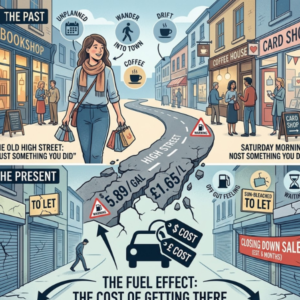
There was a time when going to the high street wasn’t really a decision. It was just something you did. Saturday morning, you’d wander into town, grab a coffee, pick up a birthday card you’d forgotten about, drift into a bookshop with no intention of buying anything, and somehow end up carrying a bag home anyway. It wasn’t planned. It didn’t need to be. It was just part of how life worked.
Walk through most town centres today — particularly anywhere outside a major city — and something feels off. You notice it in your gut before your brain catches up. Shutters that are down at noon. Storefronts with sun-bleached “To Let” signs that have clearly been there for a year, maybe two. A “Closing Down Sale” banner on a shop that seems to have been closing down for the better part of six months. The street isn’t dead exactly, but it doesn’t feel alive either. It feels like it’s waiting for something. And somewhere in the back of your mind, you wonder if that something is ever coming back.
The easy explanation is online shopping. Amazon did it. The internet won. Physical retail lost. That story isn’t wrong, exactly, but it’s lazy — and it misses something that’s been sitting right in front of us the whole time, hiding in plain sight because it’s almost too obvious to notice.
The real problem isn’t that people have stopped wanting to shop. It’s that getting to the shops now costs something. And that cost, quietly and steadily, has changed everything.
Getting There Is the Part Nobody Talks About
When the conversation turns to rising costs, people think about food bills and rent and electricity. Those are the visible ones. What doesn’t come up nearly as much is the cost of movement — the simple, boring, unglamorous expense of physically getting yourself from one place to another .High Street
For a huge chunk of the population, especially anyone living outside a city with decent public transport, going to the high street means getting in a car. And getting in a car means spending money before you’ve even looked at a shop window. Fuel costs what it costs, and it hasn’t been cheap. Parking, in many towns, has gone from a minor nuisance to a genuinely significant expense. Add in the time — the drive, the hunt for a space, the walk — and a casual trip to the shops starts to look less casual with every passing year.
Here’s where it gets interesting. The thing people are calculating, consciously or not, isn’t the price of what they’re going to buy. It’s the total cost of the whole exercise. The item plus the journey. High Street The purchase plus the parking. The shirt or the book or the birthday present, weighed against the time it takes to go and get it.
A £15 book sounds like a perfectly reasonable thing to pop out for. High Street A £15 book plus £4 in fuel plus £3.50 parking, added to an hour of your Saturday afternoon — that’s a different calculation. Not impossible, not outrageous, but not nothing either. High Street And people are doing this maths now in a way they simply didn’t used to.
Shopping Has Turned Into a Spreadsheet
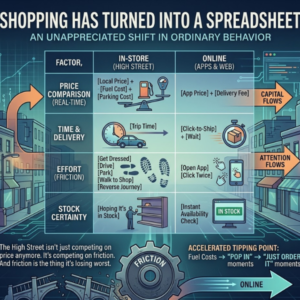
This is one of the genuinely underappreciated shifts in how ordinary people behave day to day. Shopping, which used to be a fairly emotional and spontaneous activity, has become something much more deliberate.
People are comparing, even when they don’t realise they’re doing it .High Street They’re thinking about the online price versus the in-store price. They’re thinking about how long delivery takes versus how long the trip takes. They’re thinking about the effort involved — opening an app and clicking twice, versus getting dressed, driving somewhere, finding a parking space, walking to the shop, hoping it has the thing in stock, and then doing the whole journey in reverse.
When you lay it out like that, the outcome starts to feel inevitable. The high street isn’t just competing on price anymore. It’s competing on friction. And friction is the thing it’s losing worst.
Because on pure convenience grounds, the high street was always going to struggle once people genuinely internalised how easy the alternative was .High Street The fuel costs didn’t create that problem, but they accelerated it. They pushed the tipping point closer. They turned a lot of “maybe I’ll pop in” moments into “I’ll just order it” moments. And once that habit forms, it’s very hard to undo.
The Slow Death of Wandering Around
This is the part that doesn’t get talked about enough, and it’s the part that I think matters most for understanding why so many small businesses are in genuine trouble.
There used to be a whole category of shopping behaviour that nobody had a name for because it was so natural and common that naming it would have felt strange. You’d go into town for one specific thing. You’d get it. And then, because you were already there, you’d just… walk around. You’d drift past a shop you’d never noticed before and go in out of curiosity. You’d buy something you hadn’t planned to buy — a candle, a print, a second-hand paperback — because it caught your eye and it wasn’t expensive and why not. You’d spend £40 in an afternoon and only one of those pounds was the thing you originally went for.
That behaviour is what kept a huge number of small, independent businesses going. High Street Not destination shoppers with lists. Wanderers. People who were already in the vicinity and had time and weren’t in a rush to get back to the car before the parking ran out.
That kind of shopping is quietly disappearing. And it’s not because people have fundamentally changed as human beings. It’s because the economics of getting to the high street have changed the psychology of being there. When fuel is expensive and parking is expensive and time feels scarce, you don’t wander. You execute. You go in with a list, you find the things on the list, and you leave. Every extra stop feels like an unnecessary cost. Every detour feels like a waste.
The businesses that suffer most from this are exactly the ones that could least afford to lose that foot traffic — the independents, the small shops, the places that survive on impulse purchases and people discovering them by accident. Take away the wandering and you take away a huge part of their reason for existing.
Convenience Has Reset Everyone’s Expectations
There’s something else going on underneath all of this, something that’s been building for well over a decade and is now so embedded in daily life that most people don’t even notice it anymore.
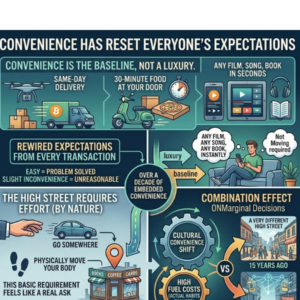
Convenience has quietly become the baseline. Not a luxury. Not a nice bonus. The baseline — the thing everything is measured against.
Same-day delivery. Food at your door in thirty minutes. Any film, any song, any book, available in seconds without moving from the sofa. These things have rewired what people expect from every transaction. When something is even slightly inconvenient — not difficult, not unreasonable, just slightly effortful — it now registers as a problem to be solved rather than a normal part of life.
The high street, by its nature, requires effort. You have to go somewhere. You have to physically move your body to a different location .High Street In a world where that’s no longer the norm, that basic requirement starts to feel like a real ask. Not for everyone, not all the time — but often enough that it tilts a lot of marginal decisions toward staying home.
Combine that cultural shift with fuel costs that have been high for long enough to change actual habits, and you end up with a very different high street from the one that existed fifteen years ago.
The Infrastructure Nobody Thought About
One of the things that rarely comes up in conversations about the high street is how much the whole thing depends on infrastructure decisions that were made decades ago and are very difficult to change.
Most British towns were designed around the assumption that people drive, that cars are the primary way people get around, and that fuel is cheap enough that the cost of driving doesn’t really factor into everyday decisions .High Street Those assumptions held up fine for a long time. They don’t hold up as well now.
In towns where public transport is genuinely poor, where cycling isn’t realistic because the roads are dangerous or the distances are too great, where there’s no real option other than driving — in those places, the high street is completely at the mercy of petrol prices. When fuel goes up, footfall goes down. It’s that direct .High Street Not in a diffuse, long-term, gradual kind of way. In a visible, immediate, you-can-see-it-happening kind of way.
Compare that with towns that invested in walkable layouts, mixed-use development, decent bus networks, or town centres that people actually live close enough to reach on foot. In those places, the high street still functions more like the old model. It’s woven into daily life rather than being a separate destination requiring its own cost-benefit analysis.
The difference between those two types of towns is enormous, and a lot of it has nothing to do with the quality of the shops. It’s about how easy it is to be there in the first place.
What Actually Survives
The high street isn’t going to disappear entirely. But the version of it that survives is going to look pretty different from what most people picture when they feel nostalgic about the shops.
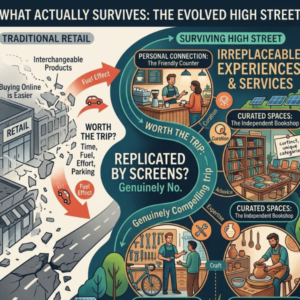
Retail in the traditional sense — you go in, you look at things, you buy one, you leave — is going to keep shrinking in physical spaces. Not because people don’t want things, but because for a huge range of products, buying it online is simply easier and often cheaper, and the reasons to make a special trip are harder to justify.
What survives will be the things that genuinely can’t be replicated by a screen and a delivery van. The coffee shop where you know the person behind the counter. The independent bookshop that feels like it was curated by someone with actual taste. The place that does repairs, or gives advice, or makes something in front of you. The spaces that feel personal and irreplaceable rather than interchangeable with a product page.
But here’s the thing — even those places, the ones with something genuinely special to offer, are only going to survive if people can get to them without it feeling like a whole thing. The experience has to be worth the trip. Not just worth it in the abstract, but worth it in the very specific, practical sense of being worth the fuel, the parking, the time, the effort .High Street
That’s where the Fuel Effect keeps coming back around. It’s not just about the economics of driving. It’s about the mental calculation people make every time they consider going somewhere versus staying home. Right now, staying home keeps winning that calculation more often than it used to. Until that changes — through lower costs, better infrastructure, or high streets that offer something genuinely compelling enough to pull people off their sofas — the drift away from physical shopping is going to continue

Your Partner in Financial Growth
Helping you save and invest smarter since 2026. Our mission is to simplify finance for everyone.