
Bitcoin Just Dropped to $67,000. Here’s What I Actually Think Is Going On.
I want to start with something that might sound counterintuitive.
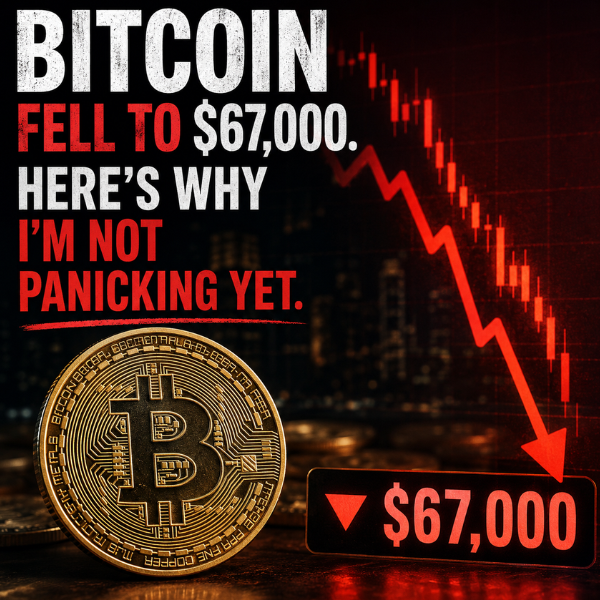
When Bitcoin dropped to $67,000 my first reaction wasn’t panic. It wasn’t excitement about a buying opportunity either. It was something closer to recognition. Like watching a pattern you’ve seen enough times that it stops surprising you even when it still hurts a little.
I’ve been paying attention to Bitcoin long enough to remember when $67,000 would have seemed like an almost incomprehensible number. I remember when people were arguing passionately about whether Bitcoin would ever reach $10,000 and whether that milestone would be real or just another bubble peak before a catastrophic collapse. The people saying it would collapse weren’t stupid. The people saying it would keep going weren’t stupid either. The truth is that nobody really knew and most of the confident predictions from both sides aged badly.
So when the price dropped back to $67,000 and my phone started buzzing with notifications and group chats started filling up with people asking what was happening and whether they should sell — I took a breath and tried to think about it clearly instead of reactively.
Here’s what I actually think is going on.
First — This Is What Bitcoin Does
I know this sounds dismissive but I want to say it plainly before anything else because I think people who are newer to this asset class genuinely don’t have the pattern recognition yet.
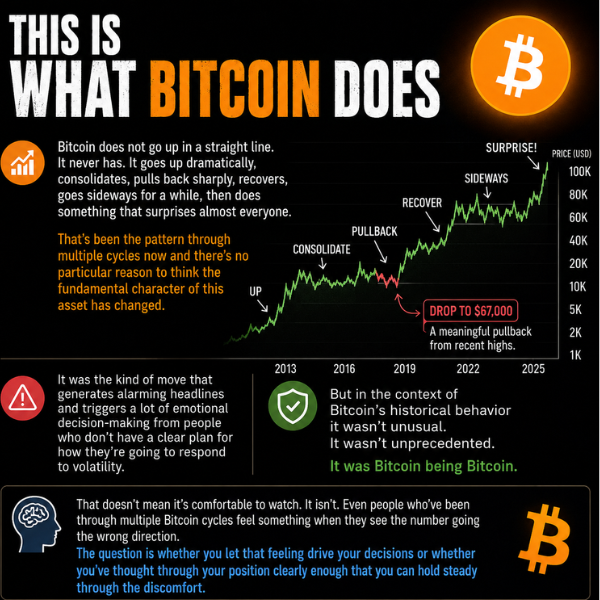
Bitcoin does not go up in a straight line. It never has. It goes up dramatically, consolidates, pulls back sharply, recovers, goes sideways for a while, then does something that surprises almost everyone. That’s been the pattern through multiple cycles now and there’s no particular reason to think the fundamental character of this asset has changed.
The drop to $67,000 represented a meaningful pullback from recent highs. It was the kind of move that generates alarming headlines and triggers a lot of emotional decision-making from people who don’t have a clear plan for how they’re going to respond to volatility. But in the context of Bitcoin’s historical behavior it wasn’t unusual. It wasn’t unprecedented. It was Bitcoin being Bitcoin.
That doesn’t mean it’s comfortable to watch. It isn’t. Even people who’ve been through multiple Bitcoin cycles feel something when they see the number going the wrong direction. The question is whether you let that feeling drive your decisions or whether you’ve thought through your position clearly enough that you can hold steady through the discomfort.
What Actually Caused This Drop
There’s always a temptation to point to a single cause when an asset price moves sharply. It makes the story cleaner and more satisfying. But markets are messier than that and I want to be honest about the multiple threads that seem to have contributed to this particular move.
The MicroStrategy story got a lot of attention and I think it’s worth addressing carefully because I’ve seen it misunderstood in both directions.
MicroStrategy has been one of the most significant corporate Bitcoin holders for years. Their strategy of continuously accumulating Bitcoin and holding it on the balance sheet has been controversial — critics have called it reckless, supporters have called it visionary — and either way it made the company’s fortunes intensely tied to Bitcoin’s price movements. When MicroStrategy sells Bitcoin, even a relatively small portion, it generates significant market attention.
Here’s what I think matters about that development. The actual impact on supply and demand from the specific sale is probably not the main mechanism. MicroStrategy selling some Bitcoin doesn’t create a shortage of buyers in a market that trades billions of dollars of volume daily. What it does is affect how people feel. It shifts the narrative. A company that became famous for never selling suddenly sells. People who were using MicroStrategy’s commitment as a signal of institutional conviction start asking whether that conviction has wavered. And when enough people ask that question simultaneously, some of them start acting on the uncertainty by reducing their own exposure.
That’s how markets actually work. Not through pure supply and demand mechanics but through the interpretation of signals and the emotional responses those interpretations generate.
The Macro Environment Sitting Underneath Everything
Here’s something that I think gets missed in a lot of Bitcoin analysis that treats it as if it exists in its own separate universe disconnected from the broader financial world.
It doesn’t. It increasingly doesn’t.
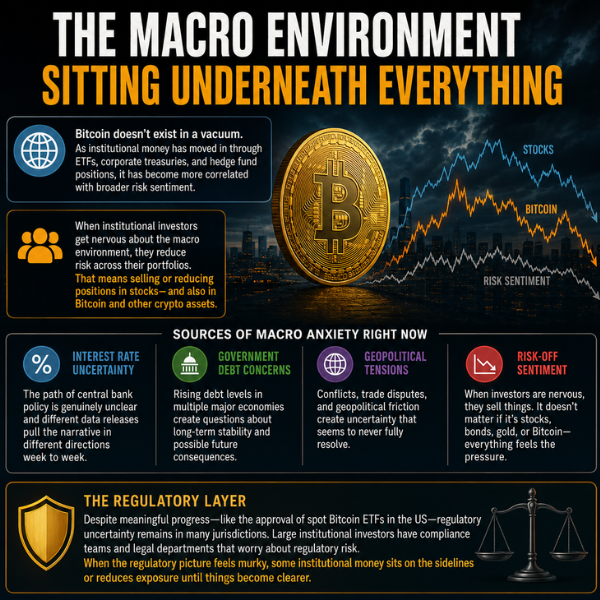
As institutional money has moved into Bitcoin — and it has moved in significantly, through ETFs and corporate treasury allocations and hedge fund positions — the asset has become more correlated with broader risk sentiment than it was in its early years. When institutional investors get nervous about the macro environment they reduce risk across their portfolios. That means selling or reducing positions in stocks and also in Bitcoin and other crypto assets.
Right now the macro environment has several genuine sources of anxiety. Interest rate uncertainty is real — the path of central bank policy is genuinely unclear and different data releases pull the narrative in different directions week to week. There are concerns about government debt levels in multiple major economies. Geopolitical tensions that seem to never fully resolve. These things don’t directly affect Bitcoin’s underlying technology or its fixed supply schedule. But they affect how nervous investors feel and nervous investors sell things.
The regulatory picture adds another layer of anxiety specifically for Bitcoin. Despite meaningful progress — the approval of spot Bitcoin ETFs in the US was genuinely significant — the regulatory environment for crypto assets remains uncertain in multiple jurisdictions. Large institutional investors have compliance departments and legal teams that are paid to worry about regulatory risk. When the regulatory picture feels murky some of that institutional money sits on the sidelines or reduces exposure until things become clearer.
The Psychology That Amplifies Everything
I want to spend some time on market psychology because I think it’s underweighted in most discussions about why prices move and it’s absolutely central to understanding short-term Bitcoin price action.
Human beings don’t respond linearly to information. We respond to information filtered through our existing emotional state, our recent experiences, our social environment and our expectations. In a market context this means that the same piece of news can produce dramatically different reactions depending on the mood of the market at the time it arrives.
When sentiment is broadly positive and prices have been rising, moderately bad news gets minimized. Investors focus on the positive interpretation, explain away the concerning elements, and prices continue higher. When sentiment is fragile or turning negative, moderately bad news gets amplified. People find confirmation of their fears everywhere. Social media fills with alarming takes. Stop-loss orders get triggered which causes further price drops which trigger more stop-loss orders which causes further drops.
That self-reinforcing dynamic is what makes drops feel so much faster and more violent than rallies. Rallies tend to be slower and steadier because buying decisions are usually more deliberate. Selling decisions — especially fear-driven selling — can happen almost instantly, particularly in a market that trades twenty-four hours a day seven days a week with no circuit breakers.
What happened in the days around the drop to $67,000 had some of that character. Not a catastrophic collapse driven by fundamental change. A sentiment shift that fed on itself for a period, amplified by social media commentary and automated selling triggers, before the natural buyers who had been waiting for a pullback started absorbing the supply.
Looking Back at April — Because It’s Actually Useful
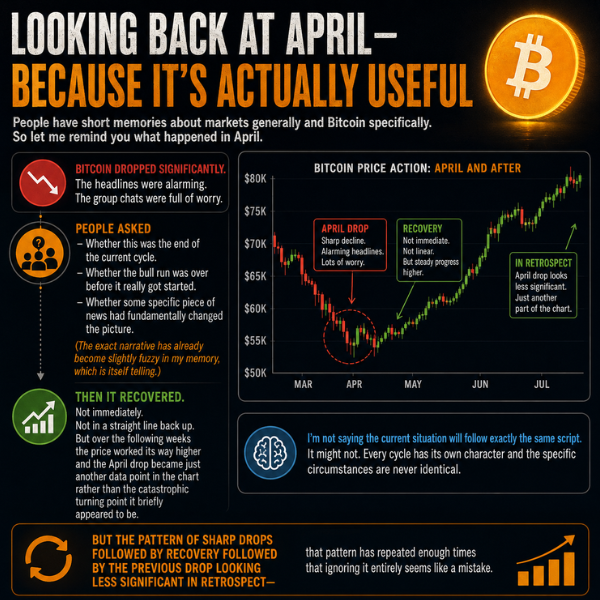
People have short memories about markets generally and Bitcoin specifically. So let me remind you what happened in April.
Bitcoin dropped significantly. The headlines were alarming. The group chats were full of worry. People asked whether this was the end of the current cycle. Whether the bull run was over before it really got started. Whether some specific piece of news — the exact narrative has already become slightly fuzzy in my memory, which is itself telling — had fundamentally changed the picture.
Then it recovered. Not immediately. Not in a straight line back up. But over the following weeks the price worked its way higher and the April drop became just another data point in the chart rather than the catastrophic turning point it briefly appeared to be.
I’m not saying the current situation will follow exactly the same script. It might not. Every cycle has its own character and the specific circumstances are never identical. But the pattern of sharp drops followed by recovery followed by the previous drop looking less significant in retrospect — that pattern has repeated enough times that ignoring it entirely seems like a mistake.
What Experienced Investors Are Actually Looking At
Let me tell you what I think the genuinely useful questions are right now because I think they’re different from the questions most people are asking.
Is on-chain activity holding up? Are people actually using the Bitcoin network, moving coins, engaging with the ecosystem? Or is the network quiet in a way that suggests broader disengagement? Network activity is a better signal of underlying health than short-term price movements.
What is institutional positioning doing? Are the Bitcoin ETFs seeing significant outflows — real money leaving — or is the price movement happening on relatively low volume with ETF positions mostly stable? Sustained ETF outflows would be more concerning than price volatility in isolation.
What’s happening with the long-term holder cohort? The people who have held Bitcoin through multiple cycles, who bought at various lower price levels and have significant unrealized gains — are they selling into this weakness? Or are they holding and in some cases adding? Long-term holder behavior is usually a better signal than the actions of recent buyers who have less conviction and lower pain thresholds.
These questions don’t make for dramatic headlines. But they’re the ones that actually matter for thinking clearly about where Bitcoin goes from here.
What I’d Tell Someone Who Is Freaking Out Right Now
If you bought Bitcoin recently and you’re watching the price and feeling genuinely anxious about it, here’s the most honest thing I can tell you.
If you don’t have a plan for how you’re going to respond to a thirty or forty or fifty percent drawdown — and Bitcoin drawdowns of that magnitude have happened multiple times and will probably happen again — then the current situation is telling you something important about your position sizing. The discomfort you’re feeling right now at a relatively modest pullback is information about whether you have more exposure to this asset than your actual risk tolerance can handle.
That’s not a criticism. It’s genuinely useful information. Better to discover it now than at a much lower price.
If you bought with money you can genuinely afford to have sitting there through a long period of volatility, if you believe in the underlying case for Bitcoin over a multi-year horizon, and if you had some expectation that pullbacks like this would happen — then the honest answer is that nothing fundamental has changed and the question is simply whether you can hold your position with the equanimity you probably told yourself you’d have when you bought.
Easier said than done. I know. But it’s still the right answer.
The Honest Bottom Line
Bitcoin dropped to $67,000. Multiple factors contributed — MicroStrategy’s sale shifting sentiment, macro anxiety reducing institutional risk appetite, regulatory uncertainty keeping some money on the sidelines, and the self-amplifying psychology of a sentiment shift in a market that never closes.
None of those things have fundamentally changed what Bitcoin is or why people believe in it as an asset over a long time horizon. The fixed supply is still fixed. The network is still running. The institutional infrastructure that’s been built around it — the ETFs, the custody solutions, the regulatory frameworks developing in multiple jurisdictions — hasn’t gone anywhere.
Whether this specific level turns out to be a buying opportunity or the beginning of a deeper correction is something that nobody can tell you honestly right now. Anyone who claims they know with confidence is either lying or fooling themselves.
What I do know is that markets reward people who think clearly under pressure and punish people who make fear-driven decisions and then have to watch the asset they sold recover without them. Bitcoin has administered that lesson to a lot of people over its history.

Your Partner in Financial Growth
Helping you save and invest smarter since 2026. Our mission is to simplify finance for everyone.