
Beginner Investing Guide: What I Wish Someone Had Told Me First
I lost $340 in my first week of investing.
Not because the market crashed. Not because of some unpredictable global event that nobody could have seen coming. I lost it because I was twenty-three years old, had just gotten my first real paycheck, convinced myself I knew what I was doing after watching YouTube videos for two weekends, and made three separate mistakes that anyone with actual experience would have caught immediately.
I didn’t tell anyone for about three months. Not my parents, not my friends, not the coworker who had casually mentioned he was “into stocks” and whose opinion I was terrified of for reasons I can’t fully explain now. I just quietly watched the number in my brokerage app and felt the particular kind of sick feeling that comes from losing money you worked hard for through decisions that were entirely your own.
Here’s the thing about that experience, though. It taught me more than any article I’d read or video I’d watched, and it set me on a path of actually learning how investing works rather than how people on the internet talk about investing — which turned out to be a very different thing.
This is the guide I wish I’d had before that first week. I’m going to be honest about the stuff that financial articles usually gloss over, the parts that sound obvious in hindsight but genuinely aren’t when you’re starting from zero.
First — Why You’re Actually Reading This
Let me guess. You have some money sitting in a bank account earning almost nothing. You’ve been vaguely aware for a while that you’re “supposed to invest” but every time you try to research it you end up in a spiral of terminology you don’t understand, conflicting advice from people who all sound confident, and a general feeling that maybe you should just come back to this later.
“Later” has been happening for a while now.
Or maybe you’re younger and you just got your first job and someone told you to “max out your 401k” and you nodded like you knew what that meant and then immediately went home and googled “what is a 401k.”
Either way — you’re in the right place, and I want to promise you something. Investing is not as complicated as the people who are good at it sometimes make it sound. There’s a reason for that: people who are good at something often forget what it felt like not to know it. I remember very clearly what it felt like not to know it, and I’ve been trying to write this guide with that memory front and center.
What Investing Actually Is — Before Anything Else
I want to start here because I think most beginner investing guides skip it and I think skipping it causes a lot of the confusion that follows.
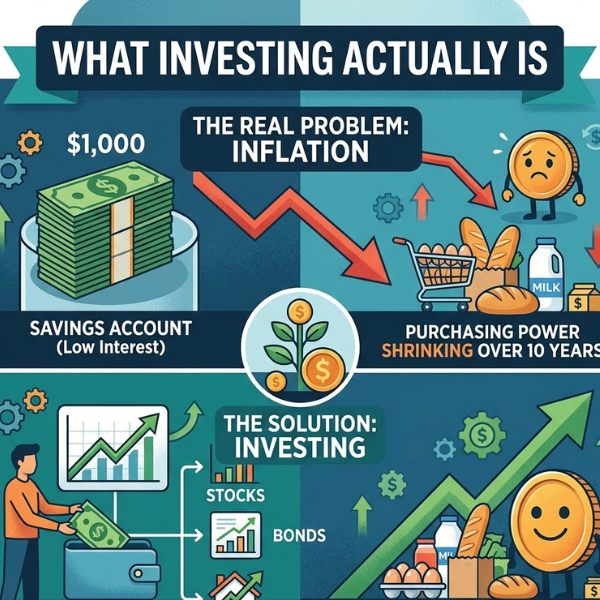
Investing, at its simplest, is putting your money to work so it grows over time instead of sitting still and slowly losing value to inflation.
That last part — the “slowly losing value to inflation” piece — is the part that doesn’t get explained enough. Money sitting in a regular savings account isn’t just not growing. It’s effectively shrinking, slowly, because inflation means that the same dollar buys a little less every year. $1,000 sitting in a low-interest savings account for ten years might still be $1,000 — or $1,020 with a tiny bit of interest — but it’ll buy what $820 bought you a decade ago. You kept the number the same and lost real purchasing power.
Investing is how you fight that. By putting money into things that have the potential to grow faster than inflation — stocks, bonds, real estate, various combinations of these — you give your money a chance to not just maintain its value but actually increase it over time.
That’s it. That’s the whole idea. Everything else is details about how to do it well.
The Thing That Would Have Saved Me $340
I promised I’d tell you what mistakes I made and I’m going to keep that promise, not because it’s comfortable to admit but because I genuinely think it’s more useful than the sanitized version most guides offer.
Mistake one: I tried to pick individual stocks.
I watched some videos, found a company I liked, decided it was “undervalued” based on approximately no real analysis, and bought a meaningful chunk of my initial investment in a single stock. The stock went down. Then it went down more. I held it, convinced it would recover. It went down a little more, I panicked and sold, and then — of course — it recovered two weeks after I sold it.
The lesson I should have learned earlier is that picking individual stocks is genuinely hard. Not “takes a bit of practice” hard. Like, “professional fund managers with decades of experience and entire teams of analysts mostly fail to beat the market consistently over time” hard. Me, with my two weekends of YouTube and my twenty-three-year-old confidence, was not going to crack the code they couldn’t.
Mistake two: I confused “familiar with a company” with “understanding a company as an investment.”
The stock I bought was a company I liked. I used their products. I thought they were great. I believed in them as a consumer. None of that has anything to do with whether the stock is a good investment. A great company can be a terrible stock if it’s already priced for perfection. A mediocre company can be a great stock if it’s deeply undervalued. These are completely different questions, and I hadn’t thought about the difference at all.
Mistake three: I didn’t have a plan.
I didn’t know what I would do if the stock went down. I didn’t know how long I was planning to hold. I didn’t know what would make me decide to sell. I just bought it and stared at it every day waiting for it to go up. That’s not investing. That’s gambling with extra steps and a brokerage account.
Okay, So What Should a Beginner Actually Do?
Here’s where I’m going to give you the boring answer that actually works, and I’m going to ask you to trust me on this even though it’s less exciting than everything you’ve probably been reading elsewhere.
Start with index funds.
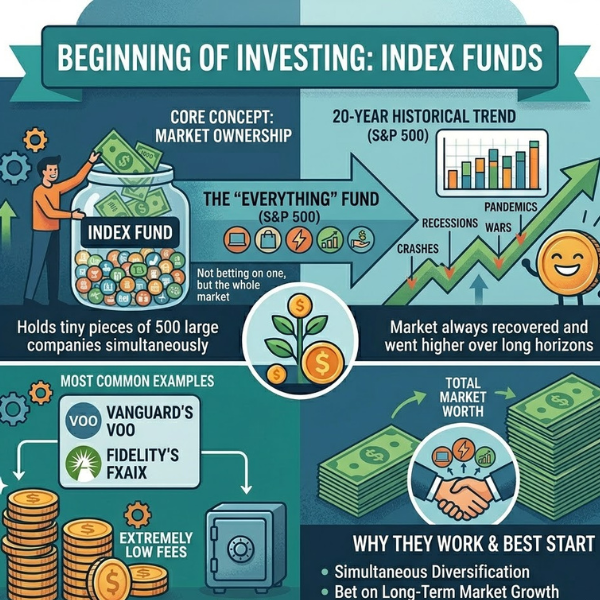
An index fund is a fund that holds a little bit of everything in a particular market — say, a fund that tracks the S&P 500 holds tiny pieces of 500 of the largest American companies simultaneously. When you buy a share of an S&P 500 index fund, you’re not betting on any individual company doing well. You’re betting that American businesses, in aggregate, will be worth more in ten or twenty years than they are today.
That bet has won every single time it’s been made over any twenty-year period in American stock market history. Every single time. There have been crashes. There have been recessions. There have been wars and pandemics and financial crises that felt, in the moment, like they might genuinely be the end of everything. And every time, over a long enough horizon, the market recovered and went higher.
I’m not promising it’ll keep working forever. But if you’re looking for a starting point as a beginner investor, “own a small piece of a huge number of companies rather than betting everything on picking the right one” is a dramatically better starting point than what I did.
The two most commonly recommended index funds for beginners are ones that track the S&P 500 — Vanguard’s VOO and Fidelity’s FXAIX are the ones you’ll hear most often. Both have extremely low fees, which matters more than most people realize.
The Fee Thing That Nobody Explains Well Enough
Speaking of fees — I want to spend a minute on this because it’s one of those things that sounds boring and technical and turns out to matter enormously over time.
Every investment fund charges what’s called an expense ratio — a small percentage of your investment that gets taken out annually to cover the fund’s operating costs. A fund with an expense ratio of 0.03% is taking thirty cents for every thousand dollars you have invested. A fund with an expense ratio of 1% is taking ten dollars for every thousand.
That difference — thirty cents versus ten dollars — sounds trivial. Over thirty years of investing, with compounding doing its thing, it becomes genuinely significant. Academic research on this is pretty clear: lower fees are one of the most reliable predictors of better investment outcomes over time, because fees are one of the few things you can actually control. You can’t control what the market does. You can control how much you’re paying someone to manage your money.
This is a big part of why index funds tend to outperform actively managed funds over long periods. They’re not smarter — they’re cheaper. And cheaper compounds into dramatically better returns over decades.
The Part Where I Talk About Time
If there’s one thing I could go back and tell twenty-three-year-old me — the one who had just made three investing mistakes and was too embarrassed to tell anyone — it would be this.
You have time. The most powerful force in investing isn’t picking the right stock or timing the market or finding some secret strategy that the professionals don’t know about. It’s just time. Starting earlier and staying consistent beats almost every other strategy, almost every time.
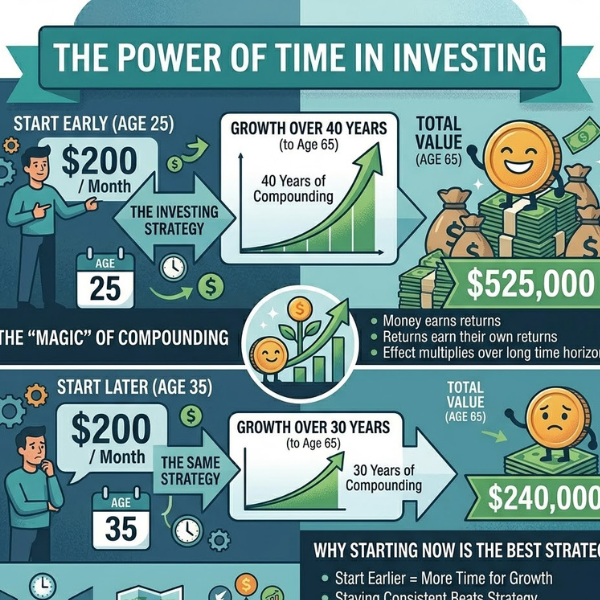
Here’s a number that I want you to actually sit with rather than skim past. If you invest $200 a month starting at twenty-five, and the market returns an average of seven percent annually — which is lower than the historical average — you’ll have roughly $525,000 by the time you’re sixty-five. Four hundred and forty dollars in total contributions. Half a million at the end.
If you wait until thirty-five to start the same $200 monthly habit, you’ll have roughly $240,000 at sixty-five. Same contributions. Same return. Just ten years later.
The difference between those two outcomes — $525,000 versus $240,000 — is entirely explained by ten years of time and compounding. Not skill. Not picking better stocks. Not some strategy you found online. Just starting a decade earlier and letting math do its thing.
I think about this number more than I probably should. Not because it makes me feel good about my own timeline — I didn’t start at twenty-five, and neither do most people — but because it’s the clearest illustration I know of why starting now, even if now isn’t perfect, is almost always better than waiting for the perfect moment.
What About When the Market Goes Down?
I need to address this directly because I think it’s the thing that stops more beginners than anything else, including the complexity.
The market goes down. Sometimes a lot. In 2020 the S&P 500 dropped about 34% in roughly a month. In 2022 it dropped about 25% over the course of a year. These are not comfortable experiences even when you know intellectually that the market has always recovered.
When the market goes down, your instinct — and mine, still, after all the years of knowing better — is to sell. To stop the bleeding. To get out before it gets worse. This instinct is wrong, almost universally, for long-term investors. The people who sold in March 2020 at the bottom of the pandemic crash locked in devastating losses and then watched the market recover to new highs within a year without them.
The thing that helps me most, personally, when the market is falling is reminding myself that I’m not selling. I’m holding. And as long as I’m holding, a paper loss isn’t a real loss — it’s just a number that looks scary but doesn’t actually affect me until the moment I decide to sell.
The people who got rich from index fund investing over the past thirty years mostly didn’t get rich by being smart about when to buy and sell. They got rich by buying and not selling, through crashes and panics and news cycles that made it feel insane to hold on. That’s the whole strategy. It’s boring. It works.
How to Actually Start — Practically
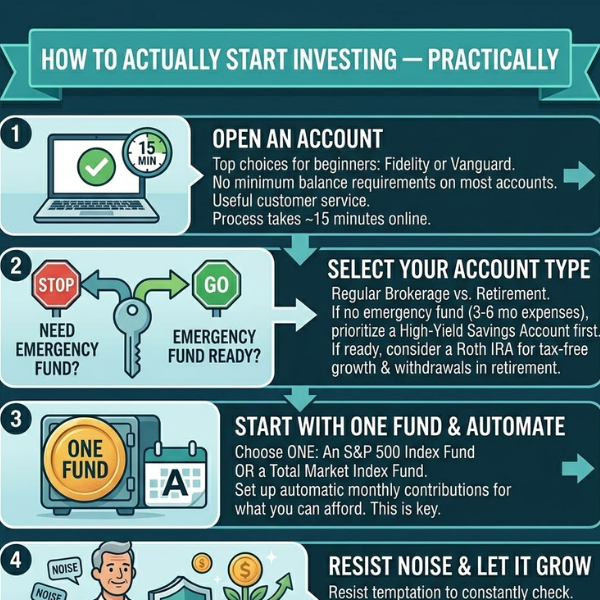
I want to give you the actual steps because I think this is where a lot of beginner guides fall short. They explain concepts but leave you staring at a brokerage account opening screen not knowing what to do.
Open an account. For most beginners Fidelity or Vanguard are solid choices. Both have no minimum balance requirements on most accounts, both have excellent index funds with low fees, and both have customer service that’s actually useful when you’re confused. The account opening process takes maybe fifteen minutes online.
Decide between a regular brokerage account and a retirement account. If you don’t have an emergency fund of three to six months of expenses yet — do that first, in a high-yield savings account. If you do have one, consider whether a Roth IRA makes sense for you. A Roth IRA lets you invest money you’ve already paid taxes on, and then your growth and withdrawals in retirement are completely tax-free. It’s one of the best deals in personal finance for people early in their careers.
Start with one fund. Not five. Not ten. One. An S&P 500 index fund or a total market index fund. Buy it. Set up an automatic monthly contribution for whatever amount you can consistently afford. And then mostly leave it alone.
Ignore most of the noise. Once you have money invested, the temptation to constantly check it and react to news and try to optimize is going to be real. Resist it. The research is pretty clear that the more active people are with their investments, the worse their outcomes tend to be. The best investors I know check their portfolios occasionally, adjust maybe once a year if their situation has changed meaningfully, and otherwise just let compounding do its thing.
The Honest Part Nobody Puts in These Guides
I want to end with something real that most investing guides don’t say.
There’s going to be a moment — probably multiple moments — where investing feels genuinely scary. Where the number in your account goes down and the news is talking about recession and your gut is screaming at you to just take what’s left and put it somewhere safe.
Those moments are the real test. Not of your investment strategy, which if you followed what I’ve laid out here is probably fine. Of your psychology. Of whether you can sit with discomfort and uncertainty without making decisions you’ll regret later.
I haven’t always passed that test. I panic-sold during one downturn early in my investing life and watched the recovery happen without me. It’s a specific kind of painful that I don’t want you to experience if I can help you avoid it by being honest about it upfront.
The strategy is simple. The psychology is hard. And the gap between knowing what to do and actually being able to do it when things feel scary is where most people’s investing stories go wrong — not at the “opening an account” stage, but at the “holding through the crash” stage.
You’re going to be okay. The market has been okay every single time, eventually, over a long enough window. Start. Be patient. Ignore the noise. And maybe, if you’re twenty-three and you just watched your first investment go wrong, give yourself a break — and then use what you learned to make the next decision better.

Your Partner in Financial Growth
Helping you save and invest smarter since 2026. Our mission is to simplify finance for everyone.