
Alphabet Is Betting Big on Infrastructure. Here’s Why That Actually Matters
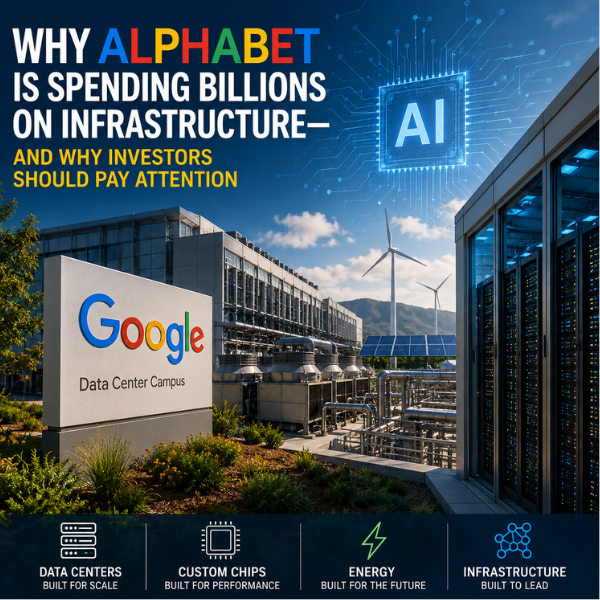
There’s a version of this story that gets told in press releases and earnings calls, and then there’s the version that actually makes sense when you step back and look at what’s happening in the technology industry right now.
The press release version is straightforward. Alphabet is spending an enormous amount of money on computing infrastructure — data centers, custom hardware, energy systems, networking equipment. The numbers are staggering. We’re talking about capital expenditure commitments that would have been unthinkable for any company a decade ago.
But the more interesting version of this story isn’t about the dollar amounts. It’s about what Alphabet is actually betting on, why the timing matters, and what it means for everyone who uses Google products, invests in technology stocks, or just pays attention to where the digital economy is heading.
Let me try to explain this the way I’d explain it to a smart friend who doesn’t follow technology stocks for a living.
The Infrastructure Arms Race Nobody Warned Us About

For most of the internet era the companies that won were the ones with the best software. The best algorithm. The best user interface. The most elegant product design. You could start a company in a garage, write brilliant code, and compete with established players because the barriers to entry were relatively low. The playing field wasn’t perfectly level but it was leveler than almost any other industry in history.
That’s changing. And it’s changing fast.
The next generation of technology products — the genuinely transformative ones, not just incremental improvements — require computing resources that are almost incomprehensibly large. Training a serious artificial intelligence model doesn’t just need good engineers. It needs thousands of specialized chips running continuously for weeks or months, consuming enough electricity to power a small city, generating enough heat to require industrial-scale cooling systems, connected by networking infrastructure that moves data faster than most people realize is physically possible.
You cannot build that in a garage. You cannot rent enough of it from someone else to build a competitive advantage. The companies that will define the next decade of technology are the ones building that infrastructure themselves, at scale, right now.
Alphabet understands this. And they’re acting on it in a way that I think deserves more attention than it’s getting.
What Alphabet Is Actually Building
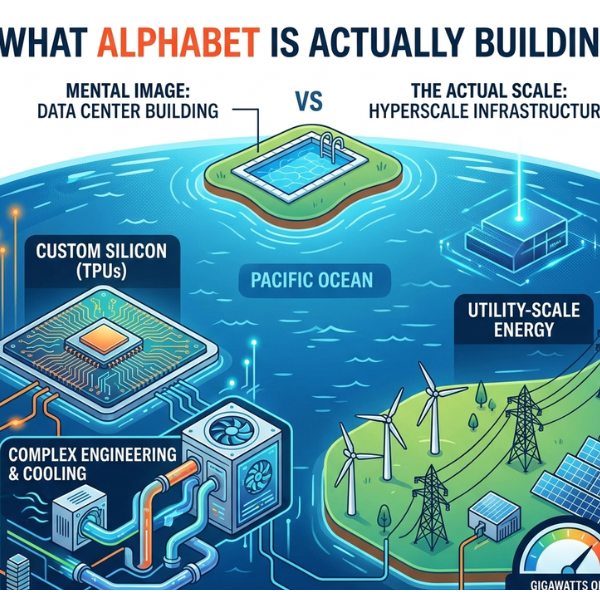
When people hear “data center investment” they tend to picture a big building full of servers. That mental image is accurate in the same way that picturing a swimming pool is accurate when someone describes the Pacific Ocean. Technically correct but missing the scale entirely.
Modern hyperscale data centers are among the most complex engineering projects humanity has ever attempted. The cooling systems alone involve technology that didn’t exist fifteen years ago. The custom silicon that Alphabet designs specifically for their workloads — chips like their Tensor Processing Units — represents years of specialized engineering work that gives them capabilities that off-the-shelf hardware simply cannot match.
And then there’s the energy question, which I think is genuinely the most underappreciated part of this story.
Running artificial intelligence workloads at the scale that Alphabet operates requires electricity in quantities that would have seemed absurd to discuss in the context of a technology company even five years ago. We’re talking about gigawatts of power consumption. That’s not a typo. Alphabet has been investing heavily in renewable energy projects not just because it looks good in an ESG report but because their energy needs are large enough that they need to think about power generation at a utility scale.
That’s a fundamentally different kind of company than the Google that once famously ran its servers on custom-built commodity hardware in an effort to keep costs low. The ambition has grown by an order of magnitude.
Why This Moment Specifically
I want to push back gently on the idea that this is just what big technology companies do — that it’s routine capital allocation that doesn’t deserve special attention.
The timing here is genuinely important. We are at an inflection point in artificial intelligence development where the gap between companies that have sufficient computing infrastructure and those that don’t is about to become very apparent in the products they can ship and the services they can offer.
Think about it from a practical standpoint. If you’re building an AI assistant that needs to respond to hundreds of millions of queries per day with a level of intelligence that actually helps people rather than just pattern-matching keywords, you need an enormous amount of inference computing capacity. The better your infrastructure, the better your product can be. The faster you can process requests, the more useful the experience feels to real users.
Alphabet’s competitors understand this too. Microsoft has been making aggressive infrastructure investments driven partly by their relationship with OpenAI. Amazon has been building out AWS capacity for AI workloads at a pace that has surprised even optimistic observers. Meta has been transparent about its own massive capital expenditure plans.
This isn’t one company making an unusual bet. This is every serious player in the industry recognizing at roughly the same moment that the physical infrastructure layer is now a genuine competitive battleground. Alphabet’s investment is notable not because it’s surprising but because of the scale and the specific areas they’re prioritizing.
The Part That Investors Are Debating
I’d be doing you a disservice if I presented this as an unambiguous positive story with no legitimate concerns. There are real questions worth thinking about and I want to address them honestly.
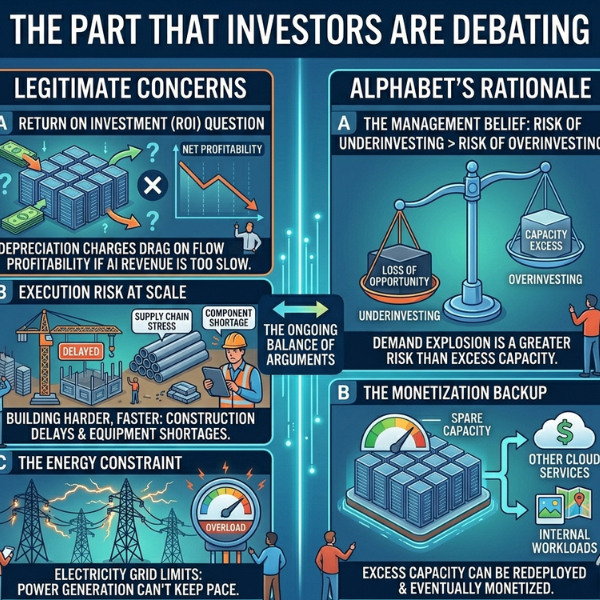
The first is the return on investment question. Spending this much on infrastructure only makes sense if the revenue it enables justifies the cost. Capital expenditure of this magnitude creates significant depreciation charges that flow through the income statement for years. If the AI products and services built on top of this infrastructure don’t generate revenue at the scale needed to justify the spending, it will show up as a drag on profitability for a long time.
Alphabet’s management has been clear that they believe the risk of underinvesting is greater than the risk of overinvesting. They’ve essentially said that if they spend too much and demand doesn’t materialize as expected, they’ll have excess capacity that they can eventually monetize in other ways. But if they underspend and demand explodes, they won’t be able to catch up because you can’t build a data center overnight.
That’s a reasonable argument. It’s also the kind of argument that can be used to justify almost any amount of spending, which is why some investors are watching the efficiency metrics very carefully.
The second concern is execution risk. Building data centers at this scale and pace is genuinely hard. Construction projects get delayed. Specialized equipment has long lead times. Supply chains for the components needed in hyperscale facilities have been stressed. Alphabet has more experience with this than almost any organization on the planet, but experience doesn’t make you immune to these challenges.
The third concern, which I find the most intellectually interesting, is the energy constraint. There are real physical limits to how fast you can build power generation and transmission infrastructure. The electricity grid in many parts of the world simply wasn’t designed to support the load that large-scale AI computing demands. Alphabet has been creative in addressing this — long-term power purchase agreements, investments in new energy projects, work on more efficient chip designs. But this is a genuine constraint that could slow things down regardless of how much money they’re willing to spend.
What This Means for Regular People
Let me bring this back to earth for a moment because I think the infrastructure conversation can get abstract in a way that loses sight of why it actually matters.
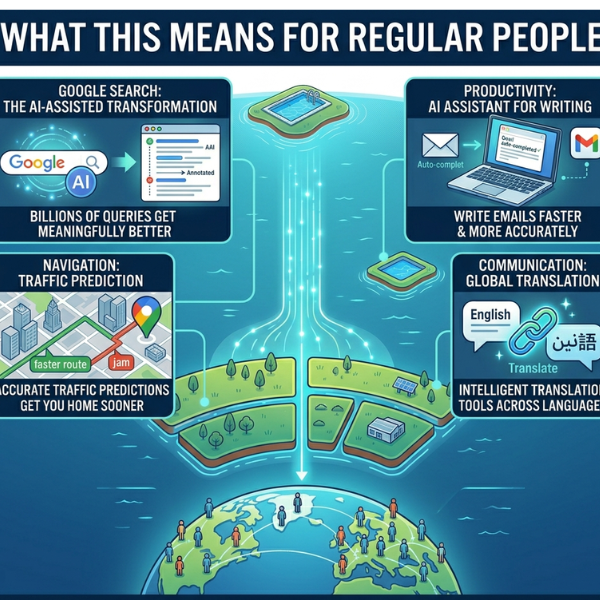
Every Google product you use is going to be meaningfully better or worse depending on whether Alphabet gets this infrastructure buildout right. Google Search, which still processes billions of queries every day, is in the middle of a fundamental transformation toward AI-assisted answers. Google Maps, Gmail, Google Photos, YouTube — all of these products have AI capabilities being layered in that require serious computing resources to run well at global scale.
The quality of the AI assistant that helps you write an email, the accuracy of the traffic prediction that gets you home faster, the intelligence of the translation tool that lets you communicate across languages — all of it depends on the infrastructure being built right now.
This isn’t abstract technology investment. It’s the foundation of products that hundreds of millions of people rely on every single day.
What To Watch Going Forward
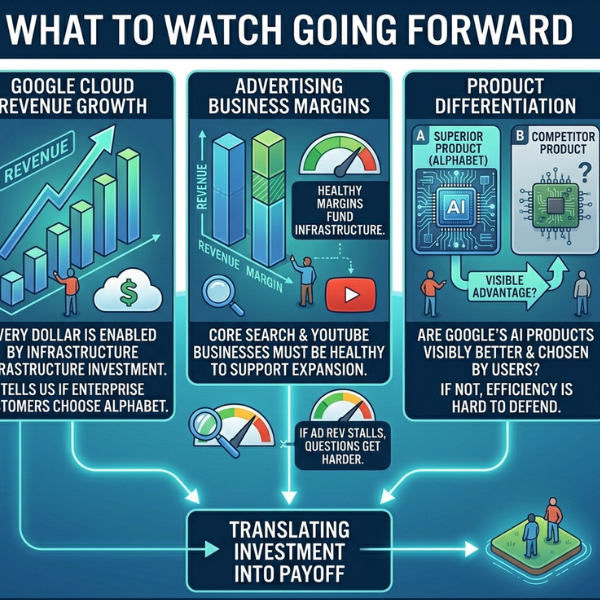
If you’re trying to evaluate whether Alphabet’s infrastructure bet is paying off, here are the things actually worth watching rather than the headline spending numbers.
Revenue growth in Google Cloud is the most direct signal. Every dollar of cloud revenue is enabled by the infrastructure investment and the trajectory of that business tells you whether enterprise customers are choosing Alphabet’s AI capabilities over competitors.
Margins in the advertising business matter because the core search and YouTube businesses need to fund this infrastructure expansion. If ad revenue stays healthy while infrastructure investment ramps, the math works. If ad revenue stalls while spending continues, the questions get harder.
Product differentiation is ultimately the payoff. Are Google’s AI products visibly better than alternatives in ways that users notice and choose? If the infrastructure investment is translating into genuinely superior products, the investment makes sense. If competitors are matching the product quality with less infrastructure spending, the efficiency argument becomes harder to defend.
The Honest Bottom Line
Alphabet is making one of the largest bets in corporate history on the idea that the physical infrastructure layer of artificial intelligence is going to be as important as the software layer. They’re not alone in making this bet but they are among the most committed.
Whether it pays off depends on factors that aren’t fully knowable today — the pace of AI adoption, the competitive dynamics with Microsoft and Amazon, the energy infrastructure buildout, and ultimately whether the products built on top of this foundation are good enough that people choose them over alternatives.
What I’m confident about is this: the companies that build this infrastructure well and early will have advantages that are genuinely difficult to close. The companies that underinvest will spend years trying to catch up against competitors who got the foundation right.
Alphabet is clearly in the first camp. The next few years will show whether the scale of the bet was right.

Your Partner in Financial Growth
Helping you save and invest smarter since 2026. Our mission is to simplify finance for everyone.