
Alibaba Stock in 2026 — Is It Actually Worth Your Money?
Let me be straight with you.
Alibaba has had a rough few years. And depending on who you ask, it is either one of the best buying opportunities sitting in front of investors right now, or a stock that looks cheap for very good reasons that are not going away anytime soon.
I am not going to sugarcoat either side. Both arguments have real weight behind them. What I want to do is walk you through what is actually happening with this company in 2026 — not the headlines, not the hype, not the panic — just a clear picture of where Alibaba stands and what you need to think about before putting your money into it.
First, Remember What Everyone Got Wrong About Alibaba
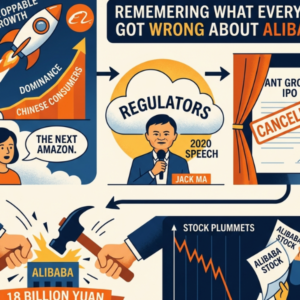
For a long time, people talked about Alibaba the same way they talked about Amazon in its early years. Unstoppable. Dominant. The kind of company that just keeps getting bigger no matter what. Chinese consumers were flooding online, Alibaba was the biggest platform by a mile, and the numbers kept going up quarter after quarter.
Then a few things happened that nobody saw coming — or at least, nobody wanted to admit they saw coming.
Jack Ma, the founder, gave a speech in late 2020 that effectively picked a fight with Chinese financial regulators. Within days, the record-breaking IPO of Ant Group — Alibaba’s financial affiliate — was pulled. Ma himself vanished from public view for months. The Chinese government launched an antitrust investigation into Alibaba and eventually handed down a fine of around eighteen billion yuan. That was the largest antitrust penalty in Chinese history at the time.
From that point on, the investment story changed completely. It was no longer just about growth. It became about survival, adaptation, and whether the Chinese government would let Alibaba operate as a genuinely independent private business or keep squeezing it.
That uncertainty hammered the stock. Investors who had bought in at the top were sitting on brutal losses. A lot of them sold. And honestly, given what they were looking at, you could not blame them.
So What Is Alibaba Actually Doing in 2026?
Here is where a lot of people get stuck — they are still thinking about Alibaba as a shopping website. That is an outdated picture.
Yes, Taobao and Tmall are still there. Hundreds of millions of people still shop on those platforms every single day. That part of the business has not disappeared. But it is no longer the exciting growth story. Chinese e-commerce has matured. Most people who are going to shop online in China are already doing it. The platforms still generate enormous amounts of cash — real, serious money — but the days of posting eye-watering growth figures from that segment alone are basically over.
Where Alibaba has been putting its energy — and its money — is cloud computing and artificial intelligence.
Alibaba Cloud is the biggest cloud provider in China. Not second biggest, not third — the biggest. And right now, with every company in every industry trying to figure out how to use AI in their operations, cloud infrastructure is where a lot of that spending flows. Companies that want to build AI tools, run AI models, or simply store and process the data that AI systems need — they need cloud providers. Alibaba is sitting right in the middle of that.
The company has also been pushing its own AI products hard. It has built large language models, integrated AI features across its platforms, and positioned Alibaba Cloud as the place for Chinese businesses to run their AI workloads. Whether this pays off the way the company is hoping is the big question. But the intention and the investment are clearly there.
On top of that, Alibaba has been expanding internationally for years. AliExpress serves buyers across Europe and the Middle East. Lazada operates across Southeast Asia. Trendyol is a serious player in Turkish e-commerce. None of these have turned into runaway profit generators yet, but they represent genuine businesses in markets outside China — which matters a lot when you are trying to reduce your dependence on any single economy.
The Part That Actually Makes the Stock Interesting
Here is what stops a lot of experienced investors from simply walking away from Alibaba despite all the noise around it.
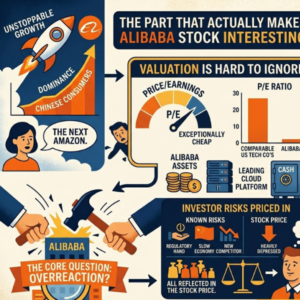
The valuation is genuinely hard to ignore.
Compare Alibaba to major US technology companies and the difference is stark. For a business of this size — one that processes billions of dollars in transactions, runs a leading cloud platform, and holds enormous cash reserves — the price you pay per share is much lower than what you would pay for a comparable Western company. By conventional valuation measures, Alibaba looks cheap. Not a little cheap. Noticeably cheap.
Now, there is an obvious reason for that. Investors are not idiots. They are pricing in a set of risks that are very real. Regulatory interference from the Chinese government. Tensions between the US and China. Slower economic growth in China than people expected. Competition from younger, faster-moving rivals.
All of that is reflected in the stock price. The question is whether it is reflected too heavily — whether the market has overdone the fear and is now pricing Alibaba as if the worst-case scenario is guaranteed, when in reality the company still has enormous assets and real growth potential.
That is the argument value investors make when they look at this stock. They are not saying the risks do not exist. They are saying the stock price already assumes those risks materialise in full, and at some point that becomes an overreaction.
Whether they are right is something nobody can tell you with certainty. But it is a serious argument, not a wishful one.
The Competition Problem Nobody Talks About Enough
One thing that does not get enough attention when people discuss Alibaba is how much harder its home market has become.
Pinduoduo came out of nowhere and built a massive user base by targeting price-sensitive shoppers with deep discounts and a group-buying model. It went from a scrappy startup to a genuine threat to Alibaba’s dominance in a surprisingly short time. Then Temu — Pinduoduo’s international arm — started eating into the global market for low-cost goods, going after customers that AliExpress had been serving.
At the same time, short video platforms — particularly Douyin, which is the Chinese version of TikTok — completely changed how a big chunk of Chinese consumers discover and buy products. Instead of searching for something on Taobao, people now watch a live-stream, see an influencer using something, and buy it instantly without leaving the app. That is a genuinely different shopping behaviour, and Alibaba was not the company that created it.
Alibaba has responded. It has built its own live-streaming commerce features and invested in content-driven shopping. But playing catch-up is always harder than being the one who defined the game in the first place. The core e-commerce business is still profitable and still huge, but staying at the top requires real spending — on subsidies, promotions, technology — that was not necessary when Alibaba had no serious competition.
The Risks You Need to Sit With
There is no version of a fair assessment of Alibaba that skips this part.
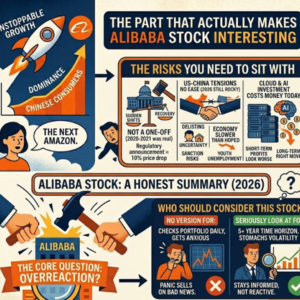
The government risk is real. What happened in 2020 and 2021 was not a one-off. The Chinese government has shown it is willing to step in and reshape how private technology companies operate, sometimes very suddenly and with significant financial consequences. That risk has not gone away. You have to be genuinely comfortable holding a stock where a regulatory announcement can drop the price ten percent in a day through no fault of the company’s actual operations.
US-China tensions are not easing. The relationship between the two countries has been rocky for years, and 2026 has not brought any dramatic thaw. For investors holding Chinese stocks listed on US exchanges, this creates a layer of uncertainty around things like continued listing rights, sanctions, and the general political mood toward Chinese investments. Some investors simply decide this is too much to deal with. That is a reasonable personal decision.
The economy in China has been slower than hoped. Chinese consumers have been more cautious with their spending than most economists predicted coming out of the pandemic years. Property market problems, youth unemployment, and general uncertainty have weighed on confidence. Alibaba cannot fix any of that from the inside. If Chinese consumers keep tightening their belts, it affects the business regardless of how well Alibaba executes its strategy.
Spending on cloud and AI costs money today. Alibaba has committed to spending billions building out data centres and AI infrastructure. This is almost certainly the right long-term move. But it means short-term profits look worse than they otherwise would, which frustrates investors who are focused on the next quarter or two rather than the next five years.
Who Should Actually Consider This Stock
Honestly, if you are the kind of person who checks their portfolio every day and gets anxious when a stock moves sharply on news outside the company’s control — Alibaba is probably going to drive you mad. This is a stock where external events, political announcements, and geopolitical headlines can move the price significantly, sometimes in ways that have nothing to do with how the underlying business is performing.
If you are someone who genuinely does not need this money for five or more years, who can stomach volatility without panic-selling at the worst possible moment, and who is willing to stay informed about what is actually happening with the company rather than reacting to every news cycle — then Alibaba is at least worth seriously looking at.
You are not buying a sure thing. Nobody is offering you one. What you are buying is a large, cash-generating, cloud-leading, AI-investing technology company at a price that looks undervalued relative to what similar companies cost in other markets. That gap either closes over time — in which case patient investors do very well — or the risks that caused the discount turn out to be worse than expected, and the gap stays or widens.
That is the honest summary.
Where This Leaves You
Alibaba in 2026 is a company that has been through real trouble and come out the other side still standing — still large, still profitable, still investing in the things that matter for the next decade of technology.
It is not the growth story it was in 2014. It is not the disaster story that some people made it out to be in 2022. It is something more complicated and more interesting than either of those — a mature tech business in a complicated market, making expensive bets on cloud and AI while defending a still-dominant but increasingly competitive home turf.
For investors who do their homework, understand what they are walking into, and have the patience to let the story develop — this is one of the more genuinely interesting situations out there right now.
For everyone else, there are simpler stocks with fewer headaches.
Neither answer is wrong. It just depends entirely on you.

Your Partner in Financial Growth
Helping you save and invest smarter since 2026. Our mission is to simplify finance for everyone.