
SpaceX IPO: A $1 Million Investment Is Now Worth $1.4 Million in One Week
I need to tell you about the phone call I got on Thursday morning.
My uncle — not a finance person, not someone who follows markets, someone who describes his investment strategy as “I put some money in something and then try not to think about it” — called me at 8:47am. I know the time because I looked at my phone and thought “why is he calling me at 8:47am on a Thursday.”
He’d gotten into the SpaceX IPO. A meaningful amount. Not a million dollars — he’s not that guy — but enough that when he read the headline about what a million dollar investment was worth now, he did the same math I’m about to do for you, and he called me because he needed to tell someone and I’m apparently the person he calls about money things.
He wasn’t celebrating exactly. He was in that specific dazed state that comes from watching a number in an account do something you didn’t fully believe was possible in the timeframe it happened. Like he needed someone to confirm the math was real and he wasn’t misreading something.
I confirmed the math. He was quiet for a second. Then he said “huh.” Just “huh.” And we stayed on the phone in silence for a moment that felt longer than it probably was.
That’s what $400,000 in unrealized gains in less than a week sounds like, apparently. It sounds like “huh” and then silence.
Let’s Actually Do the Math
Before anything else I want to walk through the numbers because I think seeing them laid out clearly does something that just reading the headline doesn’t.
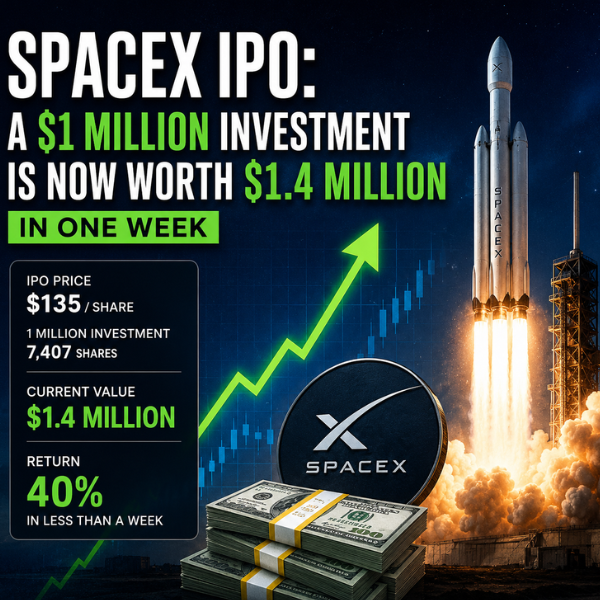
The SpaceX IPO priced at $135 per share. One million dollars at $135 per share gets you 7,407 shares. In less than a week that investment is now valued at approximately $1.4 million according to Investor’s Business Daily’s analysis of S&P Global Market Intelligence data.
That’s a 40% return. In less than a week.
Now let me do the math on smaller numbers because most of us — certainly me, certainly my uncle — don’t have a million dollars to drop into a single IPO.
$10,000 invested at $135 per share is about 74 shares. At current prices that’s roughly $14,000. A $4,000 gain in less than a week.
$5,000 invested — about 37 shares — is now worth approximately $7,000. $2,000 gain.
$1,000 invested — about 7 shares — is now worth roughly $1,400. Four hundred dollars in a week on a thousand dollar investment.
I did this math sitting at my kitchen table after my uncle’s call and I just kind of stared at it for a minute. Not because I’m surprised the math works out — the percentage is the percentage regardless of the starting amount — but because seeing it in smaller numbers makes it feel more real in a way the million dollar headline doesn’t. Most people don’t have a million dollars. Most people can imagine what they’d do with an extra $4,000 showing up in their account in a week.
The Feeling That’s Hard to Name

I want to try to describe something honestly because I think it captures what a moment like this actually feels like better than any financial analysis I could write.
When you watch an investment go up this fast — 40% in less than a week — there’s a specific emotional cocktail involved that I don’t think gets talked about enough. It’s not pure joy, though there’s definitely joy in it. It’s not just excitement, though there’s excitement too.
There’s also something that feels almost like vertigo
.
Because 40% in a week isn’t a normal thing. Normal investing is watching your account go up 7-10% over a full year. Normal investing is boring precisely because it’s supposed to be boring — slow, steady accumulation over time that you barely notice happening. When something moves this fast it doesn’t feel like investing. It feels like something else, and your brain isn’t entirely sure how to process it.
My uncle described it as feeling “unreal.” Not in the excited way. In the “I keep checking if I’m reading the number correctly” way. He said he’d looked at his account four times between when he first saw the number and when he called me, just to make sure it hadn’t changed back while he wasn’t looking.
That’s the psychology of watching an investment do something this extreme this fast. Your brain keeps waiting for the catch.
Who Actually Made Money Here
I want to be clear about something that I think gets glossed over in headlines like this one.
The people who made money on the SpaceX IPO in this first week are, primarily, people who got allocation at the IPO price of $135 per share. That group — which includes large institutional investors like BlackRock, as I wrote about previously, plus a smaller number of individual investors who got access through their brokerages — bought at $135 and are now sitting on 40% gains.
If you tried to buy SPCX after it started trading on the open market — which is what most regular investors had to do if they wanted in — you paid a price that already reflected the initial excitement. If you bought at the opening trade price, which was significantly above $135, your gains are smaller. If you bought after the first day’s close at $161, your gains through this week are more modest still.
This is an important distinction because I think the “$1 million is now $1.4 million” headline can create a misleading impression. It’s 40% gain math based on the IPO price. People who bought on the open market at higher prices have a different experience, and people who are thinking about buying now are buying into a completely different situation than the people this headline is describing.
I’m not saying this to dampen anyone’s excitement. I’m saying it because I think honest financial writing has to make this distinction clearly even when the headline doesn’t.
My Uncle’s Actual Decision

He called me again in the afternoon.
He’d been thinking all day, he said. He wanted my opinion on whether he should sell some, hold everything, or buy more.
I want to walk through what I told him because I think it’s actually useful beyond just his specific situation.
On selling some: I told him what I told my brother in last week’s piece — taking some profit after a gain this significant is not a sign of losing faith in the company. It’s a sign of being an adult about risk. Locking in a real, realized gain on a portion of your position while letting the rest ride is a strategy that removes some of the emotional volatility from the situation. You’ve banked something real. The rest can be thought of as “house money” to some extent.
On holding everything: If he genuinely believes in SpaceX’s long-term story — Starlink, the launch business, the broader vision — then holding makes sense for the portion he’s comfortable watching go up and down. But “comfortable watching go up and down” is doing a lot of work in that sentence. A position that’s up 40% can also go down 40%. Is he okay watching his gains disappear partially or entirely if the stock has a bad month? That’s the question he has to answer honestly.
On buying more: I told him I’d be careful here. Not because I’m bearish on SpaceX, but because buying more of something that’s just gone up 40% in a week means you’re now paying a very different price than the people sitting on those gains. You’re not getting the same deal they got. You’re buying into a stock that has a lot of excitement and a lot of optimism already baked into the price.
He listened to all of this. Then he said “so basically don’t do anything stupid.”
“Basically,” I said.
The Part I Keep Coming Back To
I’ve written three pieces about SpaceX now — the BlackRock order, the first day of trading, and now this. And in all three I’ve tried to do the same thing: be genuinely excited about what’s genuinely exciting while being honest about what’s genuinely uncertain.
The $1.4 million headline is genuinely exciting. A 40% gain in less than a week is extraordinary by any measure. The people who had conviction about this IPO and got in at the offering price have been dramatically rewarded in a very short time. That’s real and it deserves to be acknowledged without caveats for at least a paragraph.
But here’s the thing I keep coming back to, and it’s the same thing I said in my first piece and my second piece and I’ll keep saying it until the quarterly earnings reports start telling a different story: the business underneath the stock price still has to perform.
SpaceX is a company trying to do things that have never been done before. Orbital internet infrastructure at global scale. A reusable rocket program that keeps pushing what’s technically possible. Eventually, if the most ambitious visions pan out, the beginnings of a multi-planetary civilization. These are extraordinary ambitions and the people running the company have already demonstrated they can execute on things most experts said were impossible.
But ambition and execution on past milestones don’t guarantee future financial performance at the valuation the current stock price implies. A company can be genuinely remarkable and still be overvalued at a specific price. Whether SPCX at its current level is a good long-term investment depends on things that can only be known over years of actual business results, not days of trading excitement.
What $400,000 in a Week Actually Means

Let me end with something personal because I think it’s the most honest place to end.
When I was walking through the math for my uncle on Thursday morning — when I was confirming that yes, his gains were real, the number wasn’t a mistake, this had actually happened — I felt something that surprised me a little.
Not jealousy, exactly. More like a kind of quiet wonder at the specific combination of timing and circumstances that determines who ends up sitting on extraordinary gains. My uncle got into the SpaceX IPO because a friend mentioned it and he had some money he’d been meaning to do something with and the paperwork wasn’t too complicated. That’s it. That’s the whole story.
He didn’t have some proprietary insight into SpaceX’s prospects. He didn’t do months of research. He didn’t have a sophisticated investment thesis. He had a friend, some available cash, and the specific luck of being pointed in the right direction at the right moment.
And now he has $400,000 more than he had last week. On paper.
I keep thinking about all the people who had the same information, maybe even more conviction, but for whatever reason — timing, circumstances, access, cash available at the wrong moment — didn’t get in. And I think about how investing outcomes, even for smart, thoughtful, well-intentioned people, are partially the result of factors that have nothing to do with intelligence or effort.
This doesn’t mean you shouldn’t invest carefully or research thoroughly. It means you should hold your outcomes — both good and bad ones — with some humility about how much of them you actually controlled.
My uncle made $400,000 in a week. He’s very pleased about it and he should be. He’s also keeping two feet on the ground about what it means going forward, because he’s smarter than he sometimes lets on.

Your Partner in Financial Growth
Helping you save and invest smarter since 2026. Our mission is to simplify finance for everyone.