
SpaceX IPO Aftermath: What Happens to SPCX in Week 2

My brother finally sold.
Not all of it. Just a third of his position. He called me on a Tuesday evening, sounding a little sheepish, and said “okay, don’t say I told you so.
“
I hadn’t said anything yet. I didn’t get the chance.
A week ago I wrote about SPCX closing its first day at $161, up 19% from the IPO price, and how my brother’s screenshot with no caption said everything his words couldn’t. A week ago felt like a long time ago. A lot has happened since then, and I think it’s worth walking through it honestly — because the second week of a stock like this tells you things the first day simply can’t.
Where We Left Off
Quick recap for anyone just joining this story.
SpaceX went public. The debut was dramatic — a 19% close on day one, heavy volume, my finance friend Dev using the word “insane” without irony. My brother had a small allocation from the IPO and was, by his own admission, more emotionally invested in this stock than any rational person should be in any single position.
I ended that piece saying I didn’t know what to tell him when he texted “still holding.” A week later, I think I finally have something to tell him. It’s just not as simple as either of us wanted it to be.
What Actually Happened This Week
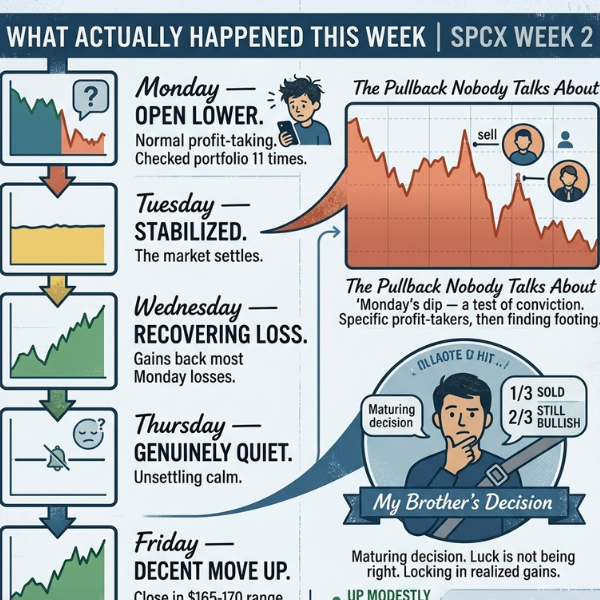
Let me walk through the week because the day-by-day texture matters here, and it’s genuinely different from what either of us expected.
Monday — the first full trading day after the debut — the stock opened lower. Not dramatically, but noticeably. It gave back maybe four or five percent from Friday’s close in the first hour. My brother texted me a single question mark. Just “?”
I told him this was normal. Some of the people who got IPO allocation were always going to take profits early, and a four or five percent pullback after a 19% pop isn’t exactly alarming. He said he knew that. He also said he checked his portfolio eleven times that morning. I believe him.
Tuesday it stabilized. Wednesday it actually moved up again, recovering most of Monday’s loss. Thursday was quiet — genuinely quiet, the kind of quiet that almost felt unsettling after the chaos of the previous days. And Friday it had another decent move up, closing the week somewhere in the $165-170 range depending on exactly when you checked.
So net for the week: up modestly from where it closed on day one, but with a lot more movement in between than that simple summary suggests. If you’d only checked the price on Friday and compared it to Friday of the week before, you’d think it was a calm week. It was not a calm week. It just ended up somewhere close to where it started, after a genuinely bumpy ride in the middle.
The Pullback Nobody Talks About
I want to focus on Monday’s dip for a minute because I think it’s actually the most instructive part of the whole week, even though it was the smallest move.
In my first piece I talked about how the strength of day one — the fact that the stock held its gains into the close rather than fading — suggested that a lot of the people holding shares weren’t planning to flip quickly. Monday’s pullback is the first real test of that idea, and I think it mostly held up, but not completely.
Some people clearly did sell into Monday’s weakness. The volume on Monday morning was elevated, and the price moved down meaningfully in a short window, which is consistent with some allocation holders deciding that a 19% first-day gain was good enough and they didn’t need to wait around to see what happened next.
But here’s the thing — it didn’t snowball. If everyone who got IPO allocation had been thinking “sell at the first opportunity,” Monday’s selling pressure should have kept building through the day and probably into Tuesday as well. It didn’t. The selling seemed to be concentrated in a relatively short window, and once it worked through, the stock found its footing and started recovering.
My read on this — and I want to be clear this is a read, not a fact — is that there was a specific group of holders who had decided in advance “I’m taking profits on day two regardless of price,” and once that group finished selling, the remaining holders were genuinely more patient. That’s a meaningfully different situation than ongoing, escalating selling pressure would have been.
My Brother’s Decision
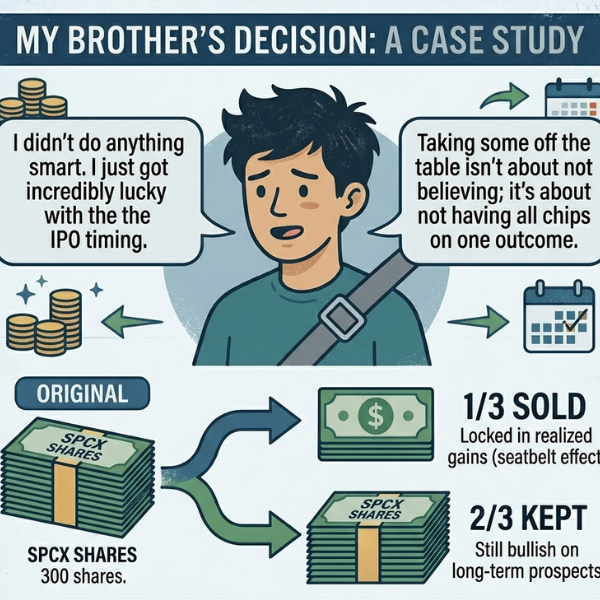
Okay, let’s get back to my brother, because I think his decision-making process this week is actually a pretty useful case study for anyone holding this stock — or thinking about buying it — right now.
He called me Tuesday evening, after the stock had recovered most of Monday’s dip, and told me he’d sold about a third of his position that afternoon.
His reasoning, as he explained it to me, was something like this: “I got incredibly lucky with the timing of this IPO. I didn’t do anything smart — I just happened to get allocation and the stock happened to pop. Taking some of that off the table doesn’t mean I don’t believe in the company. It just means I’m not an idiot about what just happened.”
I actually think that’s a really mature way to think about it, and I told him so. There’s a difference between believing in a company’s long-term prospects and believing that you, personally, with your specific position size and your specific financial situation, should have all your chips on that one outcome. He kept two-thirds of his position — which tells you he’s still bullish — but he locked in real, realized gains on the other third.
When I asked if he felt good about the decision, he said something that stuck with me: “I feel good about it in the way that you feel good about wearing a seatbelt. Not exciting. Just smart.”
That’s about as far from his “told you so” energy from a week ago as you can get, and I think the week of actual trading — with its dip and recovery and general unpredictability — is what got him there. A week of price action taught him something that the excitement of day one couldn’t.
What Dev Thinks Now
I checked in with Dev too, because his “this is insane” comment from launch day has been living in my head for a week.
His take on the week was more measured than I expected. He said something like: “Day one tells you about demand. Week one tells you about conviction. This week looked like a stock where most of the people holding it actually want to hold it, with a smaller group that was always going to sell quickly. That’s actually a pretty healthy pattern, as far as these things go.”
I asked him what would have worried him more. He said if the stock had kept declining through the whole week — if Monday’s dip had turned into Tuesday’s bigger dip and Wednesday’s bigger dip still — that would have suggested the day-one enthusiasm was mostly artificial, driven by IPO mechanics rather than genuine belief in the company. Instead, what we got was a dip that found support and a week that ended up roughly flat to slightly positive from where it started.
“It’s not a verdict,” he said. “It’s one data point that’s consistent with a healthier story than the alternative. That’s all it is.”
I appreciate Dev’s ability to say “this is mildly informative” without it sounding anticlimactic. Most people, including me most of the time, want every piece of news to mean something bigger than it actually means.
The Stuff That Actually Matters Going Forward
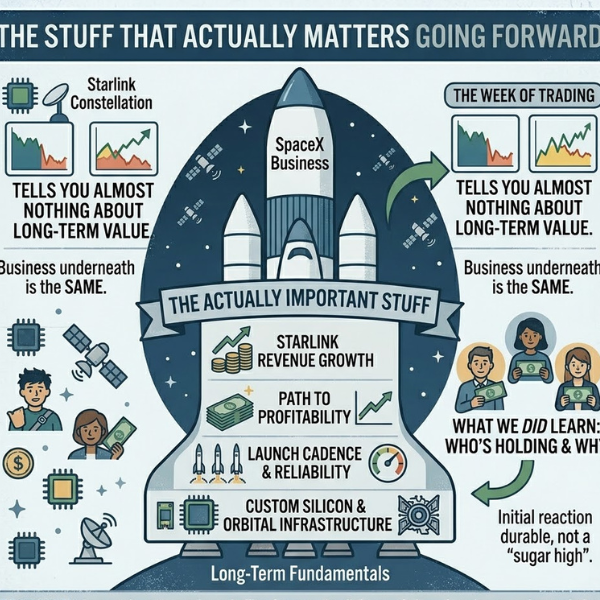
I keep coming back to this in every piece I write about SpaceX, and I’m going to keep coming back to it because I think it’s the single most important thing for anyone following this story.
One week of trading — even a week with a dip and a recovery and genuinely informative price action — tells you essentially nothing about whether SpaceX, the actual business, is going to deliver on the things that would justify a valuation in the trillions of dollars over the coming years.
Starlink’s revenue growth. The path to profitability. Launch cadence and reliability. The custom silicon and orbital infrastructure stuff that’s mostly speculative right now. None of those things changed this week. The stock price moved around — sometimes a lot, day to day — but the business underneath it is the same business it was two weeks ago.
What this week did give us is a slightly clearer picture of who’s holding the stock and why. That’s genuinely useful information, but it’s a different kind of information than “is this a good investment.” It’s more like “is the market’s initial reaction to this IPO showing signs of being durable, or signs of being a sugar high that’s about to crash.”
So far — and I want to emphasize “so far” because one week is still genuinely a small sample — it looks more like the former than the latter. But “looks more like” is doing a lot of work in that sentence, and I don’t want to oversell it.
The Lock-Up Period Is Still the Real Marker
I mentioned this in my first piece and I want to mention it again because I think it’s the next genuinely significant date for this story, and it’s still months away.
The lock-up period — the time during which insiders and early investors are contractually prevented from selling — hasn’t expired yet. Everything that’s happened this week, including my brother’s decision to sell a third of his position, has happened within a market where the largest, longest-term holders of SpaceX stock haven’t had the option to sell even if they wanted to.
When that lock-up expires, we’ll get a much clearer signal. If a meaningful number of those long-term holders — the people who’ve been with this company for years, who know it best, who arguably have the most informed view of its prospects — choose to sell a significant chunk of their holdings the moment they’re able to, that tells you something. If most of them hold, that tells you something different.
That date is the one I’m actually circling on my calendar. Everything that’s happened in the first two weeks is interesting, and I don’t want to dismiss it. But it’s also happening in a market that’s still missing a huge amount of potential supply, because the people who’d be most likely to sell simply can’t yet.
My Brother, One Week Later
I want to end where I started, because I think it’s a nice bookend.
A week ago, my brother sent a screenshot with no caption, and I genuinely didn’t know what to tell him. This week, he sold a third of his position, kept the rest, and described the decision as feeling like wearing a seatbelt.
I asked him if he regretted not selling more, given that the stock didn’t keep climbing the way it might have in some alternate universe where day one’s momentum just kept going. He said no — and then he said something that I think is actually the most useful takeaway from this entire two-week saga.
“I think the lesson isn’t about this stock specifically. It’s that I got lucky once, and I shouldn’t confuse being lucky with being right. Taking some profit doesn’t mean I think the company is bad. It just means I’m not betting my whole financial life on being lucky twice in a row.”
I told him that’s probably the smartest thing he’s said about money in years. He told me not to get used to it.
We’ll check back in when the lock-up period approaches. Until then, I think the honest summary of week two is this: nothing that happened this week proved the bulls right or the bears right. It just gave both sides a little more information than they had before — and for a stock this big, with this much riding on the years ahead rather than the weeks behind, that’s probably exactly as it should be.

Your Partner in Financial Growth
Helping you save and invest smarter since 2026. Our mission is to simplify finance for everyone.