
The Crypto Market Is Bleeding. Here’s What I Actually Think Is Going On.
Let me tell you something embarrassing.
I told myself I wouldn’t check my portfolio on Tuesday morning. I had a whole plan. I was going to make coffee, sit down, focus on work, and not look at prices until the end of the week. I’d done the research. I believed in my positions. Short term volatility was noise. I knew all of this.
I checked at 7:43am. Before the coffee was even finished brewing.|
And then I checked again at 8:15. And again at 9:30 when I was supposed to be in a meeting.
If you’ve been doing the same thing this week you’re not alone. The past several days in crypto have been the kind of market action that turns rational long-term investors into anxious price-checkers who refresh their portfolio app more often than their email. Bitcoin took a meaningful hit. Altcoins got hit harder — significantly harder in many cases. And the comment sections of every crypto community I follow have been oscillating between people calling the bottom and people announcing they’re done with this forever.
I’ve watched enough market cycles to be skeptical of both reactions. Here’s what I actually think is happening and what I think matters going forward.
Why Is the Crypto Market Falling — And It’s Not Just Volatility

The first thing I want to push back on is the narrative that this is simply normal crypto volatility and everyone should just calm down and zoom out.
That’s not entirely wrong. Crypto is volatile. Corrections happen in bull markets. Zooming out usually does help. But I think that framing misses something important about the specific dynamics driving this particular moment and understanding those dynamics actually matters for how you position yourself going forward.
The most significant thing happening right now isn’t actually inside the crypto market. It’s what’s happening around it.
Artificial intelligence has consumed the investment conversation in a way that I don’t think has fully registered for a lot of crypto investors. I don’t mean this in an abstract cultural sense. I mean it in a direct capital flows sense. The money that flows into financial markets is not infinite. Institutions have allocation frameworks. Individual investors have finite savings. Every dollar that goes into Nvidia or an AI infrastructure ETF or a data center REIT is a dollar that didn’t go into Bitcoin or Ethereum or anything else.
For a period of time crypto and AI coexisted reasonably well as investment themes because the overall risk appetite in markets was high enough to accommodate both. That coexistence is getting more complicated. AI is generating the kind of excitement and the kind of actual earnings results that pull capital toward it gravitationally. Crypto is generating uncertainty. When those two things happen simultaneously in a market where liquidity is finite, you can pretty much predict which direction the flows go.
This doesn’t mean crypto is broken. It means crypto has serious competition for the first time from something that has both a compelling narrative and increasingly demonstrable fundamental results. That’s a different competitive environment than crypto has operated in before.
The IPO Anticipation That Nobody Is Talking About Enough
Here’s a factor that I’ve seen mentioned briefly in a few places but not explored seriously and I think it deserves more attention.
There is significant anticipation building around major IPOs. The SpaceX conversation has been running hot. There are other large private companies in various stages of considering public listings. When institutional and sophisticated retail investors believe a major IPO is coming they do something very specific — they start building cash positions.
This process is less dramatic than it sounds but the aggregate effect is real. An investor who wants to participate meaningfully in a major IPO listing needs capital available at the time of the offering. If that capital is currently deployed in existing positions — including crypto positions — they need to trim or close those positions to free up the cash.
One person doing this is irrelevant. A few thousand sophisticated investors doing this simultaneously creates real selling pressure across speculative assets. And crypto, for all the progress it has made toward institutional legitimacy, is still categorized as a speculative asset in most portfolio frameworks. When institutions need to raise cash it tends to come from speculative allocations first.
I’m not saying IPO anticipation is the primary driver of what we’re seeing. I’m saying it’s a contributing factor that adds to the overall pressure on crypto prices in a way that has nothing to do with anything fundamentally wrong with the crypto market itself. Understanding that distinction matters because it affects how you interpret the current weakness.
The Bitcoin Maturation Problem That’s Actually a Long-Term Good Thing
Let me talk about something that I genuinely believe is the most important structural shift in crypto markets and one that a lot of Bitcoin maximalists are still in denial about.
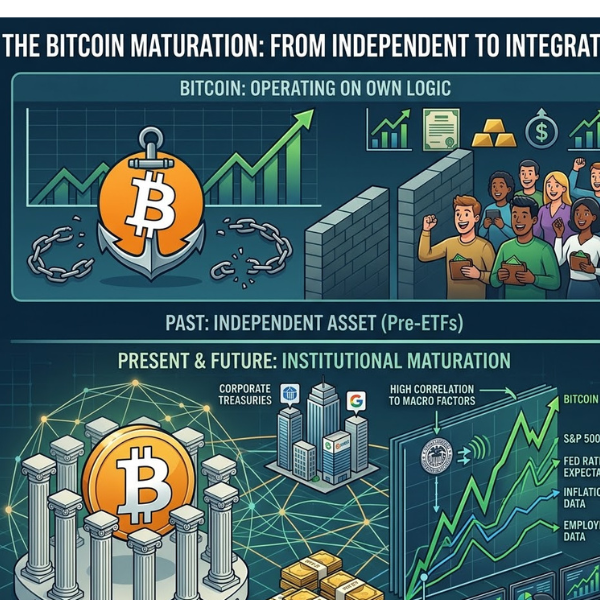
Bitcoin is no longer the asset it was four years ago. I don’t mean that negatively. I mean it descriptively. It has become too large, too institutionally held, and too integrated into mainstream financial infrastructure to continue behaving like an independent alternative financial system that moves according to its own internal logic.
Spot ETFs changed this. Corporate treasury adoption changed this. The sheer amount of institutional capital that now holds Bitcoin as a portfolio asset changed this. These developments were almost universally celebrated by the Bitcoin community when they happened because they represented legitimacy and mainstream acceptance. And they should have been celebrated. They were genuinely significant milestones.
But legitimacy comes with a cost. The cost is correlation. As Bitcoin has become part of the mainstream financial system it has started responding to the same forces that move the mainstream financial system. Interest rate expectations. Employment data. Inflation reports. Federal Reserve communication. All the macro factors that stock and bond investors spend their time analyzing now apply to Bitcoin too.
This is disorienting for investors who got into crypto specifically because it seemed to operate independently of traditional market forces. That independence is significantly reduced now. When the Fed signals that rates might stay higher for longer the crypto market moves. When a strong jobs report raises concerns about persistent inflation the crypto market moves. When risk appetite globally contracts for macro reasons the crypto market contracts with it.
This is going to be permanently true going forward. The path of institutional adoption that Bitcoin is on is a one-way street. You don’t get the ETF inflows and the corporate treasury legitimacy without also getting the macro correlations that come with being part of the institutional financial system. The sooner crypto investors update their mental models to incorporate this reality the better positioned they’ll be to understand future market movements.
The Michael Saylor Question That Everyone Is Tiptoeing Around
I want to address something directly that I’ve seen discussed in hushed tones in various communities but rarely stated plainly.
Strategy — the company formerly known as MicroStrategy — has built one of the most concentrated and leveraged Bitcoin positions in the corporate world. Michael Saylor has become the most recognizable face of institutional Bitcoin adoption and his company’s accumulation strategy has been treated by a significant portion of the Bitcoin community as something between a brilliant trade and a philosophical commitment.
The questions that are now circulating deserve honest engagement rather than dismissal.
Funding large-scale continuous Bitcoin accumulation requires capital. That capital comes from somewhere — debt instruments, convertible notes, preferred share issuances, various forms of financing that each carry their own costs and obligations. When markets are rising and sentiment is positive and financing is cheap these structures work smoothly. When markets tighten, financing costs rise, and the positions being financed are underwater, the math gets harder.
I want to be careful here because I’m not predicting an imminent blow-up or making specific claims about the company’s financial position. What I am saying is that the questions being asked are legitimate questions that any serious investor should engage with rather than wave away as FUD. Can the accumulation strategy continue indefinitely? What are the conditions under which it becomes unsustainable? What is the potential market impact if the strategy needs to unwind in any significant way?
These are real questions. Asking them isn’t bearish. It’s the kind of thinking that separates investors from speculators.
What’s Happening to Altcoins Is More Serious Than It Looks
Let me be honest about the altcoin situation because I think the “Bitcoin is fine just zoom out” framing obscures something important about what’s happening in the broader crypto market.
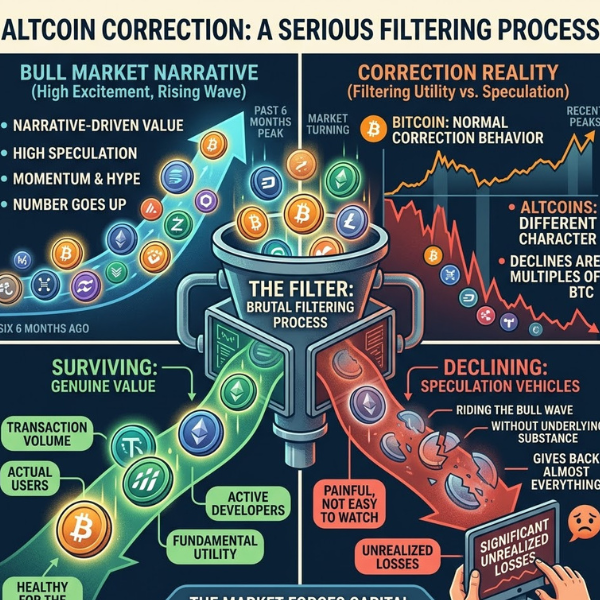
Bitcoin’s pullback in this period has been meaningful but within the range of normal correction behavior for this asset. The altcoin situation is different in character. Many tokens have experienced declines that are multiples of Bitcoin’s move down. Some projects that were generating significant community excitement six months ago have seen their tokens lose the majority of their value from recent peaks.
I’ve watched this pattern repeat enough times to recognize it. During rising markets the narrative about altcoins focuses on diversification, on upside leverage relative to Bitcoin, on the unique value propositions of individual projects. Everything looks brilliant when number goes up.
When the market turns the brutal filtering process begins. And what the filtering reveals, consistently, is that the vast majority of altcoin value in a bull market was momentum and narrative rather than fundamental utility. The projects that actually have users, actual transaction volume, actual developers building on them — those tend to survive corrections with something intact. The projects that were riding the bull market wave without underlying substance tend to give back almost everything.
The current correction is that filtering process happening in real time. It’s painful if you’re holding tokens that are declining. It’s actually healthy for the ecosystem because it forces capital toward projects with genuine value and away from projects that were existing primarily as speculation vehicles.
But healthy and comfortable are different things and I don’t want to pretend this is easy to watch if you’re sitting in significant unrealized losses.
Why I Keep Coming Back to the Macro Picture
I know this is the part that crypto purists find most frustrating. But I’d be doing you a disservice if I didn’t address it clearly.
The Federal Reserve and what it does with interest rates is currently one of the most important variables affecting crypto prices. Not because crypto is supposed to work this way. Not because it’s philosophically consistent with Bitcoin’s design as a non-sovereign currency. But because of the institutional integration I described earlier.
When rates are high and expected to stay high, risk assets face headwinds. Full stop. Investors who need to choose between assets that generate yield and assets that generate nothing except speculative appreciation will lean toward yield when yield is substantial. Risk-free rates near five percent change the calculation for every speculative asset class.
The current environment is one where inflation has proven stickier than most analysts hoped a year ago. Each strong economic data release that reduces the probability of near-term rate cuts creates a headwind for crypto. This isn’t complicated and it’s not going away until the rate picture actually changes.
I’m not saying crypto can’t go up in a high rate environment. It can and has. I’m saying the macro headwind is real and ignoring it doesn’t make it disappear.
Is the Bull Market Over

This is the question everyone is actually asking underneath all the other questions and I want to answer it as honestly as I can.
I don’t think the current correction definitively signals the end of the bull cycle. Corrections of this magnitude and character have occurred multiple times within bull markets historically. The pattern of sharp drawdown followed by recovery followed by higher highs has repeated enough that treating every significant decline as cycle-ending would have caused you to exit at the worst possible times repeatedly.
Bitcoin has survived things that seemed genuinely existential at the time. Exchange collapses that wiped out significant portions of market infrastructure. Regulatory crackdowns that banned mining in major countries. Macro crises that sent every risk asset plummeting simultaneously. Each time the obituaries were written. Each time they were premature.
None of that history guarantees anything about the future. Past survival doesn’t create future immunity. But it does provide context that makes current prices and current headlines look somewhat less catastrophic than they feel in the moment.
What I’m Actually Doing Right Now
I’ll tell you what I’m not doing. I’m not panic selling positions I took at significantly lower prices based on a few bad weeks of price action. I’m not dramatically increasing my exposure trying to catch a bottom that I can’t reliably identify. I’m not spending three hours a day checking prices and reading takes from people on the internet who are equally uncertain but expressing that uncertainty with more confidence than the situation warrants.
What I am doing is thinking carefully about which positions I hold for reasons that remain intact regardless of current price action and which positions I hold primarily because the price was going up and that felt like a reason at the time.
That distinction matters enormously during corrections. The first category you hold through the discomfort. The second category is worth honest examination.
The market right now is doing what markets do — it’s forcing investors to decide what they actually believe versus what they believed because believing it was easy and profitable. That process is uncomfortable. It’s also the thing that separates investors who compound wealth over time from people who buy tops and sell bottoms in every cycle.
The noise is loudest right now. That’s almost always exactly when it matters most to think clearly rather than react emotionally.

Your Partner in Financial Growth
Helping you save and invest smarter since 2026. Our mission is to simplify finance for everyone.