
Broadcom Just Had a Monster Quarter. So Why Did Investors Act Like Something Went Wrong?
I want to start with something that should feel absurd but has become completely normal in how markets work.
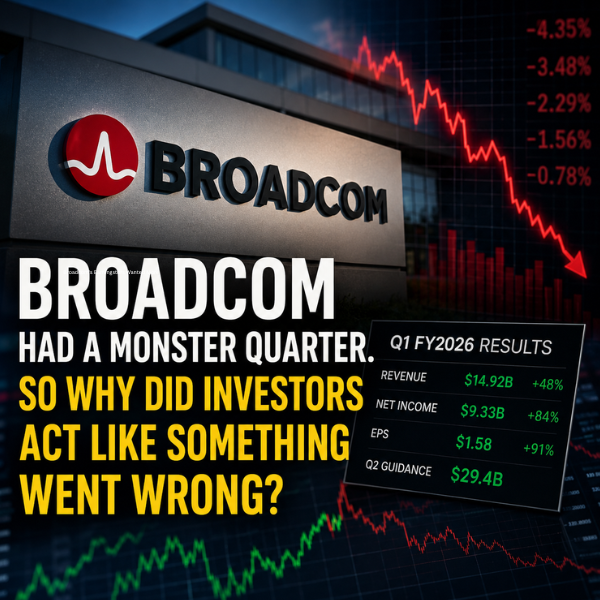
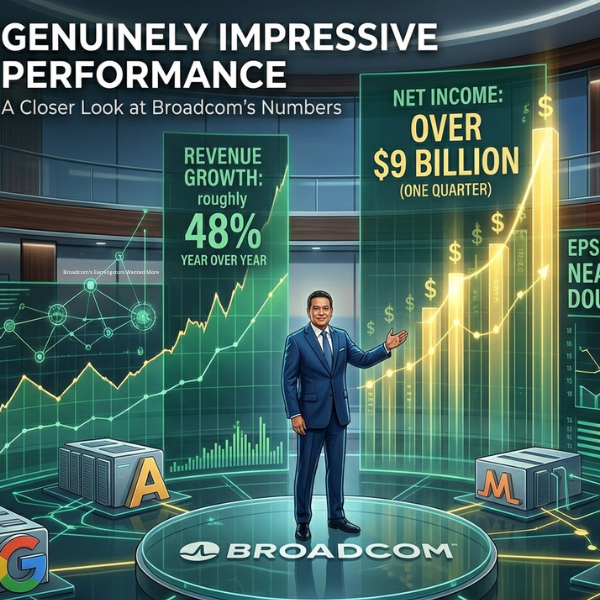
Broadcom reported revenue growth of roughly 48% year over year. Net income jumped to over nine billion dollars. Earnings per share almost doubled. Management gave guidance of around $29.4 billion for the next quarter which was better than most analysts had penciled in. By any reasonable measure this was an extraordinary earnings report from a company operating at enormous scale.
The stock stumbled.
Not crashed. Not collapsed. But stumbled in a way that confused people who looked at the numbers and then looked at the market reaction and tried to figure out what they were missing. How do you report those kinds of numbers and have investors walk away feeling vaguely disappointed?
The answer to that question tells you something important — not just about Broadcom specifically but about what it means to be an AI infrastructure company in 2026 when the entire investment world has piled into the sector and expectations have been bid up to levels that reality struggles to satisfy.First — Let’s Actually Acknowledge What Broadcom Did
Before getting into the market reaction I want to spend a moment just sitting with what those numbers represent because I think the disappointment narrative can make people forget that this was genuinely impressive performance.
48% revenue growth for a company the size of Broadcom is not a small thing. Broadcom’s Earnings Were Strong, But Investors Wanted More This isn’t a startup posting triple-digit growth off a tiny base. Broadcom is one of the most important technology infrastructure companies in the world. Getting from wherever you were a year ago to 48% more revenue at that scale requires winning enormous amounts of new business, executing on complex customer relationships, and delivering products that major technology companies are willing to pay premium prices for.
Net income over nine billion dollars in a single quarter. Earnings per share nearly doubling. Broadcom’s Earnings Were Strong, But Investors Wanted More These are the numbers of a company that is genuinely firing on most of its cylinders. The profitability here isn’t a fluke or an accounting artifact. Broadcom’s Earnings Were Strong, But Investors Wanted More It reflects real pricing power and real operational efficiency .Earnings Broadcom’s Earnings Were Strong, But Investors Wanted More
Most companies in the world would announce those results and their CEO would be giving interviews about what a fantastic quarter it was. Earnings The mood at Broadcom headquarters after this report was probably more complicated than that .Earnings
The Trap That Success Builds
Here’s the dynamic that I think gets under-explained whenever this kind of market reaction happens.
When a company becomes strongly associated with a powerful investment theme — and Broadcom has become as closely associated with AI infrastructure as any company outside of Nvidia — its stock price starts reflecting not just what the company is doing today but what investors believe it will do over a long future horizon. Earnings The valuation expands beyond current earnings to price in years of expected growth.
That’s fine as long as everything keeps confirming the narrative. Every earnings report, every guidance update, every management comment becomes a data point that either reinforces or challenges the story investors have built around the company.
The challenge with this dynamic is that it changes what counts as good news. For a normal company, meeting expectations is success. Earnings For an AI darling trading at a premium valuation that’s already priced in years of strong growth, meeting expectations can actually read as neutral to slightly disappointing. Investors don’t need you to confirm the story they already believe. They need you to make it bigge r.Earnings
Broadcom didn’t make the story bigger this quarter .Earnings They confirmed it. And confirmation, when you’re already priced for perfection, doesn’t move the stock in the direction the company probably hoped.
The Software Problem That Nobody Saw Coming
Here’s the part of this story that I find genuinely interesting from a business strategy perspective.
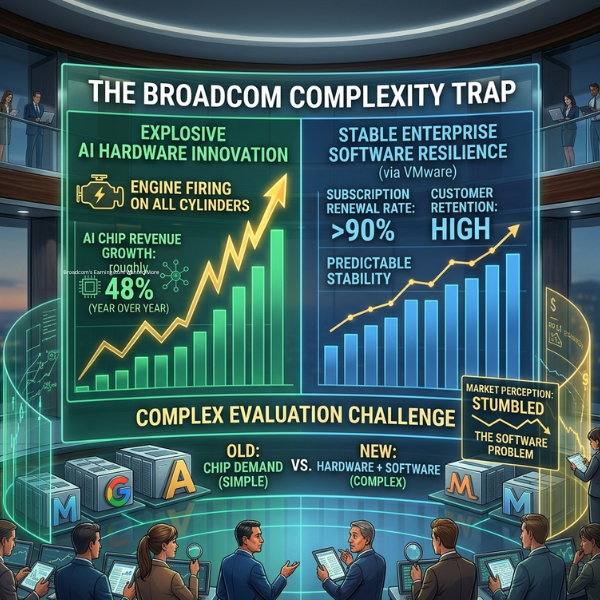
A few years ago Broadcom made a massive bet on software through its acquisition of VMware. Earnings The logic was defensible. Semiconductor businesses are inherently cyclical — they run hot when demand is strong and run cold when the inventory cycle turns. Earnings Software businesses, particularly enterprise software businesses with subscription revenue models, tend to be more predictable, more recurring, and less sensitive to the boom-bust dynamics of hardware.
Diversifying into software was supposed to make Broadcom more resilient. Give it multiple engines of growth. Reduce the volatility that comes from pure semiconductor exposure.
What management perhaps underestimated is how the software acquisition would change how investors evaluated the whole company. Earnings When Broadcom was primarily a semiconductor business investors had a relatively simple framework for thinking about it. How is chip demand? How is pricing? What’s the AI exposure? Clean and relatively easy to monitor.
Now investors are evaluating a much more complex entity. The semiconductor business is performing excellently. The networking business is strong. The AI custom chip business is expanding. And then there’s the software business, which is growing but growing slower than the headline AI numbers, and which requires a different kind of evaluation — customer retention, integration execution, subscription renewal rates, all the metrics of enterprise software that semiconductor analysts aren’t necessarily equipped to assess.
The irony here is sharp. The VMware acquisition was intended to make the company more stable. Instead it’s introduced a new source of uncertainty — not because the software business is failing, but because it’s growing at a pace that looks modest compared to the AI numbers sitting next to it.
In a different market environment slower-but-solid software growth would probably be fine. In an environment where every number gets measured against the extraordinary AI hardware growth happening in the same company, it stands out as a weak spot.
What Broadcom Actually Does That People Underestimate
Let me take a step back from the earnings drama and explain something about Broadcom’s business that I think most coverage handles too superficially.
When people talk about AI infrastructure they tend to focus on the GPU manufacturers. Understandably — the numbers from Nvidia in particular have been extraordinary and the story of how graphics chips became the engines of artificial intelligence is genuinely fascinating. But focusing only on GPUs misses something important about how AI actually works at scale.
A data center running AI workloads isn’t just a building full of GPUs. It’s an enormously complex system where the individual processors need to communicate with each other at extraordinary speeds, where data needs to move across the network with minimal latency, where the system needs to be managed and orchestrated and cooled and powered in ways that require sophisticated engineering at every layer.
Broadcom sits in the plumbing of all of that.
Their networking chips manage the flow of data between processors inside AI clusters. Earnings Their custom silicon designs help major technology companies build specialized hardware optimized for their specific workloads. Their connectivity solutions handle the movement of enormous amounts of data that modern AI training and inference requires.
None of this is visible to the end user who interacts with an AI product. But none of the AI product works without it. That’s the definition of infrastructure — invisible until it fails, essential always.
This is why the phrase “picks and shovels” gets used so often about Broadcom and companies like it. During the gold rush the people who got reliably rich weren’t the miners — it was the people selling picks and shovels to all of them. Broadcom sells picks and shovels to essentially everyone competing in the AI race regardless of which company ultimately produces the best models or the most successful applications.
The Custom Silicon Trend That Broadcom Is Quietly Winning
There’s a specific development in the AI hardware world that I think will be more significant over the next several years than most current coverage suggests and Broadcom is positioned well for it.
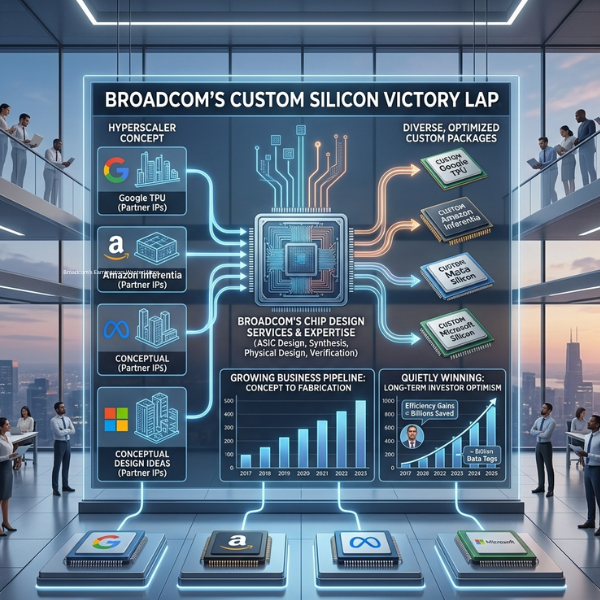
Major technology companies are increasingly moving away from buying standard off-the-shelf chips and toward building custom processors designed specifically for their workloads. Google has been doing this for years with their TPU line. Amazon has their Trainium and Inferentia chips. Meta is building custom silicon. Earnings Microsoft is moving in the same direction.
The motivation is straightforward. General purpose chips are good at many things. Custom chips designed for your specific workload can be dramatically better at that workload specifically, while consuming less power and potentially costing less at scale. When you’re running AI at the scale these companies operate, marginal improvements in efficiency translate to billions of dollars in operating costs over time.
Building custom chips is hard. The design process is complex, the tooling is expensive, and the expertise required to get from a concept to a manufacturable chip is scarce. That’s where Broadcom’s chip design services come in. They’ve built deep relationships with the companies pursuing custom silicon strategies, and they have the expertise to help turn those companies’ architectural ideas into actual silicon that gets fabricated and deployed.
This business is growing. It’s going to keep growing. And it’s one of the reasons that long-term investors who understand what Broadcom actually does remain optimistic despite the short-term volatility around earnings reports.
Why the Stock Moved the Way It Did — The Less Interesting Explanation
I’ve been talking about the business dynamics but I should also acknowledge the simpler explanation for the stock movement because it’s probably at least as important as any of the fundamental factors.
Broadcom’s stock has had an extraordinary run over the past couple of years. That run has attracted an enormous amount of capital. Institutional investors, hedge funds, retail investors who wanted AI exposure — they’ve all been buying.
When a stock is widely owned at elevated valuations the psychology around earnings reports changes. Everyone is sitting on gains and thinking about when to take some off the table. The earnings report becomes a catalyst — not necessarily for a new fundamental assessment but for the profit-taking decision that people had already been contemplating.
A report that was slightly less than perfect gave those investors the permission structure they were looking for. Not a reason to believe the company is fundamentally broken. Just enough ambiguity to decide this was a reasonable moment to reduce a position that had grown very large.
That kind of selling has nothing to do with Broadcom’s actual business prospects. But it’s real and it moves prices.
What Actually Matters Going Forward
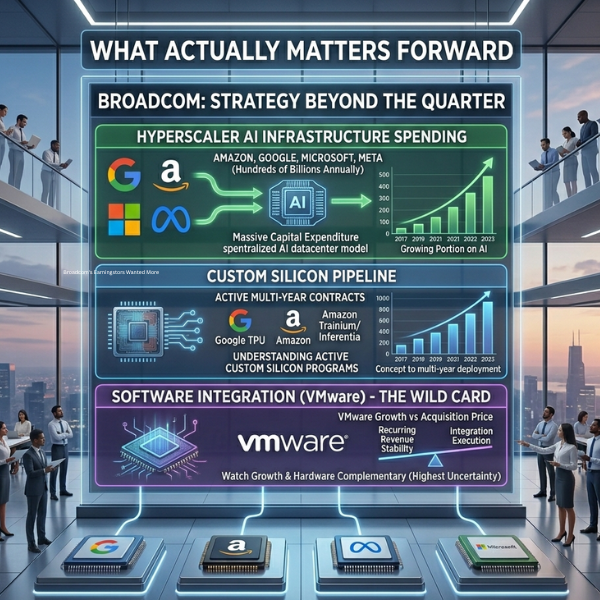
If you’re trying to think clearly about Broadcom as a business rather than as a ticker symbol here are the things I’d actually pay attention to.
AI infrastructure spending by the major hyperscalers is the most important driver. Amazon, Google, Microsoft, Meta — these companies collectively spend hundreds of billions of dollars annually on technology infrastructure and they’ve been explicit that AI represents a growing portion of that spending. Broadcom is embedded in their supply chains deeply enough that sustained hyperscaler spending is probably the single biggest tailwind.
The custom silicon pipeline matters more than the quarterly revenue number. The contracts that Broadcom wins today for custom chip design will generate revenue over multiple years. Understanding which major technology companies have active custom silicon programs with Broadcom is a better indicator of medium-term prospects than any single earnings report.
Software integration is the wild card. The VMware business needs to demonstrate that it can grow at a pace that justifies the acquisition price and complements the hardware business. This is probably the area of most legitimate uncertainty and the one I’d watch most carefully over the next several quarters.
The Honest Bottom Line
Broadcom reported a genuinely impressive quarter and got a complicated reaction because markets are weird and expectations at the top of a major investment cycle are almost impossible to satisfy cleanly.
The underlying business is strong. The AI infrastructure thesis that has driven the stock is real and intact. The custom silicon business is growing in ways that most people don’t fully appreciate. The networking and connectivity businesses remain essential to how AI data centers work.
The software business is the genuine question mark and it deserves more scrutiny than it’s been getting while everyone focuses on the AI hardware numbers.
But here’s what I keep coming back to. A company that grows revenue 48% year over year and reports over nine billion dollars of net income in a quarter is not a company with a problem. It’s a company with a perception management challenge in a market that decided perfection was the only acceptable outcome.
Those two things feel the same in the short run. They’re very different in the long run.
Broadcom is still one of the most important companies in the AI infrastructure stack. The earnings report didn’t change that. The stock reaction didn’t change that. What happens over the next several years will be determined by how AI infrastructure spending evolves and whether Broadcom executes on its software integration — not by whether management raised its AI revenue guidance by five percent versus three percent in a single quarterly update.

Your Partner in Financial Growth
Helping you save and invest smarter since 2026. Our mission is to simplify finance for everyone.