
The Great Australian Dream Is Still Alive. But Honestly? It’s Slipping Away.
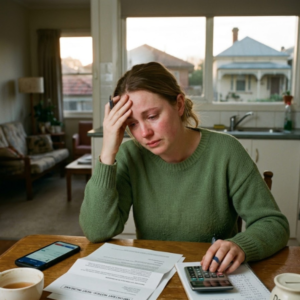
My cousin called me crying last year.
Not dramatically crying. Not the kind of crying that needs an intervention. Just that quiet tired crying that happens when someone has been holding something heavy for too long and finally puts it down for a second. She’d just gotten a letter from her landlord. Rent was going up again. Third time in four years. She’d done the math already — she does the math constantly now, it’s become this anxious habit she can’t shake — and after the increase she’d be left with about two hundred dollars a month after rent, bills, groceries and transport.
Two hundred dollars. That’s her deposit savings for the month. That’s what stands between her and owning something. Two hundred dollars against a deposit target that keeps moving further away no matter how carefully she lives.
She’s thirty four. She has a good job. She works hard. She doesn’t take expensive holidays or buy things she doesn’t need. She has done everything the way you’re supposed to do it and she is so far from owning a home that she’s started to wonder if it’s ever going to happen.
I didn’t know what to say to her. Because honestly there isn’t much to say. The situation is genuinely broken and telling someone to just keep trying starts to feel almost cruel after a certain point.
What We’re Actually Talking About When We Talk About This Dream
I want to be careful here because I think the housing conversation in Australia often goes wrong by turning into an abstract argument about economics and policy before it sits with the actual human reality for long enough .Young Australians
The Great Australian Dream was never really about real estate. Young Australians It was never about property prices or capital gains or investment portfolios. The people who built that dream — the truck drivers and nurses and factory workers and shop owners who bought modest houses in the suburbs in the seventies and eighties — weren’t thinking about any of that. They were thinking about stability. About having a place that was theirs. About not being one bad month away from having to move again. About being able to paint the walls a colour they actually liked without asking anyone’s permission .Young Australians
That’s it. That’s the whole thing. Stability and autonomy and the feeling that you had built something solid enough to stand on.
For my cousin’s parents that was achievable on genuinely ordinary incomes. Young Australians Her dad drove trucks. Her mum worked part time. They scraped together a deposit and bought a house in the western suburbs that needed work and they did the work slowly over years and they built a life there. The house wasn’t impressive. The backyard had a Hills Hoist and some patchy lawn and a second hand barbecue that her dad was always convinced he’d fixed and hadn’t. Young Australians But it was theirs and that made it worth everything.
My cousin grew up in that house and absorbed the completely reasonable belief that she would eventually do the same thing. Different suburb, probably. Smaller maybe. But the same basic script. Young Australians
She’s now realising the script has changed and nobody updated her copy.
The Numbers Are Actually Worse Than They Sound
People throw around phrases like “housing affordability crisis” so often that they’ve started to lose their weight. So let me try to put some concrete reality on this because I think it helps.
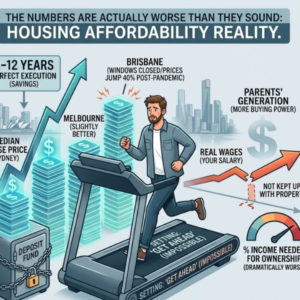
In Sydney right now the median house price is sitting at a level where the deposit alone — just the deposit, before you’ve borrowed a single dollar — represents somewhere between eight and twelve years of savings for a typical first home buyer. That’s if nothing goes wrong. No job loss. No health issue. No period of reduced income for any reason. No helping family out .Young Australians Nothing. Eight to twelve years of perfect execution just to get to the starting line.
In Melbourne it’s slightly better but not in any way that should make you feel good about it. Brisbane was the city young buyers were fleeing to for a while because it was the last major market with some affordability left. Young Australians That window closed during the pandemic when everyone had the same idea simultaneously and prices jumped forty percent in about eighteen months.
And wages. This is the part that doesn’t get said clearly enough. Real wages — what your salary actually buys you in the real world — have not kept up with what’s happened to property prices. You might be earning more dollars than your parents did at your age. Young Australians In real terms, adjusted for what those dollars buy, you are often not better off. And in terms of what percentage of your income you need to spend to own a roof over your head you are dramatically worse off. Young Australians
The treadmill analogy people use is right. It’s not that young Australians are standing still. It’s that the treadmill is set just fast enough that no matter how hard you run you can’t quite get ahead.
The Trap That Catches Everyone
Here’s the specific mechanism that makes this feel inescapable once you’re in it.
You can’t buy because you don’t have a deposit. You don’t have a deposit because rent is eating most of what you earn. Rent is high because not enough housing is being built. Young Australians Not enough housing is being built partly because the people who already own homes don’t want new developments near them. So the supply stays tight. Young Australians Which keeps rents high. Which keeps you from saving. Which keeps you renting.
That’s the loop. There’s no single villain in it. There’s no one moment where someone made a deliberate decision to trap young people in perpetual renting. Young Australians It just evolved that way through thousands of individual decisions that each made sense from the perspective of the person making them and collectively produced a system that is genuinely failing an entire generation.
The rental market itself has become something that would have seemed extraordinary to Australians twenty years ago. Vacancy rates in major cities at historic lows. Young Australians Multiple applications for every decent property. Renters writing personal letters to landlords explaining why they’d be responsible tenants. People offering to pay above the listed rent just to secure somewhere to live. The most basic human need — shelter — being competed for like a luxury good.
My cousin applied for six properties before she got the one she’s in now. Six applications. References, financial documents, a personal statement. For a two bedroom apartment she doesn’t even particularly like in a suburb she didn’t particularly want to live in. She took it because she was getting desperate.
Why Aren’t We Building More — And Why That’s Complicated
The obvious answer to a housing shortage is build more houses. It’s obviously right and obviously complicated.
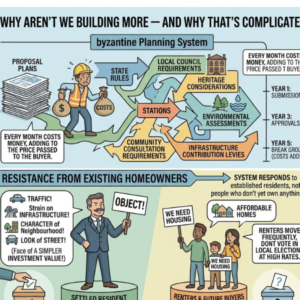
Planning systems in Australian cities are genuinely byzantine. State rules, local council requirements, heritage considerations, environmental assessments, community consultation requirements, infrastructure contribution levies — a developer trying to build apartments in an established suburb can spend three to five years just getting approval before a single worker shows up on site. Every month of that approval process costs money. Young Australians That money gets added to the price of the finished apartment and passed on to the buyer.
So by the time the new housing that was theoretically supposed to make things more affordable actually gets built it’s already expensive because the system that was supposed to facilitate it spent years making it more expensive.
But there’s an even harder conversation underneath that one. A lot of the resistance to new housing development comes from existing homeowners. Not all of them. Not even most of them individually. But organized, vocal, politically engaged groups of existing homeowners who show up to council meetings and submit objections and campaign against developments in their neighbourhoods.
The reasons they give vary. Traffic. Character of the neighbourhood. Strain on local infrastructure. Concern about the look of the street. These are real concerns in some cases. In a lot of cases they’re the acceptable face of a simpler concern which is: I bought this house partly as an investment and I don’t want anything that might affect its value to happen nearby.
That’s a human thing to feel. I’m not going to be harsh about it. But the political consequence of it is that local governments across Australia have for decades been more responsive to the concerns of existing property owners than to the needs of people who don’t yet own anything. The people who need more housing to be built are often renters who move frequently and don’t vote in local elections at high rates. Young Australians The people who want to stop new housing being built are settled, established residents who vote consistently and know how to work the system.
The system responds accordingly. It’s not corruption. It’s just politics doing what politics does.
The Interest Rate Squeeze That Hit First Home Buyers Hardest
When rates started rising aggressively in 2022 a lot of people assumed it would make housing more affordable. Basic economics — higher borrowing costs should reduce demand which should reduce prices.
It didn’t work out that cleanly. Prices did fall in some markets in 2022 and into 2023. But the falls were less than the reduction in borrowing capacity. Young Australians A buyer who could have borrowed nine hundred thousand dollars at three percent could now borrow maybe six hundred and fifty thousand at seven percent. But the house they wanted to buy didn’t drop from nine hundred to six fifty. It dropped from nine hundred to maybe eight hundred. Young Australians Then started climbing again.
So first home buyers got squeezed from both sides simultaneously. Higher rates reduced what they could borrow. Higher prices meant they needed to borrow more. And because they were trying to enter the market — rather than just service an existing mortgage — they got none of the protection that existing owners had from already being inside the system.
The people hurt most by rising rates were the ones who hadn’t yet bought. Young Australians The people protected most by still-elevated prices were the ones who already owned. That’s the pattern that has played out repeatedly over the last few years and it keeps widening the gap between the two groups.
What It’s Doing to People’s Heads
I want to say this clearly because it gets glossed over in economic analysis.
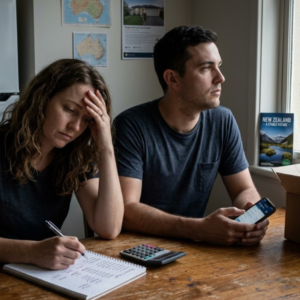
There’s a specific kind of exhaustion that comes from working hard toward a goal for years and watching it not get closer. It’s different from failing. Failure you can learn from and adjust. Young Australians This is different — it’s doing everything right and still not making meaningful progress and not being able to identify what you could do differently because you’re already doing everything you can.
I’ve watched it change people I know. The ones who were energetic and optimistic about the future in their mid-twenties and are now in their early thirties and have gone quiet about that particular topic. They’ve stopped talking about buying a place. Not because they’ve made peace with renting but because maintaining active hope toward something that keeps retreating started to hurt more than it was worth.
Some of them are thinking seriously about leaving. Not because they don’t love Australia. Because the life they want to build — stable, settled, with some sense of permanence — seems more achievable somewhere else. That’s a real thing happening. It doesn’t show up cleanly in housing statistics but it’s real.
What Would Actually Change Things
I’m not going to pretend I have a policy blueprint because I don’t and anyone who claims to have a simple solution to this is not being straight with you.
What would help is more supply in places people actually want to live. That means planning reform with actual teeth — reform that can override local opposition when the community benefit of new housing clearly outweighs the objections of nearby residents. It means looking seriously at the tax settings that make property such a preferred investment vehicle over more productive economic activity. It means genuine commitment to affordable housing rather than demand-side subsidies that tend to push prices higher by putting more money into buyers’ hands without adding more homes to the market.
None of that is easy. All of it involves taking something from someone who currently benefits from the status quo. In a democracy that’s hard. The people who benefit from the status quo vote. The people who would benefit from change are often too busy surviving to organize effectively.
The Part I Keep Coming Back To
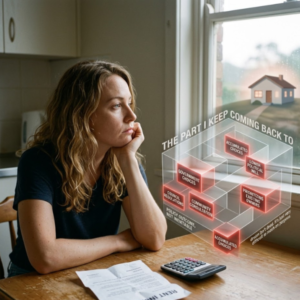
My cousin isn’t asking for anything extraordinary. She’s not expecting a big house in an expensive suburb. She’d take a small apartment somewhere reasonable. Something she owned. Something she could count on being hers next year and the year after.
The fact that even that feels out of reach for someone working hard and doing everything right — that’s not a market outcome we should accept as inevitable. It’s a policy outcome. It’s a choice. Not one single choice made on one single day but accumulated choices made over decades by governments and councils and communities that consistently prioritized protecting what existed over building what was needed.
Choices made for reasons people understood at the time.
Choices that have brought us here.
Choices that can be made differently if there’s enough political will to make them.
The dream isn’t dead. It’s just been made very difficult to reach on purpose even if nobody quite meant it to turn out this way.
That’s somehow more frustrating than if it were inevitable.

Your Partner in Financial Growth
Helping you save and invest smarter since 2026. Our mission is to simplify finance for everyone.