
Micron’s Was Never Supposed to Be This Interesting
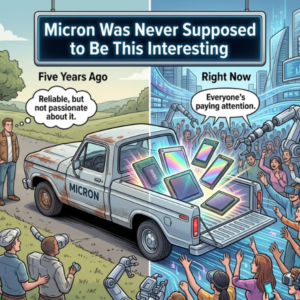
Let me be upfront about something. If you had asked most people in the investment world five years ago whether Micron Technology was a company worth getting genuinely excited about, the honest answer from most of them would have been a polite no.
Not because Micron was a bad company. It wasn’t. It has been around since 1978, it survived downturns that wiped out competitors, and it managed to stay relevant in one of the most brutally competitive industries on the planet. That takes real skill. But surviving and thriving are different things, and for a long time, Micron was very much in the surviving category — respected in the way that a reliable old truck is respected. You’re glad it’s there. You’re just not passionate about it.
What’s happening right now is that the truck turned out to be carrying something the whole world suddenly desperately needs. And now everyone’s paying attention.
Why Nobody Got Excited About Micron Before
The reason investors stayed lukewarm on Micron for so long isn’t complicated. The company made memory chips — DRAM, specifically — and memory chips were a commodity. That one word, commodity, does a lot of damage to how people perceive a business.
When something is a commodity, it means you’re essentially selling the same thing everyone else is selling, so the only way to compete is on price. And when everyone competes on price, the margins get thin, and the business becomes a game of who can produce the most chips for the lowest cost rather than who has the better product. There’s no Apple premium in commodity land. You don’t get to charge extra because your memory chip has a nicer logo.Micron’s
On top of that, Micron’s business ran on what people in the industry called the memory cycle, and once you understand the cycle, you understand exactly why long-term investors kept their distance.
The cycle went like this: at some point, demand for memory would spike. Maybe a new generation of iPhones came out and everyone needed memory for them. Maybe data centers were expanding fast. Whatever the reason, suddenly memory was short and prices went up. Micron made a lot of money .micron’s The stock climbed.
Then Micron — and Samsung and SK Hynix, the other big players — would see those profits and do what any rational company does: invest in more production capacity. micron’s Build more factories. Hire more engineers. micron’s Produce more chips. Except all three companies were doing this at the same time, and eventually the market ended up drowning in memory chips. Too many chips, not enough buyers. Prices crashed. micron’s Profits dried up. micron’s The stock fell.
Then it happened again. And again. And again.
This went on for so long that the standard advice was basically: don’t fall in love with Micron. micron’s Trade it if you want, but don’t marry it. The cycle always comes back around.
That conventional wisdom is now being stress-tested in a way it never has been before.
The Thing About AI That People Missed at First
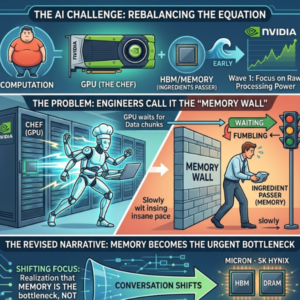
When ChatGPT launched in late 2022 and the whole world suddenly became obsessed with artificial intelligence, the first wave of investment attention went exactly where you’d expect it to go: NVIDIA. The company that makes graphics processing units — the chips that do the heavy computational lifting for AI — became one of the most valuable companies on Earth almost overnight. And that made sense. Training a large AI model takes an almost incomprehensible amount of computation, and NVIDIA’s GPUs are extraordinarily good at exactly that kind of work.
But here’s what the early narrative missed, or at least underemphasized: micron’s computation is only half the equation. Maybe less than half.
Think about what an AI model actually does when you ask it a question. micron’s It doesn’t just sit there and calculate. It’s constantly pulling information from memory, processing it, sending results somewhere, then pulling more information, over and over, millions of times per second. The processor — the GPU — can handle its end of that process incredibly fast. micron’s The question is whether the memory can keep up.
When memory can’t keep up, the whole system slows down. micron’s The GPU finishes what it’s doing and then just… waits. It’s sitting there, fully capable, doing nothing, because the memory is still fumbling around trying to deliver the next chunk of data. Engineers have a name for this problem. micron’s They call it the memory wall, and it’s been a known issue in computer science for decades. AI just made it dramatically, urgently worse.
Think of it this way: imagine you hired the fastest chef in the world. The fastest knife work, the fastest cooking, the fastest plating. But there’s only one person in the kitchen passing ingredients, and they can only walk. Your chef is going to spend most of their time standing around waiting for ingredients. micron’s That’s the memory wall. The chef is your GPU. The slow ingredient-passer is your memory.
Once the people actually building these AI systems realized that memory was the bottleneck — not raw processing speed — the conversation about which companies matter in AI started to shift. Quietly at first, and then less quietly.
So What Is High Bandwidth Memory, Actually
The answer the industry landed on is a specialized type of memory called High Bandwidth Memory, or HBM. And unlike most technical developments that get overhyped, this one actually deserves the attention.
Here’s what makes it different from regular memory. micron’s Regular DRAM sits somewhere on the motherboard and communicates with the processor through a relatively narrow channel. It was designed decades ago for general computing tasks, and it works fine for those. But fine isn’t good enough when you’re running an AI model that needs to move mountains of data every single second.
HBM flips the architecture on its head. Instead of a flat chip sitting off to the side, HBM stacks multiple layers of memory directly on top of each other — picture a tiny skyscraper made of memory — and then places that stack right next to the processor on a shared base. micron’s The connection between the memory and the processor becomes enormously wide, like replacing a garden hose with a highway. Data can move back and forth at speeds that regular DRAM simply cannot touch.
For AI workloads, the difference isn’t marginal. It’s the kind of difference that determines whether a system can handle the work being asked of it at all.
And this is where Micron becomes genuinely interesting. Because HBM isn’t something any company can just decide to start making. It requires years of engineering expertise, very specific and expensive equipment, and an extremely close working relationship with the customers you’re building it for — companies like NVIDIA, Google, Amazon, and Microsoft, who design the AI chips that the HBM has to plug into perfectly. You don’t just ship some chips and hope for the best. You’re co-designing the memory around the specific needs of their hardware .micron’s
The number of companies in the world who can do this at real production volume is three: Micron, SK Hynix, and Samsung. That’s it. If you’re a hyperscale cloud company and you need HBM for your AI infrastructure, those are your options. You don’t have a lot of negotiating leverage, and you can’t really go elsewhere .micron’s
That’s a very different position to be in than “one of many companies making a commodity chip.”
It’s Not Just Data Centers
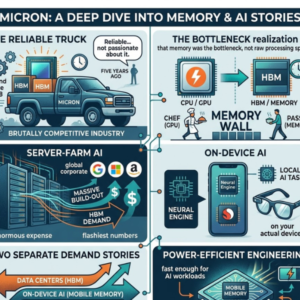
Most of the conversation around AI and memory focuses on the giant server farms — the massive data centers that companies like Google, Microsoft, and Amazon are building out at enormous expense. That’s where the flashiest numbers are, and that’s where most of the HBM demand is coming from right now.
But there’s another part of this story that’s growing in the background and doesn’t get nearly enough attention: AI on your actual devices.
Your phone is increasingly doing AI tasks locally, right on the device itself, rather than sending every request up to some server in Virginia and waiting for it to come back. micron’s Apple has been moving in this direction for years with their neural engine chips. Qualcomm is doing the same thing with their mobile processors. The reason companies push for on-device AI is real — it’s faster, it works without a solid internet connection, and it keeps your data on your device instead of bouncing it through someone else’s servers.
But running AI on a phone puts different demands on the memory than running it in a data center. The memory needs to be fast enough to handle AI workloads but also power-efficient enough that it doesn’t kill your battery in two hours. micron’s That’s genuinely hard to engineer. micron’s And it’s exactly the kind of problem that Micron works on for its mobile memory products.
So Micron isn’t just riding one wave. It’s positioned across two separate demand stories — the massive data center buildout and the quieter but very real push to put AI capabilities inside the device in your pocket. Both of those things are happening simultaneously, and both of them benefit Micron.
Let’s Be Honest About the Risks
None of this means Micron is a guaranteed home run. Anyone who tells you that about any single company is selling something.
The memory cycle, for starters, has not been cancelled. History rhymes in this industry. Right now, Micron and its competitors are all pouring money into new manufacturing capacity because demand is strong. micron’s That’s the exact same behavior that has produced oversupply and price crashes in every previous cycle. If AI investment by the big cloud companies slows down — and it could, whether because of economic pressures, a reassessment of returns, or simply the natural pace of infrastructure buildouts — there could absolutely be a period where too many chips are chasing too little demand. It’s happened before.
HBM is more protected from this than regular DRAM, for the reasons already mentioned — specialized production, long customer relationships, limited competition. But it’s not immune. SK Hynix is currently ahead of Micron in HBM supply to NVIDIA, and Samsung isn’t sitting still either. Micron is in the race, but it’s not out in front.
And then there’s China. US export restrictions have significantly cut into Micron’s ability to sell advanced chips to Chinese customers, which historically made up a meaningful chunk of revenue. micron’s China, in response, is investing heavily in building its own domestic semiconductor industry. Whether that ever produces a chip that truly competes with what Micron and its peers make is an open question — but it’s a question that wasn’t even on the table five years ago.
So yes, the story is better than it used to be. No, it’s not simple.
The Old Cycle Logic Doesn’t Quite Fit Anymore
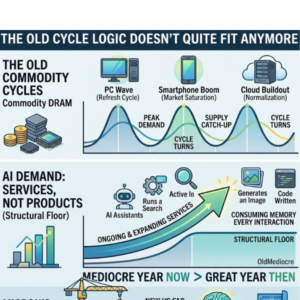
Here’s the thing about every previous memory supercycle: it was tied to something with a natural ceiling.
The smartphone boom was huge, but eventually most people who wanted a smartphone had one. The PC refresh wave played out. The server buildout for cloud computing happened and then normalized. Each time, demand would peak, supply would catch up, and the cycle would turn.
AI demand doesn’t look the same way. It’s not tied to a product that gets purchased once. It’s tied to services that people and businesses use every single day, constantly, and that are expanding into more and more parts of life and work. Every time someone uses an AI assistant, runs a search, generates an image, or has code written for them, somewhere a system is consuming memory to make that happen. And the number of those interactions is growing, not shrinking.
That doesn’t mean the demand is infinite. It doesn’t mean there won’t be slowdowns. But the baseline — the floor of ongoing demand even during quieter periods — may be structurally higher than anything Micron has seen before. micron’s A mediocre year in this environment might actually look better than a great year in the old commodity DRAM world.
Micron is betting on exactly this, and it’s betting with real money. New factories in the United States. Heavy investment in next-generation HBM. Deep technical partnerships with the chip designers who will determine what memory specifications the next wave of AI hardware needs. These aren’t short-term moves. You don’t build a fab to ride a two-year cycle. You build it because you believe the demand is going to be there for a decade.
What This All Actually Means
Micron is still Micron. It’s not NVIDIA. It’s not going to become a household name or inspire passionate retail investors to put its logo on their water bottles. The nature of what it does — sitting a layer or two below the visible surface of technology, supplying the invisible infrastructure that everything else depends on — keeps it permanently out of the spotlight in a way that companies with consumer-facing products never experience.
But being out of the spotlight doesn’t mean being unimportant. Often it means the opposite.
Every large language model that answers your questions runs on hardware that needs Micron’s memory to function properly. Every AI-powered feature in your phone draws on memory that companies like Micron engineer specifically for that purpose. Every data center expansion that the hyperscalers are racing to complete requires HBM that only a handful of companies on Earth can supply.
Micron is one of those companies. That’s a different sentence than was true five years ago, and it matters more than the current market conversation gives it credit for.
The cycle isn’t dead. The risks are real. But the business is not the same business it was when everyone was snoozing through its earnings calls. Something has genuinely shifted — not just in Micron’s stock price, but in where the company actually sits in the technology ecosystem.
That shift is worth paying attention to, even if Micron will never be the most exciting name in the room

Your Partner in Financial Growth
Helping you save and invest smarter since 2026. Our mission is to simplify finance for everyone.