
Stock Market Holidays Explained: Is Wall Street Open or Closed Today?
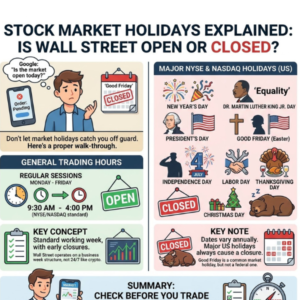
I still remember the first time I tried to place a trade on a Friday that turned out to be Good Friday. Nothing happened. The app just sat there. I refreshed it maybe four times before I finally Googled whether the market was even open. It wasn’t. And I felt like an idiot for not knowing that.
The thing is, nobody really teaches you this stuff. You learn about stocks, about earnings, about diversification — but the basic question of when the market is actually running? That one slips through the cracks for most people until it bites them. Stock market holidays catch people off guard more often than they should, and it’s not because investors are careless. It’s just one of those unglamorous details that nobody talks about until something goes wrong.
So let me just walk through it properly.
When Is the Market Actually Open?
There are two main stock exchanges in the US — the New York Stock Exchange and the Nasdaq. Both of them run on the same schedule, and that schedule is a lot more limited than most people assume.
Regular trading hours are 9:30 in the morning to 4:00 in the afternoon, Eastern Time. Monday through Friday only. Stock Market Holidays That’s 6.5 hours a day. That’s it. Financial news runs around the clock, your brokerage app loads instantly whenever you open it, prices feel like they’re always doing something — but real trades, actual buying and selling, only happens inside that window on business days. Stock Market Holidays
Now there’s also pre-market trading, which can start as early as 4:00 a.m. for people reacting to news that broke overnight. And after the closing bell, you can still trade until around 8:00 p.m. in what’s called after-hours. But here’s the thing about both of those sessions — they’re thin. Not many people are participating, which means prices can move in weird ways on very little volume. Stock Market Holidays A single large order can push a stock around more than it normally would. If you’re newer to all this, I’d honestly suggest understanding those sessions well before you start using them. Stock Market Holidays They can fool you into thinking something big is happening when it’s just low-traffic noise.
What Even Is a Stock Market Holiday?
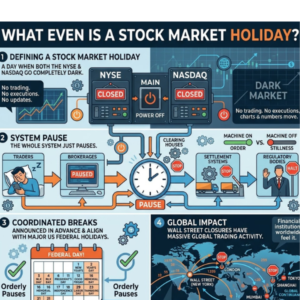
A stock market holiday is simply a day when both the NYSE and Nasdaq go completely dark. No trading at all. Orders don’t execute, prices don’t update, nothing moves. Stock Market Holidays The whole system just pauses.
These days are announced in advance every year and they line up almost entirely with major US federal holidays. It’s not random — the financial system needs coordinated breaks. Think about how many moving parts are involved: traders, brokerages, clearing houses, settlement systems, regulatory bodies. Stock Market Holidays All of them need to stop at the same time for things to stay orderly. Stock Market Holidays You can’t have some parts of the machine running while others are off.
What makes this more significant than people realize is that the US market isn’t just an American thing. Wall Street drives a massive amount of global trading activity. Stock Market Holidays When American markets close, financial institutions and trading desks all over the world feel it. Not everything stops, but a lot slows down in ways that matter.
The Full 2026 Holiday Calendar
For this year, these are the days the market is completely closed:
- New Year’s Day — January 1
- Martin Luther King Jr. Day — January 19
- Presidents’ Day — February 16
- Good Friday — April 3
- Memorial Day — May 25
- Juneteenth — June 19
- Independence Day (observed) — July 3
- Labor Day — September 7
- Thanksgiving Day — November 26
- Christmas Day — December 25
Besides full closures, there are also early close days where trading stops at 1:00 p.m Stock Market Holidays. Eastern instead of the usual 4:00. The Friday right after Thanksgiving is the most well-known one. Markets open that day, but only run for a few hours. A lot of newer investors get confused by this because they assume it’s either fully open or fully closed — the half-day thing surprises people.
One more thing worth knowing: if a holiday falls on a Saturday, the market closes the Friday before instead .Stock Market Holidays If it falls on a Sunday, it closes Monday. Either way, there’s always a full weekday off — it just shifts depending on the calendar. Worth double-checking before any long weekend if timing matters to you.
What’s Actually Happening While the Market Is Closed
Here’s where most people have the wrong mental picture. Stock Market Holidays They imagine the market is closed, everything freezes, and when it reopens everything picks up exactly where it left off. Stock Market Holidays That’s not how it works at all, and the gap between that assumption and reality has burned a lot of people.
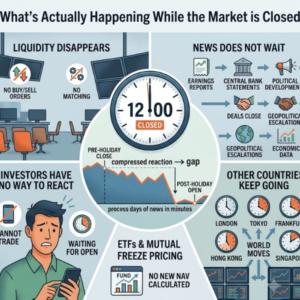
Liquidity just disappears. On a regular trading day, there are hundreds of millions of individual buy and sell orders flowing through the system every single hour. Stock Market Holidays That constant back-and-forth is what creates liquidity — meaning if you want to buy or sell something, there’s usually someone on the other side of the trade at a reasonable price .Stock Market Holidays Pull all that activity out and you’re left with nothing. No live prices, no order matching, no way to get in or out of anything. Markets are stable in large part because of liquidity. Stock Market Holidays When it’s gone, the first session after a break can get messy fast.
The news absolutely does not wait. This is probably the thing that surprises people most. The market being closed does not mean the world pauses. Companies release earnings reports on holidays. Central banks issue statements. Political developments happen. Deals close, geopolitical situations escalate, economic data gets published. All of it happens on the same schedule regardless of whether Wall Street is open.
So if something genuinely significant happens while markets are closed — say a major company misses earnings badly, or some unexpected policy announcement drops — investors have no way to react until trading resumes. When it does open, everyone acts at once. That compressed reaction is what traders call a gap. You’ll sometimes see a stock open 5, 8, even 15 percent above or below where it was trading the day before the holiday, purely because the market is trying to process several days of news in the first few minutes of trading.
Other countries keep going. While American investors are sitting on their hands, traders in London, Tokyo, Frankfurt, Hong Kong, Singapore and everywhere else are still at their screens. Currencies move. Stock Market Holidays Oil prices shift. International stocks react to whatever news came out. Stock Market Holidays By the time US markets come back online, they often have to “catch up” to a world that kept moving without them. That catch-up is rarely smooth.
ETFs and mutual funds freeze their pricing too. Both of these work off end-of-day prices to calculate their net asset value — the per-share value of the fund. On a market holiday, no new NAV gets calculated. If you place an order for an ETF or mutual fund on a holiday, it just queues up and gets filled on the next business day at whatever the price is then, not when you clicked the button. This is standard, totally normal, totally expected — but if you’re used to stocks where you at least see a price and get a rough idea of where your order will fill, mutual funds on holiday weekends can feel weirdly uncertain.
Why Holidays Actually Change How the Market Behaves
One thing that took me a while to appreciate: holidays don’t just affect the day they fall on. They change market behavior for a day or two on either side, sometimes more.
Before a long weekend, volume drops and things get weird. A lot of experienced traders and institutional players pull back their activity before a holiday. They don’t want to hold a risky position over a three-day weekend when they can’t react if something bad happens. When those players step back, the order book gets thinner. And when the order book is thin, individual orders carry more weight than usual. A normal-sized trade that wouldn’t move the needle on a busy Tuesday can cause a meaningful price move on the Wednesday before Thanksgiving. So counterintuitively, the market can actually get more erratic right before a closure, not more calm.
There’s a recognized pattern around holidays that traders watch. It doesn’t have a single universally agreed-upon name, but the general observation is that markets often drift slightly upward in the day or two before a holiday, volume stays low, and the first session after the break tends to be more active and choppy than a normal day. Nobody has fully cracked why this happens consistently enough to be notable. Most explanations point to the psychological behavior of a reduced participant pool — when fewer people are trading, the ones who are tend to be either very cautious or aggressive in ways that show up in the price.
The reopening session after a long break is usually a mess. Everything that accumulated while the market was closed — all the news, all the global moves, all the pent-up orders — hits at once when the opening bell rings. It’s like trying to empty a bathtub through a small drain. Orders queued up over the holiday start executing simultaneously. Positions get adjusted by investors who’ve been waiting days to make changes. The result is often a volatile opening hour before the market finally settles into a more normal rhythm. If you’ve ever noticed a stock looks strange on Monday morning after a long weekend, this is almost always the explanation.
A Few Habits That Actually Help
You don’t need to dramatically change how you invest just because of market holidays. But there are some small habits that save you from unnecessary headaches.
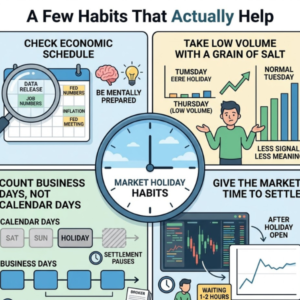
Before any long weekend, spend a minute checking whether any major economic data is scheduled to drop during the closure. That means Fed meeting decisions, monthly jobs numbers, inflation data, major earnings releases. You don’t necessarily need to do anything about it — sometimes the right move is nothing — but being mentally prepared for a gap open on Monday is a lot better than being blindsided by one.
When you notice strange price movements in the day or two before a holiday, take them with a grain of salt. Low volume can make things look more dramatic than they are. A 2% move on a slow pre-holiday Thursday doesn’t mean the same thing as a 2% move on a normal busy Tuesday. The fewer people trading, the less each individual price tick means in terms of true market direction.
If you’re dealing with anything time-sensitive — a tax deadline, a transfer between accounts, a settlement that needs to land by a specific date — always count business days, not calendar days. Weekends and holidays both pause the settlement clock. A standard two-day settlement takes three or four real days if a holiday falls in between. Brokerages mention this in their fine print but almost nobody reads it until they’re waiting on funds that haven’t shown up yet.
After a holiday, especially a long one, give the market an hour or two to sort itself out before making decisions. The opening session is genuinely noisier than usual. Prices often overshoot in one direction and then correct back. If you’re not working against some hard deadline, waiting for the dust to settle usually gets you a cleaner price than jumping in during the first twenty minutes.
What This Actually Comes Down To
The stock market has a real schedule with real closures, and those closures do real things to how prices behave and how your orders get processed. It’s not some minor footnote — it’s a basic part of how the system works.
You don’t need to obsess over the holiday calendar or treat every three-day weekend like some major strategic event. But knowing which days the market is closed, understanding that the world doesn’t pause when Wall Street does, and keeping a few practical habits in mind will save you from the specific kind of frustration that comes from expecting the market to behave normally when it isn’t running normally at all.

Your Partner in Financial Growth
Helping you save and invest smarter since 2026. Our mission is to simplify finance for everyone.