
Meta Layoffs Explained: Why Thousands Lost Their Jobs Overnight
For a long time, getting a job at Meta felt like winning something. Not just a salary, not just a title — something bigger than that. It felt like proof that you were good enough to be part of one of the most powerful companies ever built. People outside tech would hear you worked at Meta and their eyebrows would go up slightly. People inside tech would nod with a kind of quiet respect. It was that kind of job.
And why wouldn’t it feel that way? Facebook had genuinely changed how human beings communicate. Instagram had become so embedded in daily life that people couldn’t remember what they did before it. WhatsApp was essentially the phone network for entire countries .Meta Layoffs Explained The company behind all three of those things didn’t feel fragile. It felt permanent — like one of those institutions that just keeps going regardless of what happens around it.
Nobody who worked there was sitting around worrying about job security. That wasn’t the conversation. The conversations were about promotions, about stock options vesting, about which new product might be the next billion-user platform. The whole culture was built around the assumption that the machine would keep running, keep growing, keep expanding. That was just the nature of the place.
And then, almost overnight, it wasn’t.
When the layoff announcements came — thousands of people, gone, quickly — it didn’t feel like a normal business decision. It felt like something had cracked Meta Layoffs Explained Like the ground that everyone had been standing on turned out to be less solid than anyone realised. People who had given years of their lives to the company, who had turned down other offers, who had built their routines and identities around working there, were suddenly out. Meta Layoffs Explained Not with much warning. Not gradually. Just — out.
To understand how that happened, you have to go back a few years and look at what the pandemic did to the tech industry’s brain.
The Pandemic Convinced Everyone the Party Would Never End
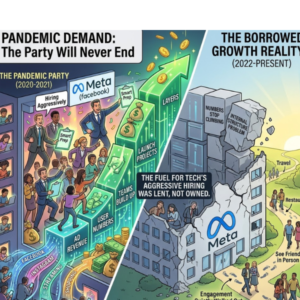
When the world locked down in 2020, something strange happened to tech companies. Meta Layoffs Explained Their numbers went through the roof.
People stuck at home had nothing to do but stare at screens .Meta Layoffs Explained They were on Facebook reconnecting with people they hadn’t spoken to in years. They were on Instagram because it was the only window into a world that had otherwise closed. They were shopping online, streaming everything, spending hours on platforms they used to visit for twenty minutes a day. Ad revenue surged. User numbers climbed. Everything was pointing up and to the right.
From inside a company like Meta, this felt like confirmation. Like the future had arrived early. The thinking went something like: people have finally made the full switch to digital life, and we are the ones who own that space. So they hired. They hired aggressively, quickly, with the confidence of a company that believed its growth curve had permanently shifted upward.
At the time, that decision didn’t look reckless. It looked like smart preparation. If your platforms are being used more than they’ve ever been used before, and you genuinely believe that’s the new baseline, then of course you staff up to meet that demand. Of course you build more teams, launch more projects, add more layers. That’s what growth looks like from the inside.
The problem was that the growth wasn’t what they thought it was. It was borrowed. It was people with nowhere else to go, pouring time into platforms because the alternative was staring at the walls. The moment the world opened back up — the moment people could go to restaurants and travel again and see their friends in person — a big chunk of that engagement quietly walked out the door.
The numbers didn’t collapse. But they stopped climbing. And for a company that had built its entire internal structure around the assumption that they would keep climbing, that was a serious problem.
What Happens When a Growth Machine Hits a Wall
There’s something psychologically difficult about being a fast-growing company that suddenly isn’t growing fast anymore. The whole system — the hiring plans, the budget cycles, the way teams are structured and projects are greenlit — is calibrated for expansion. When expansion stops, none of those systems automatically adjust. They just keep running, burning through resources, producing output that the business can no longer justify at the same scale.
Meta found itself in exactly that position. Too many people. Too many teams. Too many projects that had been approved during a period of optimism that no longer reflected reality. And at the same time, the advertising market — which is essentially the entire engine that powers the business — was tightening up.
Inflation had started eating into people’s spending power. Companies were becoming more careful about where they put their marketing budgets. The free-flowing digital ad spend of the pandemic years started to pull back. So Meta was caught in a squeeze: costs that had ballooned during the boom, and revenue growth that had softened considerably.
That’s the combination that forces a company’s hand. Not one thing going wrong — two things going wrong at the same time, pulling in opposite directions.
Apple Quietly Blew a Hole in the Business Model
On top of all of that, something happened that Meta had very little control over, and it hit them harder than almost anything else.
Apple changed its privacy rules.
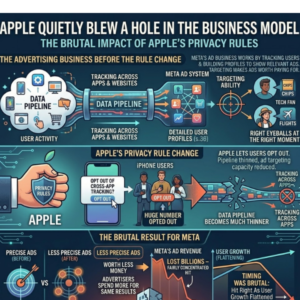
It sounds technical and dry, but the practical effect was enormous. Meta’s advertising business works — or worked — by tracking what users do across apps and websites, building detailed profiles of their interests and behaviour, and using that data to show them ads that are genuinely relevant to them. That targeting ability is what makes Meta’s ads worth paying for. Advertisers aren’t just buying eyeballs. Meta Layoffs Explained They’re buying the right eyeballs at the right moment.
When Apple introduced changes that let iPhone users opt out of cross-app tracking, a huge number of them did exactly that. Almost immediately, the data pipeline that Meta’s ad system ran on became much thinner. Ads became less precise. Less precise ads are worth less money .Meta Layoffs Explained Advertisers had to spend more to get the same results, which made the whole proposition less attractive.
Meta lost billions — not slowly, not in a way that gave them time to adjust, but in a fairly concentrated hit that landed right as their user growth was already flattening. Meta Layoffs Explained The timing was brutal.
The Metaverse Made It All Look Worse
And then there was the metaverse.
Mark Zuckerberg had made a massive, public, all-in bet on virtual reality as the future of human interaction. The company literally renamed itself around this vision. Billions were being poured into building virtual worlds where people would work and socialise and attend concerts and do all the things they currently do on flat screens, but in three dimensions with headsets on.
Whatever you think of that vision — and plenty of smart people think it’s genuinely interesting — the timing created a perception problem that was hard to ignore. On one hand, teams working on products that actually made money were being told there wasn’t room for them anymore. On the other hand, enormous budgets were still flowing into a futuristic project that hadn’t come close to proving itself commercially.
From the outside, that looked like a contradiction. Meta Layoffs Explained From inside the company, it probably felt like one too. You can understand the long-term logic — the core business is mature, the next platform shift needs to be built now or you’ll miss it — but that logic is very hard to feel good about when your colleagues are being escorted out of the building.
The metaverse spending became a symbol for everything that felt off about Meta’s priorities during this period. Whether that’s entirely fair is debatable. Meta Layoffs Explained But perception matters inside companies, and the perception was not good.
What the People Who Lost Their Jobs Actually Lost
Here’s the part that gets lost when this story gets told in terms of strategy and quarterly numbers.
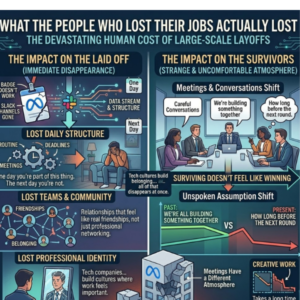
The people who were laid off didn’t just lose a pay cheque. They lost their daily structure, their teams, their sense of professional identity. Tech companies, and Meta in particular, are very good at building cultures where people feel like they belong to something meaningful. Meta Layoffs Explained Where the work feels important. Meta Layoffs Explained Where the relationships with colleagues feel like real friendships, not just professional networking.
When layoffs happen at that scale and that speed, all of that disappears at once. Not gradually, in a way you can adjust to. Immediately, in a way that leaves people genuinely disoriented. One day you’re part of this thing. The next day you’re not, and the badge doesn’t work, and the Slack channels are gone, and you’re sitting at home trying to figure out what just happened.
And for the people who stayed — the so-called survivors — it wasn’t exactly a relief. Anyone who’s been through a large-scale layoff at close range will tell you that surviving it doesn’t feel like winning. It feels strange and uncomfortable. Meta Layoffs Explained Meetings have a different atmosphere. Conversations become more careful. The unspoken assumption shifts from “we’re all building something together” to “how long before the next round.” That’s not a good environment to do creative work in, and it takes a long time to recover from.
The Signal It Sent to the Whole Industry
Meta wasn’t alone in doing this. But because of its size and its reputation, what it did sent a message that echoed across the entire tech industry.
If Meta — profitable, dominant, sitting on billions in cash — could cut this many people this quickly, then nobody was untouchable. Google laid people off. Amazon laid people off .Meta Layoffs Explained Microsoft laid people off. The dominoes fell in a way that would have seemed impossible to imagine just two or three years earlier.
The idea that tech jobs were a special category — secure in a way that other jobs weren’t, growing in a way that other industries weren’t — took a serious knock. The perks culture, the unlimited snacks and the ping pong tables and the generous parental leave policies, started to look like the dressing on a promise that turned out to have conditions attached.
What replaced it was something that looked a lot more like every other industry. Meta Layoffs Explained Cost discipline. Headcount justification. A focus on profit margins that felt almost old-fashioned compared to the growth-at-all-costs mentality that had dominated for a decade.
Where It Leaves Things Now
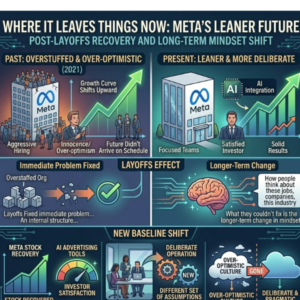
Meta as a company is doing fine. The stock recovered. Meta Layoffs Explained The business adapted. AI has given the advertising operation a new set of tools and the results have been solid enough to satisfy investors.
But something shifted that won’t fully shift back. Meta Layoffs Explained The company is leaner and more deliberate than it was, and the culture inside reflects that. People who work there now do so with a different set of assumptions than the people who worked there in 2021. The innocence — if you can call it that — is gone.
The layoffs fixed the immediate problem of an overstuffed, over-optimistic organisation that had hired for a future that didn’t arrive on schedule. Meta Layoffs Explained What they couldn’t fix is the longer-term change in how people think about these jobs, these companies, and this industry.

Your Partner in Financial Growth
Helping you save and invest smarter since 2026. Our mission is to simplify finance for everyone.