
Beyond Politics: What Actually Holds U.S.–China Business Together
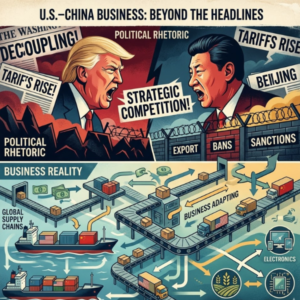
Honestly, most of what we hear on TV doesn’t match what’s actually happening on the ground., you would be forgiven for thinking the two countries are in the middle of a slow, bitter divorce. The language coming out of Washington and Beijing over the past several years has been full of words like decoupling, containment, and strategic competition. Tariffs go up. Export bans get announced. Sanctions are added to lists that keep growing longer. The tone is adversarial, and the tone is loud.
And once you start looking beyond headlines, the picture changes completely And the reality of how American and Chinese businesses actually operate — how goods get made, how money moves, how supply chains function on a Tuesday morning when no politician is watching — is considerably more complicated than the headlines suggest. In fact, in several important ways, it is the opposite of what the headlines suggest.
Instead of breaking apart, the system is slowly reshaping itself in ways most people don’t notice.. It is bending, adjusting, and in some places quietly routing around the political pressure being applied to it. That is a very different thing.
Decoupling Is a Word Politicians Love and Businesses Mostly Ignore
Politicians talk about “decoupling” like it’s something they can switch on or off.
But in real life, global trade doesn’t work like a button. and then done. As though some trade official signs a paper and the world’s two largest economies begin the orderly process of separating from each other.
Once two economies are deeply connected, separating them becomes extremely slow and messy.
Use 2–3 short sentences instead of one long paragraph. Some companies are diversifying where they source components. Some are moving final assembly out of China and into Vietnam, India, or Mexico. Some are building what they call “China-plus-one” strategies, meaning they keep significant operations in China while developing a backup elsewhere. None of this is fast. None of it is cheap. And none of it amounts to anything close to the clean separation the political language implies.
The reason is simple: the United States and China spent roughly four decades building a shared economic system together. Not just trade in the straightforward sense of one country selling things to another, but something far more interwoven than that. Factories calibrated to each other’s specifications. Shipping routes and port infrastructure built around specific trade volumes. Supplier networks where a company in Shenzhen knows the tolerances and timelines of a company in Ohio because they have been working together since the early 2000s. Logistics hubs, warehousing systems, quality control processes — all of it built up over decades of iterative relationship-building.
That kind of infrastructure does not disappear because a trade war starts. It persists, because nothing has been built to replace it yet, and because the economics of the existing system are still, in many cases, more favourable than the alternatives being proposed.
How Products Are Actually Made
To understand why this relationship is so difficult to restructure, it helps to think concretely about how modern manufactured goods actually come into existence.
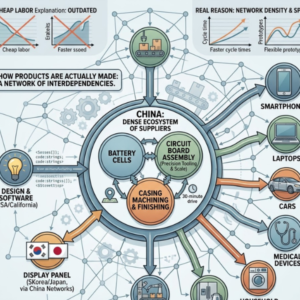
Let’s take a smartphone. It looks simple when you hold it, but it is actually built across several countries. but behind it is a global chain you never see because virtually everyone reading this owns one No single place makes it completely. Different parts come from different regions, and everything is assembled together at the end. But then things get complicated quickly The display panel might come from South Korea or Japan, but manufactured in a facility with deep ties to Chinese supply networks. The battery cells are likely Chinese. The circuit board assembly — the process of taking hundreds of tiny components and placing them precisely on a board the size of a playing card — happens in factories in China that have spent years developing the specific expertise and tooling to do this at scale and speed. The casing might be machined in one place, coated in another, quality-checked in a third.
This isn’t just about smartphones — it’s how almost all modern products are made.
Today’s manufacturing is a network, not a single factory. Every product depends on multiple connected systems working together.It is a network of interdependencies, and in many of the most important product categories, China sits at the centre of that network.
The real reason China is so important in manufacturing is not just cheap labor anymore. That explanation was already becoming outdated a decade ago and is increasingly misleading now .It’s the ecosystem — suppliers, factories, and tools all located close to each other, making production fast and efficient.. In the manufacturing regions of southern and eastern China, you can find the toolmaker, the component supplier, the assembly house, and the quality testing facility within a thirty-minute drive of each other. When a product needs to be modified — when an engineer spots a problem at midnight and needs a revised prototype by morning — that geographical concentration makes it possible. Moving production to a country where that ecosystem does not yet exist means losing that speed and flexibility, and for companies competing in fast-moving markets, that loss is not trivial.
The Feedback Loop Nobody Talks About
Companies don’t just manufacture in China — they actually learn from it. that rarely makes it into mainstream discussions: the relationship between American companies and China is not simply one of design-here, manufacture-there. It is genuinely two-directional in ways that have consequences for innovation.
Working in such a competitive market changes how they design and improve products later.. They learn things. They learn from operating in one of the most intensely competitive consumer markets on earth, where expectations are high, trends move fast, and rivals are aggressive. They learn from working alongside Chinese engineers and manufacturers who have developed real technical expertise over the years — expertise that, in some domains, is now world-leading rather than derivative.
That knowledge travels. Executives who have spent time managing operations in China bring a particular understanding back with them. Engineers who have worked on production lines in Chinese factories understand manufacturing constraints in ways that affect how they design products in the future. These feedback loops are invisible in trade statistics but they are real, and they are one reason why the relationship is not simply transactional in the direction people assume .
The Consumer Market That Cannot Be Ignored
Even if production moved somewhere else, companies still cannot ignore China. — which it cannot — it would still face a separate and equally awkward question: what do you do about the customers?
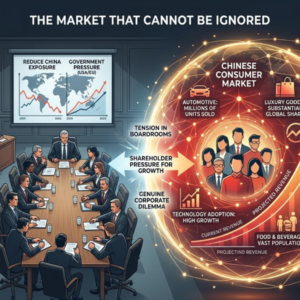
It is one of the biggest consumer markets in the world, and for many businesses, it is a major source of revenue.. For many global companies, it is not a nice-to-have. It is a significant portion of current revenue and an even larger portion of projected future growth. Automotive companies sell millions of vehicles there. Luxury goods companies depend on Chinese consumers for a substantial share of global sales. Technology companies, food and beverage companies, retail brands — across sector after sector, China represents a market that no serious global business can simply walk away from because the political atmosphere has become uncomfortable.
This creates a genuine tension in corporate boardrooms that does not get discussed honestly very often. Executives are simultaneously under pressure from governments to reduce exposure to China and under pressure from shareholders to maintain access to Chinese consumers and growth. These pressures do not resolve neatly. They get managed, which usually means companies say the right things publicly while making quieter calculations privately about what they can and cannot afford to give up.
The People Who Actually Keep It Working
Behind this entire system, there are thousands of professionals who quietly keep everything running. of this whole story is the human infrastructure that holds it together.
Over the past three or four decades, a substantial professional class has built careers specifically around the U.S.–China economic relationship. Trade lawyers who understand both regulatory systems. Logistics managers who know which ports get backed up in typhoon season and which shipping routes avoid the worst of it . Procurement specialists who have personal relationships with supplier factories going back fifteen years. Financial professionals who understand how to structure transactions across two currency systems and two legal frameworks.
They don’t appear in news headlines, but without them, the system would not function properly. They are not part of the decoupling conversation. But when something goes wrong — when a new regulation appears and creates a compliance problem, when a tariff change disrupts a pricing model, when a shipping bottleneck threatens a product launch — these are the people who figure out what to do next. They find workarounds. T hey reroute. They call someone they know on the other side of the world and solve the problem before it becomes a headline.
The system functions under political pressure in large part because of these individuals, and their accumulated expertise is itself a form of infrastructure that would take a generation to rebuild if the relationship were ever genuinely severed.
Where Politics Is Actually Changing Things
Politics does matter, but mainly in a few sensitive areas like technology and security.. It clearly does, and the effect has grown significantly over the past five or six years.
Outside of that, most trade and business continues almost normally. has been one of the most consequential shifts. Semiconductors are the clearest example — advanced chips are now treated as a strategic resource, and the restrictions on their sale and the technology used to make them have created genuine disruption. But it goes beyond chips. Artificial intelligence hardware, advanced battery technology, certain categories of biotech and genomic data — these are all areas where governments on both sides are actively trying to limit the other’s access, and where the commercial and the political have become genuinely hard to separate.
What this is creating is not a clean decoupling but something more uneven — a two-speed relationship where high-technology sectors are being deliberately pulled apart while everything else largely continues as before. Consumer goods keep moving. General manufacturing keeps humming. The economic logic in those areas is simply too strong to override with political will alone.
Companies are adapting to this bifurcation in various ways. Some are building parallel structures — separate supply chains, separate data systems, separate management teams — so that their Chinese operations are sufficiently ring-fenced from their operations elsewhere to satisfy regulators on both sides. Others are creating what they call China-for-China models, where products sold in China are developed and made entirely within China, reducing the points of contact that create regulatory risk.
What Comes Next
The honest answer is that The reality is simple — this relationship is not breaking apart. and anyone who tells you otherwise with great confidence is probably selling you something.
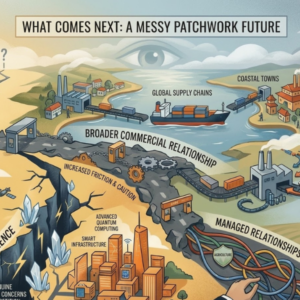
It is changing slowly, becoming more complicated, but still deeply connected in many ways the full integration of the past nor the clean separation that some politicians advocate for. It is something messier and more specific — a patchwork of sectors and products and relationships, some more restricted than before, some largely unchanged, all of it managed with more friction and more caution than existed ten years ago .
The high-technology sectors will probably continue to diverge, driven by genuine security concerns on both sides as well as genuine competition for technological leadership. The broader commercial relationship — the mass of ordinary goods and consumer products and industrial components that constitute the bulk of actual trade — will continue for the same reasons it always has: because it works, because alternatives are not yet ready, and because the economic consequences of abandoning it are ones that neither side has yet been willing to absorb.
The Stubborn Reality
The simplest way to misread the U.S.–China relationship is to take the political narrative at face value. Politics deals in clear positions, firm stances, and decisive-sounding language. The economic reality underneath it is slower, stickier, and considerably less dramatic.
Supply chains built over four decades do not reorganise in four years. Markets the size of China’s do not become optional because the diplomatic relationship sours. Expertise accumulated over careers does not transfer to new locations because a policy document says it should.
What you end up with is a relationship that is more contested than it was, more carefully managed, more subject to restriction in specific sensitive areas — but still fundamentally intact in the ways that govern most of daily commercial life. Held together not by goodwill, not by political alignment, and certainly not by trust in any simple sense. Held together by the accumulated weight of four decades of mutual economic dependency, which turns out to be one of the more durable forces in modern life.

Your Partner in Financial Growth
Helping you save and invest smarter since 2026. Our mission is to simplify finance for everyone.