
The Ardoyne Community Urban Forest: How One Belfast Neighbourhood Is Growing Something Worth Keeping
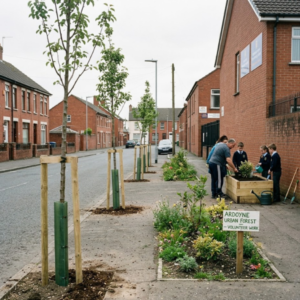
Walk through Ardoyne on a Tuesday morning and you might not notice it straight away. It is not a dramatic transformation. There is no grand park with a sign at the entrance. What you see instead are small things — a row of young trees along a kerbside, their trunks wrapped in protective guards. A patch of ground that last year held nothing but litter and old bricks, now cleared and planted. A school wall with a raised bed beside it, built by the children who use it .Ardoyne
These are the beginnings of the Ardoyne Community Urban Forest, and if you know anything about how this part of North Belfast has looked for the past several decades, you will understand why even these small beginnings matter .Ardoyne
A Neighbourhood Built Without Breathing Room
Ardoyne was built quickly, as so many working-class neighbourhoods in Belfast and across these islands were. Housing went up fast to meet demand. Streets were packed in tightly. Green space was not a priority — or at least, nobody in a position of power treated it as one. The result is a dense residential area where concrete, brick and tarmac dominate almost everything you can see from street level .Ardoyne
That is not a complaint unique to Ardoyne, of course. It is the story of dozens of similar communities across Belfast, across the north of Ireland, across Britain. But it has real consequences for the people who live there. Heat is one of them. Cities trap warmth in ways that open countryside does not, and the effect is most severe in the most built-up areas. On a hot summer day, a street with no trees offers no shade. The asphalt radiates heat long after the sun goes down. Walking to the corner shop becomes genuinely unpleasant. For older residents and children, it can be worse than unpleasant. Ardoyne
Air quality is another issue. Trees do not just look nice — they filter pollutants, absorb carbon dioxide, and release moisture that keeps the air cooler and cleaner. A street with mature trees on both sides is measurably different to breathe on compared to one without. Ardoyne has had very few mature trees, and that has shown.
Then there is something harder to quantify but equally real: what it feels like to live somewhere that has no green. No leaves changing in October. No blossom in April. No shade on a bench in July. These things affect mood. They affect how people feel about where they live. Researchers who study urban environments have documented this consistently — access to green space is tied to better mental health outcomes, lower stress, a greater sense of community connection. Its absence is not neutral .Ardoyne
What Changed, and Why It Matters That It Wasn’t Top-Down
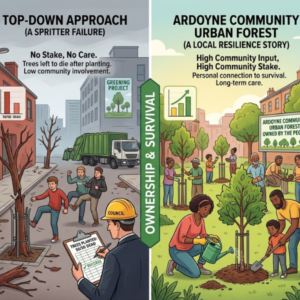
A lot of urban greening projects work like this: a local council identifies an area with low tree coverage, draws up a plan, hires contractors, plants trees. The trees go in. Within three or four years, half of them are dead. Nobody pruned them. Nobody watered them through the first dry summer. Teenagers kicked the guards off for something to do. The council marks it as a success on a spreadsheet because the trees were planted, and moves on .Ardoyne
The Ardoyne project is trying to do it differently. The starting point was not a council office or a grant application — it was the community. Residents were involved in deciding where trees should go, what species would be planted, and what the project was actually for. That sounds like a small thing, a procedural nicety, but it fundamentally changes what the project is. When people have had no say in something, they have no stake in it. When they helped choose it, helped plan it, maybe helped dig the first hole, it belongs to them in a way that a top-down intervention simply does no t Ardoyne
This matters enormously for what happens next. Trees take years to establish. The first couple of summers are critical — a young tree needs water, needs its guard checked, needs someone to notice if it is struggling. TArdoyne hat kind of attention only comes from people who care. And people care when they feel ownership. The community involvement in Ardoyne is not a nice add-on to the project. It is the mechanism that gives the project a realistic chance of lasting.
Fruit Trees and the Question of Usefulness
One of the more interesting choices the project has made is to plant fruit trees alongside ornamental and native species. Apple trees, pear trees, plum trees — the kind that will, in a few years, actually produce something you can eat.
This is not just a symbolic gesture. It changes the relationship between residents and the trees in a practical way. A fruit tree is visibly useful. Children who grow up watching it blossom in spring and checking it for apples in August are learning something direct and memorable about how plants work, about seasons, about patience. That knowledge does not go away .Ardoyne
There is also something important about what fruit trees say about public space. A green space that just has grass and decorative trees sends a message: this is maintained for you to look at. A space with fruit trees you are welcome to pick from sends a different message: this is productive, this is yours, take from it. It is a more generous conception of what shared urban land can be. Ardoyne
The fruit trees also do everything that other trees do. They provide shade. They support pollinators — bees in particular, which are under considerable pressure across the British Isles as their habitats disappear. They slow the movement of rainwater, reducing the load on drainage systems during heavy downpours, which is increasingly relevant as rainfall patterns become more unpredictable. A mature apple tree is not just a nice thing to look at. It is doing several jobs at once. Ardoyne
Children and Schools at the Centre
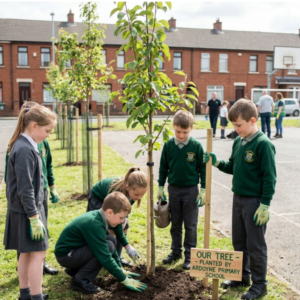
The project has made a deliberate effort to involve schools and children, and this is one of the smarter things about it. Children who plant a tree and watch it grow develop a connection to it that is hard to manufacture any other way. They will remember planting it. They will notice when it flowers. Five years from now, some of them will bring a younger sibling to show them the tree they planted when they were in primary school. Ardoyne
This is how environmental values are actually transmitted between generations — not through lessons about climate change in abstract, but through tangible, local, personal experience. A child who grew up with nothing but concrete around them, and who then helped plant a tree and watched it survive its first winter, has learned something that no classroom can fully replicate.
Schools also provide a natural structure for the ongoing care that young trees need. When tree care becomes part of a school’s routine — watering during the summer when the caretaker is around, checking on the trees in the playground, talking about what they’re noticing — it normalises the idea that people are responsible for the living things around them. That is a genuinely useful attitude to grow up with .Ardoyne
Training, Pruning, and the Long Game
The project has also been running training sessions for adult residents on how to care for trees — how to prune correctly so you don’t damage the tree, how to water effectively, when to harvest, what signs of disease or stress to look for. This is practical knowledge, the kind that used to be passed down through communities naturally but has largely been lost in urban settings over the past century.
It is also a signal about what kind of project this is. If you plant trees and then leave people to figure out the rest on their own, you are setting up the trees to fail and the community to feel let down. If you equip people with the skills to look after what has been planted, you are building something that can actually sustain itself. The training sessions are not a secondary feature of the project — they are part of its core logic.
What Ardoyne Might Look Like in Twenty Years
It would be dishonest to pretend the transformation is already visible in any dramatic way. A young tree planted last autumn is still a young tree. The changes that are coming will arrive slowly, over years and decades .Ardoyne
But that is also the point. The goal is not a quick win that looks good in photographs and then fades. The goal is a neighbourhood that, over time, becomes genuinely different to live in. Streets with canopies. Air that feels cleaner in summer. Blossom in spring that people start to expect and look forward to. Fruit that children pick on the way home from school without thinking twice about it, because it has always been there .Ardoyne
Alongside the physical change is a shift in how residents relate to their own neighbourhood. Not as something that happens to them, managed by agencies and authorities who may or may not show up, but as something they are part of making. That shift is slower and harder to measure than tree coverage, but it may ultimately be the more lasting thing .Ardoyne
Ardoyne has not always had reason to expect much from the people and institutions with power over it. This project is not going to change that history. But it is doing something smaller and in some ways more durable: it is giving people in the neighbourhood a reason to invest in the place they live, and real tools to make that investment count Ardoyne

Your Partner in Financial Growth
Helping you save and invest smarter since 2026. Our mission is to simplify finance for everyone.