
HCA Healthcare Q1 2026 — What the Numbers Are Actually Telling You
Let me be straight with you from the start.
HCA Healthcare’s Q1 2026 results are the kind of earnings report that looks perfectly fine at first glance and then starts to feel a bit uncomfortable the longer you sit with it. The headline numbers are not bad. Revenue came in at $19.1 billion, up a few percent from the same quarter last year. Adjusted earnings per share landed around $7.15, which also grew nicely year over year. If you just read the summary and moved on, you would probably think everything is ticking along just fine.
But the stock dropped roughly seven percent in premarket trading after those results came out.
That reaction is the real story. Markets do not drop a stock seven percent on a decent earnings report because investors are in a bad mood. They do it because when they looked past the headline figures, something underneath made them nervous. And in this case, there were actually a few things worth being nervous about — some temporary, some potentially more persistent.
Let me walk through what actually happened this quarter and why it matters.
Why the First Impression Is Misleading
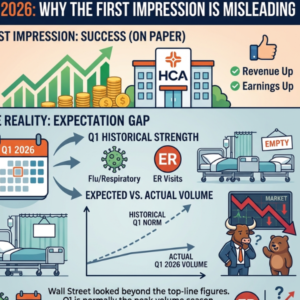
When you look at the top-line numbers for Q1 2026, HCA Healthcare looks like a company that is doing its job. Revenue up, earnings up, operations humming along in a business that is one of the largest hospital operators in the entire United States.
So what is the problem?
The problem is expectations. Not just Wall Street analyst expectations — though those matter too — but the kind of expectations that come from understanding how hospital businesses actually work and what a normal first quarter is supposed to look like for them.
Q1 is historically a strong period for hospitals. Winter brings flu season, respiratory illnesses, emergency room visits, all the things that push patient volumes up and keep hospital beds full. Insurance deductibles reset at the start of the year, which sounds counterintuitive — you might think people avoid hospitals when they have to pay more out of pocket — but in practice a lot of people who have been putting off treatment come in early in the year once their coverage resets.
In short, Q1 should be a busy, profitable quarter for a hospital operator like HCA Healthcare. This particular Q1 was not as busy as it should have been. And that gap between what normally happens and what actually happened this time is what the market was reacting to.
The Flu Season That Did Not Show Up
The single biggest factor behind the softer-than-expected patient volumes this quarter was remarkably simple: fewer people got seriously sick this winter.
Compared to the prior year, respiratory illness cases dropped noticeably. The flu season was milder than usual. That sounds like straightforwardly good news for public health, and in a human sense it obviously is. But for a hospital network that depends on seasonal volume spikes to drive a strong first quarter, a mild flu season is a genuine financial headwind.
When fewer people develop serious respiratory illnesses, you get fewer hospital admissions. Fewer admissions means fewer emergency room visits, fewer inpatient stays, and fewer high-margin treatments like ICU care and complex respiratory interventions. These are among the more profitable services a hospital provides. When that wave of patients simply does not arrive the way it normally does, it leaves a visible hole in the numbers.
This is not a management failure. HCA Healthcare did not do anything wrong here. The flu season was mild across the country and every hospital operator felt some version of this. But mild flu seasons are not permanent — they rotate. The question investors are always asking in situations like this is whether the weakness is genuinely temporary or whether it is masking something more structural. We will come back to that.
The Winter Storm Nobody Is Talking About
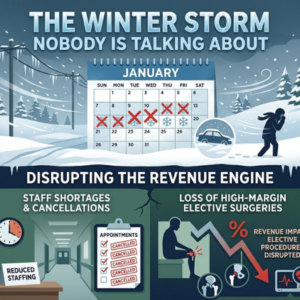
On top of the mild flu season, HCA Healthcare was also dealing with the aftermath of a significant winter storm in January that disrupted normal hospital operations across several of its regional markets.
Storms cause problems for hospitals in ways that are not always obvious. Elective surgeries get postponed because patients cannot safely travel to appointments. Staff have difficulty getting to work, which forces hospitals to run lean. Patients who would normally come in for scheduled procedures stay home. The storm passes, but the activity that was supposed to happen during those disrupted days does not always fully recover — some of it gets rescheduled, but some of it just disappears from the quarter entirely.
Elective surgeries matter a lot to hospital profitability. These are planned procedures — knee replacements, hip replacements, cardiac procedures, various outpatient surgeries — that patients schedule in advance. They tend to be high-margin, relatively predictable, and important to the overall revenue mix. When a storm knocks out several days of elective procedure scheduling across multiple facilities in a large network like HCA Healthcare’s, the financial impact is real.
Put the mild flu season and the January storm together and you start to understand why Q1 came in softer than expected despite the headline numbers looking acceptable.
The Numbers Underneath the Numbers
When you look at HCA Healthcare’s same-facility metrics — the figures that show how existing hospitals are performing, stripping out any expansion — the picture becomes clearer.
Admissions were up about one percent. That sounds okay until you remember that Q1 historically delivers meaningfully stronger growth. Emergency room visits were almost flat. Surgeries were slightly down. Outpatient procedures were also down.
Now here is the part that matters most and does not always get explained clearly.
Hospitals do not make the same amount of money from every patient. A patient who comes in for a complex surgical procedure generates far more revenue than a patient who comes in for a basic emergency room visit. A patient who requires intensive care over several days is significantly more valuable to the hospital’s bottom line than someone who is admitted overnight for observation.
So even a small decline in surgical volumes hits profitability harder than the raw patient count numbers suggest. If admissions are up slightly but the mix of those patients skews toward lower-complexity cases — because the high-acuity winter illnesses did not arrive in normal volumes — revenue and margins both feel it. The headlines say patient volumes were roughly stable. What they do not say is that the composition of those patients was less favourable than usual.
The Insurance Mix Shift That Has Investors More Concerned
Here is where things get a little more complicated, and honestly a little more worrying than the seasonal stuff.
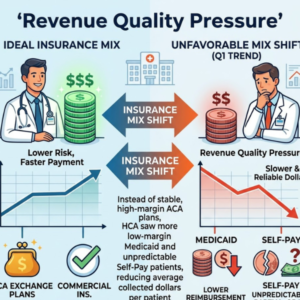
HCA Healthcare saw a decline this quarter in patients coming through ACA exchange plans. These are the government-subsidised insurance marketplaces where individuals and families purchase coverage. Patients coming through these plans generally have predictable insurance reimbursements — the hospital treats them, submits the claim, and gets paid a known amount on a known timeline.
What HCA Healthcare saw instead was more patients falling into two less desirable categories: Medicaid and self-pay.
Medicaid patients are insured, but Medicaid reimbursement rates are lower than commercial insurance rates. The hospital still gets paid, but it gets paid less per patient than it would for someone with private insurance or an ACA plan. Self-pay patients are even more complicated — these are people without insurance coverage, and collecting payment from them is slower, less predictable, and often results in partial payment or no payment at all.
This insurance mix shift creates what analysts call revenue quality pressure. The total number of patients may not fall dramatically, but if an increasing share of those patients are reimbursing the hospital at lower rates or not reliably paying at all, the actual dollars collected per patient goes down. HCA Healthcare’s management estimated that this dynamic alone created a meaningful headwind to EBITDA during the quarter.
This is the part of the Q1 story that investors found most unsettling. Mild flu seasons and winter storms are temporary and unpredictable by nature — they wash out over time and do not tell you much about the structural health of the business. But insurance mix shifts can be stickier. If the trend of fewer ACA exchange patients and more Medicaid and self-pay patients continues into future quarters, that is a more persistent headwind that affects the quality of every dollar HCA Healthcare earns.
The One Thing That Actually Went Right
In the middle of all this, there was one genuine positive worth acknowledging.
Even though the volume of patients was weaker than expected, the patients HCA Healthcare did treat tended to be more complex cases. In hospital finance, this is referred to as acuity — a measure of how sick or medically complicated the average patient is. Higher acuity means more intensive treatment, more expensive procedures, and higher reimbursement per patient.
So while HCA Healthcare was seeing fewer patients in certain categories, the patients it was seeing required more care. Revenue per adjusted admission grew. That is what helped prevent the volume weakness from translating directly into a proportionally worse revenue shortfall. The higher acuity of the patient mix acted as a partial offset to the lower volumes.
This is actually a credit to how HCA Healthcare has positioned its facilities — in markets and service lines where complex, high-acuity cases come naturally. But it is worth noting that you can only lean on acuity so much. You cannot replace volume weakness entirely with higher revenue per patient indefinitely.
Cost Control — The Quiet Strength That Keeps Getting Overlooked
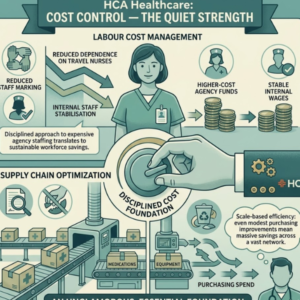
While all the attention goes to volumes and insurance mix, HCA Healthcare’s cost management this quarter deserves credit.
Labour costs — the single largest expense for any hospital operator — were kept under control. This is harder than it sounds. Healthcare staffing has been genuinely difficult and expensive coming out of the pandemic years, with nursing shortages driving up wages and travel nurse costs across the industry. HCA Healthcare has worked steadily to reduce its dependence on expensive agency and travel nurses and rebuild more stable internal staffing. That work is showing up in the numbers.
Supply chain management also improved. Hospitals purchase enormous quantities of medical supplies — equipment, medications, consumables of every kind. At the scale HCA Healthcare operates, even modest improvements in purchasing efficiency, waste reduction, and contract negotiation translate into hundreds of millions of dollars in savings across a full year.
None of this is exciting. It does not generate headlines the way a major acquisition or an AI announcement does. But disciplined cost management is what keeps a large hospital operator financially healthy during quarters when the revenue side disappoints. It is the unglamorous foundation that everything else rests on.
A Word on the AI Conversation
Because it is impossible to discuss any large company in 2026 without someone bringing up artificial intelligence, let us address it briefly and honestly.
HCA Healthcare is using AI in parts of its operation. Specifically, it has been deploying AI tools to handle administrative tasks that previously consumed significant amounts of physician and nursing time — documentation, note-taking, coding. It is using predictive models to help manage patient discharge timing, which affects bed availability and operational flow. And it is applying AI to billing and insurance claims processing to reduce errors and speed up collections.
All of this is genuinely useful. It is saving time and reducing waste in a system where both are chronically scarce. But it is not a revolutionary transformation of how the hospital operates. It is technology being applied sensibly to specific operational problems. Worth knowing about, worth keeping an eye on as it scales — but not a reason on its own to buy or sell the stock.
Cash Flow Tells the Real Story of Where HCA Healthcare Stands
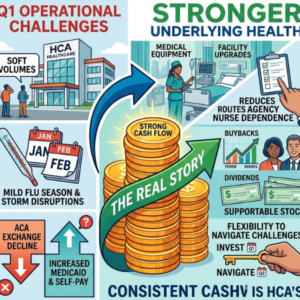
Despite the softer volume quarter and the margin pressures, HCA Healthcare still generated strong cash flow. This is the most important single fact about the company’s financial health right now.
Hospitals are expensive to run and expensive to expand. Equipment costs money. Facilities need constant maintenance and upgrading. New capacity requires significant upfront capital. Through all of that, HCA Healthcare’s ability to consistently generate cash from its operations is what gives it the flexibility to invest, return money to shareholders, and navigate quarters like this one without any real threat to the business.
The company has been aggressive about returning capital to shareholders through buybacks. Fewer shares outstanding means earnings per share look better even when net income is not growing rapidly — it is a mathematical lever that HCA Healthcare has been pulling consistently. Combined with steady dividend payments, this makes the stock more supportable during periods when operational growth is uneven.
Is This a One-Quarter Blip or Something More?
The honest answer is that it is probably both, depending on which part of the Q1 story you are looking at.
The seasonal factors — the mild flu season and the January storm — are almost certainly temporary. Healthcare demand does not evaporate. People who delayed treatment will eventually come in. Respiratory illness patterns will shift again next winter. These are not structural problems with HCA Healthcare’s business model.
The insurance mix shift is a more open question. If ACA exchange enrollment continues to decline and more patients arrive uninsured or on Medicaid, that creates a persistent headwind to revenue quality that does not go away when flu season returns. Management says they expect volumes to normalise through the rest of 2026. That is probably true on the volume side. Whether the insurance mix normalises alongside it is less certain.
What This Quarter Actually Tells You About HCA Healthcare
HCA Healthcare is not a company in trouble. Let us be clear about that. It is still one of the most operationally capable hospital operators in the country, with a scale, a cost structure, and a cash generation profile that most competitors cannot match.
But Q1 2026 is a reminder that even the strongest businesses in defensive industries are not immune to external pressures. A milder-than-normal flu season, a well-timed storm, a shift in the insurance landscape — none of these are catastrophic individually, but they land in the same quarter and together they produce results that disappoint a market that had grown used to reliable outperformance.
The stock reaction reflects that disappointment and the uncertainty about how much of what happened in Q1 carries into the rest of the year.
For investors, the question is straightforward even if the answer is not: is the business fundamentally as strong as it was six months ago, and did the market overreact to a quarter that had some genuinely unusual circumstances behind it?
My read is yes to the first question and probably yes to the second — but with the caveat that the insurance mix trend is worth watching very carefully over the next two quarters. If that stabilises, the stock looks interesting at these levels. If it continues to shift in the wrong direction, the Q1 weakness starts to look like the beginning of something rather than a one-off.

Your Partner in Financial Growth
Helping you save and invest smarter since 2026. Our mission is to simplify finance for everyone.