
10 Simple Money Habits That Can Quietly Make You Wealthier Over Time

Most people think building wealth comes down to discipline.
I used to believe that too.
The idea makes sense on the surface. You decide you are going to save money, you stick to the plan, and eventually your bank account grows. Simple enough.
Except it almost never works that wayv.Saving
The problem with relying on discipline is that it holds up fine for a few days, maybe a couple of weeks if you are really motivated. Then real life shows up. Your friend texts asking if you want to grab dinner. Your car starts making a noise it was not making last week. You walk past a shop window and see something that somehow feels urgent to own even though you survived perfectly fine without it until thirty seconds ago.
The money you planned to save finds somewhere else to go. And then you feel guilty about it, which somehow makes the next impulse purchase easier to justify. It becomes a cycle. Saving
Here is the thing though — the people who consistently build savings and grow their wealth over time are usually not more disciplined than you. They have not unlocked some secret reserve of willpower that the rest of us lack. What they have done, almost without exception, is set things up so that saving happens automatically, without requiring a decision every single time.
The habits below are not dramatic. None of them will feel like a life-changing revelation. But done consistently, in the Saving background, without requiring you to be motivated every day, they quietly add up to something significant. That is the whole point.
1. Stop Expecting Willpower to Do the Heavy Lifting
Let us start with the most common money mistake people make, because getting this wrong undermines everything else.
Most people save whatever is left over at the end of the month. The logic seems reasonable — pay your bills, cover your expenses, enjoy your life, and put aside whatever remains.
The problem is that there is almost never anything left. Not because people are reckless with money, but because money is remarkably good at disappearing into small, forgettable purchases. A coffee here, a takeaway there, a few things added to an online basket without much thought. By the end of the month, you look at your account and wonder where it all went .Saving
The fix is simple but it requires you to flip the order of things .Saving
Move money into savings before you have a chance to spend it. Not at the end of the month — at the beginning. Ideally the same day your pay arrives. Set up an automatic transfer that pulls money into a savings account the moment your salary hits.
You do not have to start big. Five percent of your income is a perfectly reasonable starting point. The goal is not the amount — it is making saving something that happens without you needing to decide to do it every single month. Because if it requires a decision, there will eventually be a month where you decide not to .Saving
2. Make Your Savings Slightly Inconvenient to Access
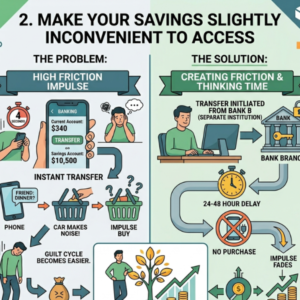
This one sounds strange at first. Why would you want your own money to be harder to reach? Saving
Here is why.
When your savings account lives right next to your current account inside the same banking app, moving money between them takes about four seconds. That is convenient for emergencies — genuine ones, where you need cash fast. But it is a real problem for everything else, because it means that whenever you feel a strong urge to buy something, there is almost no friction standing between that urge and your savings disappearing. Saving
Open a savings account at a completely separate bank. One that is not connected to your main account in the same app. When you want to move money out of it, you have to log into a different bank, navigate to the transfer section, and wait for the transfer to process — usually a day or two. Saving
That delay is the point. It gives you time to think. Most impulse purchases feel absolutely necessary in the moment and completely unnecessary twenty-four hours later. The inconvenience is not a bug. It is doing exactly what it is supposed to do.
3. Increase Your Savings Rate So Slowly You Barely Notice
A lot of people try to fix their finances all at once. They sit down one Sunday, feel genuinely motivated, and decide that starting Monday they are going to save thirty percent of their income, cut out every non-essential expense, and meal prep every single day.
By Thursday the plan has usually fallen apart. Saving
The problem is not the goal — it is the pace. Trying to change everything at once is exhausting, and the moment one part slips, the whole thing tends to collapse. Saving
A much better approach is almost embarrassingly gradual. If you are currently saving five percent of your income, try bumping it to six. That is it. Just one extra percentage point.
You will genuinely not feel that difference in your day-to-saving day life. Your spending habits do not need to change significantly. But if you do that once every three or four months — moving from five to six, then six to seven, then seven to eight — within a couple of years you are saving at a rate that would have felt completely impossible when you started.
Small increases, done consistently, beat dramatic overhauls every single time. The dramatic overhauls feel more satisfying to plan but they rarely last. The boring, gradual increases almost always do.
4. Go Through Your Subscriptions Every Few Months
Subscriptions are designed to be forgettable. That is not an accident. Saving
Companies that sell subscription services know that the hardest part is getting you to sign up. Once you have signed up and a monthly charge is quietly leaving your account, most people never think about it again. The charge blends into the noise of all the other small transactions and just keeps going, month after month, sometimes for years .Saving
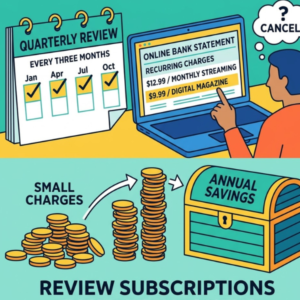
Set a reminder in your calendar every three months. When it goes off, open your bank statement and go through every single recurring charge. Write them down if it helps.
For each one, ask yourself honestly: if this subscription did not already exist and someone offered it to me today at this price, would I pay for it?
Not “do I kind of like having it.” Not “I might use it more in future.” Would you actually sign up for it right now, paying what you currently pay?
If the answer is anything other than a clear yes, cancel it .Saving
You will likely find two or three things you had completely forgotten you were paying for. Some people find more. Those monthly charges are small individually, but they add up to a meaningful amount over a year.
5. Never Walk Away From Free Money at Work
If your employer offers a pension or retirement match and you are not taking the full amount, you are leaving part of your salary on the table. There is no polite way to say this — it is one of the most straightforward financial mistakes you can make.
Here is how it typically works. Your employer agrees to match a certain percentage of whatever you contribute to your retirement fund. So if you put in three percent of your salary, they also put in three percent. That is an immediate 100 percent return on your contribution before any investment growth has happened at all. Saving
There is almost nothing else in personal finance that gives you that kind of instant return. It beats any savings account rate. It beats most investment returns you will see in a normal year.
If you are not contributing enough to capture the full employer match, adjust your contributions until you are. Do it this week if you can. Every month you are not doing this is a month where you are handing back part of your compensation.
6. Build a Small Emergency Fund First — Before Anything Else

A lot of personal finance advice jumps straight to investing, growing wealth, and building long-term assets. All of that matters. But if you do not have a basic emergency fund in place, you are building everything on a shaky foundation.
Here is what happens without one. Something unexpected comes up — car trouble, a medical bill, a boiler breaking down, a gap between jobs. Because you have no savings set aside for exactly this kind of thing, you either go into debt to cover it or you drain whatever investments you had started to build.
Then you are back at square one, often slightly worse off because you paid interest on top.
Start by saving one month of essential expenses. Not luxuries — just rent, food, bills, and transport. Once you have that sitting somewhere safe and accessible, extend it to two months. The common advice is to eventually have three to six months saved, but even one month creates a cushion that changes how you handle unexpected costs.
With a real emergency fund in place, a broken car is an inconvenience, not a financial crisis. That distinction matters more than people realise.
7. Pay Attention to What You Actually Spend — Even Once
Most people have a rough mental picture of where their money goes each month. That picture is almost always wrong.
Not because people are careless, but because we are genuinely bad at tracking small, repeated spending. We remember the big things — rent, car payment, electricity. We consistently underestimate the small, frequent things — the coffees, the lunches, the quick online orders, the apps.
You do not need to obsessively track every penny for the rest of your life. But doing it for a single month — really paying attention, logging everything — tends to reveal one or two spending categories where the numbers are much higher than you expected.
That knowledge alone changes behaviour. Once you see that you spent a genuinely surprising amount on food delivery last month, you naturally think about it differently the next time you are about to order. Awareness does a lot of the work that willpower alone cannot.
8. Stop Trying to Time the Market — Just Start
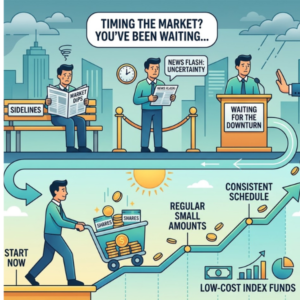
If you are waiting for the right moment to start investing, you have probably been waiting for a while.
Markets go up, then they dip, then there is some news event that makes everything feel uncertain, then they recover, and then there is something else to worry about. There is never a moment that feels perfectly safe and obvious to start.
The research on this is fairly consistent — the biggest cost of trying to time the market is the time you spend out of it. Being invested, even imperfectly, even at a slightly wrong moment, tends to beat sitting on the sidelines waiting for the stars to align.
If you have access to low-cost index funds, start putting regular, small amounts in on a consistent schedule. Do not try to predict when to buy more or pull back. Just keep going. This approach — sometimes called pound-cost averaging or dollar-cost averaging depending on where you are — smooths out the ups and downs naturally over time. You buy more shares when prices are lower and fewer when prices are higher, without having to make that call yourself.
The best time to start was earlier. The second best time is now.
9. Be Honest About Lifestyle Creep
Every time your income goes up — a pay rise, a bonus, a better job — there is a natural pull to upgrade your life in proportion. Better flat, newer car, nicer restaurants, more frequent holidays. Some of that is entirely reasonable. You earn more, you enjoy more. There is nothing wrong with that.
The issue is when every single income increase gets immediately absorbed into a higher spending baseline, leaving you with more income but exactly the same amount left over at the end of the month. This is lifestyle creep, and it is one of the main reasons people on genuinely good salaries still feel like they cannot seem to get ahead.
When you get a pay rise, make a deliberate decision about how to split it before you have a chance to absorb it into your spending without thinking. Something like — half goes toward lifestyle improvements, half goes toward savings or investments. The exact split is up to you, but having any split is what matters. Otherwise the entire increase tends to disappear into daily life without you making any intentional choice about it.
10. Stop Comparing Your Finances to Other People’s Visible Spending
This one is harder to quantify than the others but it matters more than most people admit.
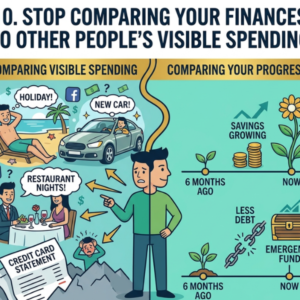
A huge amount of spending that people regret later happens because of comparison. The friend who seems to be going on holiday every few months. The colleague with the newer car. The social media feed full of people eating at restaurants you have never been to and wearing things you cannot quite afford.
What you are seeing is other people’s highlights. You are not seeing their credit card statements, their overdrafts, their arguments about money, or the anxiety that sometimes comes with spending more than you earn because you felt pressure to look a certain way.
Some of those people are genuinely wealthy and can afford everything they appear to be doing. Some of them absolutely cannot and are quietly in financial trouble. From the outside, it is almost impossible to tell which is which.
The only comparison that actually helps your financial situation is comparing where you are now to where you were six months or a year ago. Are you saving more? Do you have less debt? Is your emergency fund growing? Those are the numbers that matter for your life — not what someone else’s life looks like from the outside.
The Honest Truth About All of This
None of these habits is a secret. None of them will make you rich overnight. What they will do, if you build them into your life and let them run quietly in the background, is steadily move your financial situation in the right direction — month after month, year after year, without requiring you to be perfectly disciplined or motivated every single day.
That is how most people who end up in a genuinely comfortable financial position got there. Not through one brilliant decision or one dramatic sacrifice. Through boring, consistent habits that they kept doing long after the initial motivation wore off.

Your Partner in Financial Growth
Helping you save and invest smarter since 2026. Our mission is to simplify finance for everyone.